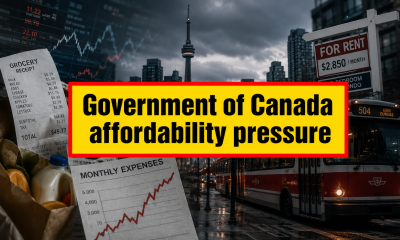
In recent years, Government of Canada affordability pressure has become a recurring phrase in public debate, reflecting a growing sense that everyday costs are moving faster than household incomes in Canada. While officials point to global inflation cycles and post-pandemic adjustments, many Canadians are increasingly questioning whether external factors alone explain what they are experiencing on the ground.
What makes this moment more complex is not just the numbers, but the comparison. Across Canada, the United States, and other advanced economies, similar economic shocks have played out in different ways. Yet the gap in perceived affordability has become part of a broader discussion about whether policy responses have matched the scale of change.
The central question remains unresolved: how much of this shift is structural and global, and how much is tied to domestic policy choices that are still unfolding?
What Actually Happened
Over the past decade, Canada has faced overlapping economic pressures including housing shortages, inflationary spikes, and wage stagnation in key sectors. Institutions like the Government of Canada and the Bank of Canada have responded with a mix of monetary tightening and targeted policy measures aimed at stabilizing inflation.
However, the lived experience has not always aligned with macroeconomic indicators. While inflation has cooled in certain periods, housing costs and essential goods have remained elevated in many regions. This divergence has fueled ongoing public debate about whether stabilization at the macro level translates into relief at the household level.
At the same time, comparative data from the United States shows a similar inflation cycle but with different regional outcomes, particularly in wage growth and housing supply responsiveness.
Why This Moment Matters
The significance of Government of Canada affordability pressure lies in how it is reshaping public expectations of economic stability. Unlike previous cycles where recovery felt more synchronized across income groups, the current period shows uneven recovery patterns.
In Canada, core expenses such as rent, groceries, and transportation have become persistent stress points. Even when headline inflation declines, these categories often remain sticky, creating a perception gap between official reports and daily reality.
This matters because perception drives trust. When economic messaging and personal experience diverge, public confidence in institutions begins to fragment, even if headline indicators suggest stabilization.
The Pattern Behind the Event
A deeper pattern emerging across Canada is the lag between policy implementation and household impact. Fiscal and monetary tools tend to operate on national averages, while affordability challenges are highly localized.
Internal analysis such as our breakdown of Canadian affordability trends highlights how housing supply constraints, regional wage differences, and population growth pressures interact in uneven ways.
Meanwhile, peer economies such as the United States show similar pressures but with more regional divergence in outcomes, particularly where housing markets adjust more rapidly to interest rate changes.
The result is not a single crisis, but a layered one—where multiple small pressures accumulate rather than one defining shock.
Where the Tensions Are Building
The tension is increasingly visible between institutional framing and public interpretation. Government messaging emphasizes global inflation cycles, supply chain recovery, and long-term policy investments. Yet households often focus on immediate monthly cost increases.
This divergence is amplified by regional inequality. Urban centers face different affordability constraints than rural areas, and interprovincial migration patterns suggest people are actively responding to these differences.
Within this environment, the role of the Bank of Canada remains central, as interest rate policy continues to influence borrowing costs, housing affordability, and consumer credit conditions.
What This Could Signal Next
The unresolved question is whether current pressures represent a transitional phase or a structural shift in Canadian economic life. If affordability gaps persist despite stabilization in inflation metrics, the definition of “recovery” itself may evolve.
What happens next will depend on how effectively policy tools can address not just inflation, but distributional impacts across income groups and regions. The gap between national averages and lived experience remains the key variable.
And as this gap continues to be debated, the broader question remains open: whether the current trajectory reflects temporary adjustment—or a longer redefinition of affordability in Canada.
About the Author

______________________________________________
🔴 Support Independent Journalism
This work is independently produced without corporate funding.
If you value it, a small donation helps keep it going and supports a senior creator continuing this work.
👉 Support here: I NEED Your Help Today