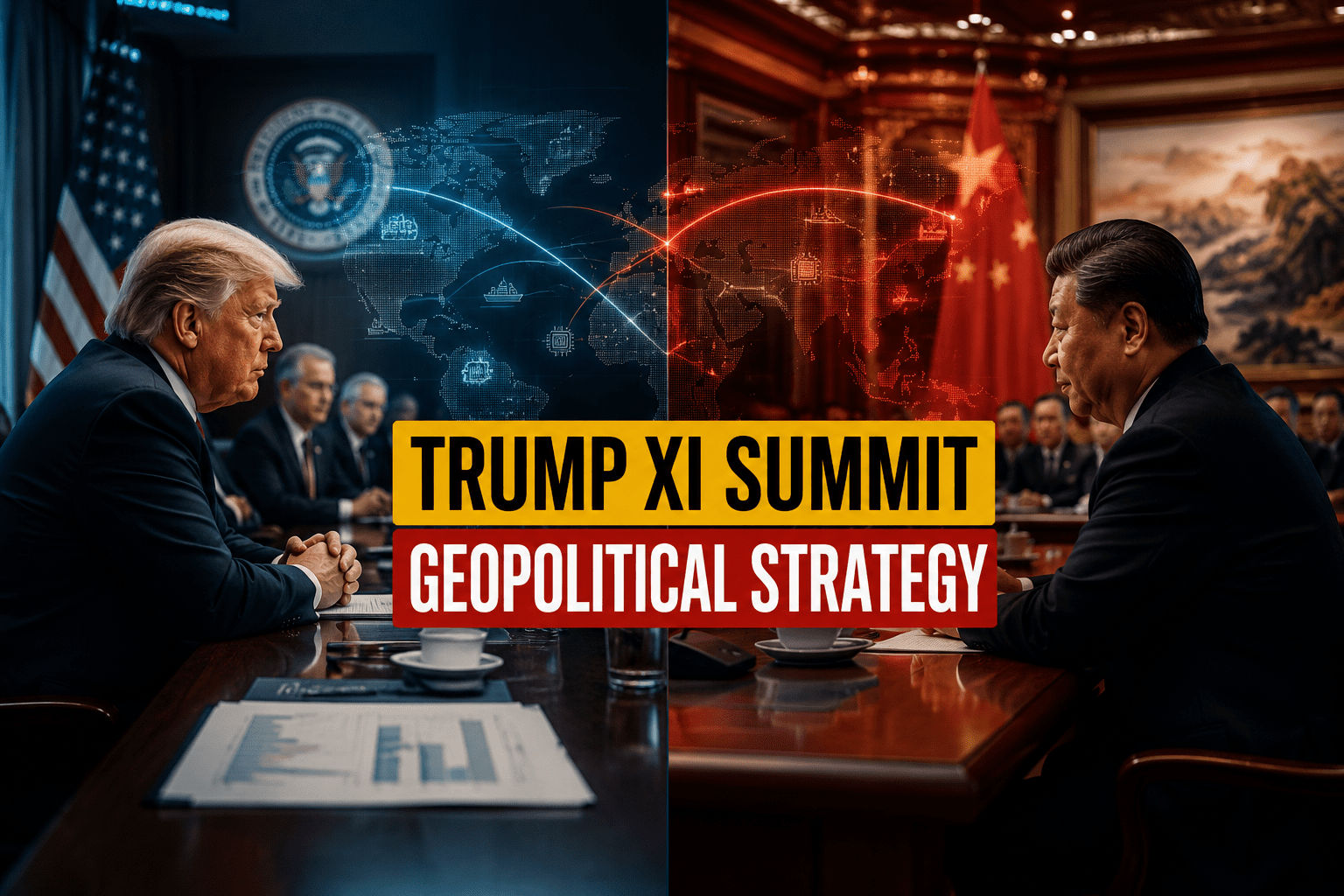
Trump and Xi face off in Beijing as global tensions quietly intensify behind closed-door negotiations
For a few hours in Beijing, the world’s most consequential tensions were compressed into a single room — and almost nothing about it felt routine.
Behind the formal handshakes and carefully staged optics, something more deliberate was unfolding.
What Actually Happened
During high-level talks in Beijing, U.S. President Donald Trump and Chinese President Xi Jinping met face-to-face amid a backdrop of escalating global friction — from trade disputes to geopolitical flashpoints.
According to Reuters reporting, the discussions extended beyond predictable economic disagreements and moved into sensitive territory, including Iran and Taiwan. The scope alone signaled that this was not just another diplomatic check-in, but a broader attempt to stabilize multiple pressure points at once.
Source: https://www.reuters.com/world/trump-xi-summit-live-talks-beijing-include-iran-trade-taiwan-2026-05-14/
Both sides maintained measured language publicly. But the inclusion of issues like Taiwan — one of the most volatile fault lines in global politics — suggested deeper concerns were being addressed behind closed doors.
Nothing was announced as a breakthrough.
That may be the point.
Why This Moment Matters
Diplomatic meetings often produce statements.
This one produced silence — and that silence carries weight.
______________________________________________
🔴 Help keep this independent voice alive and uncensored -> Buy us a Coffee <-
When global powers widen the scope of talks instead of narrowing them, it usually reflects rising uncertainty rather than resolution. Trade disputes alone would not require discussions involving Iran or military-sensitive regions.
This wasn’t about solving one issue.
It was about preventing multiple ones from spiraling at once.
The timing also matters. Global markets, supply chains, and security alliances are already under strain. A misstep between the U.S. and China doesn’t stay contained — it ripples outward quickly.
The Pattern Behind the Event
This meeting fits into a broader pattern that has been quietly forming:
Major powers are no longer treating economic policy, military positioning, and regional conflicts as separate tracks.
They are merging them.
Trade negotiations now include security implications.
Security discussions now involve economic leverage.
And diplomatic summits are increasingly becoming multi-layered negotiations where no topic stands alone.
That shift changes the stakes.
It also makes outcomes harder to interpret — and easier to misread.
Where the Tensions Are Building
Several pressure zones are converging at once:
Taiwan remains a critical flashpoint, with both symbolic and strategic significance.
Iran introduces another layer, linking Middle Eastern stability with broader global alignments.
Trade tensions continue to simmer beneath everything, influencing decisions that appear political but are deeply economic.
Each of these areas carries its own risks.
Together, they form a network of interdependencies that make escalation more unpredictable — and containment more difficult.
What This Could Signal Next
When leaders expand the agenda instead of narrowing it, it often signals preparation rather than resolution.
Preparation for what is less clear.
It could mean an attempt to build guardrails before tensions escalate further.
Or it could reflect recognition that existing frameworks are no longer sufficient to manage what’s coming.
Either way, the structure of these talks suggests that both sides are thinking several steps ahead — not just reacting to current events.
And that shift in mindset tends to precede larger changes.
The meeting ended without dramatic announcements, but the absence of clarity may be the clearest signal of all — something is moving beneath the surface, and it hasn’t fully revealed itself yet.
About the Author