It didn’t feel normal.
Not at the time. Not even now, looking back.
The COVID compliance test theory keeps resurfacing because something about those months never quite settled into place.
Rules changed overnight. Then again the next week. And again.
Some made sense. Others… didn’t even try to.
And yet, most people followed them anyway.
When the Rules Stopped Feeling Logical
At first, there was urgency. A real sense of threat. That part is hard to deny.
But then the details started to blur.
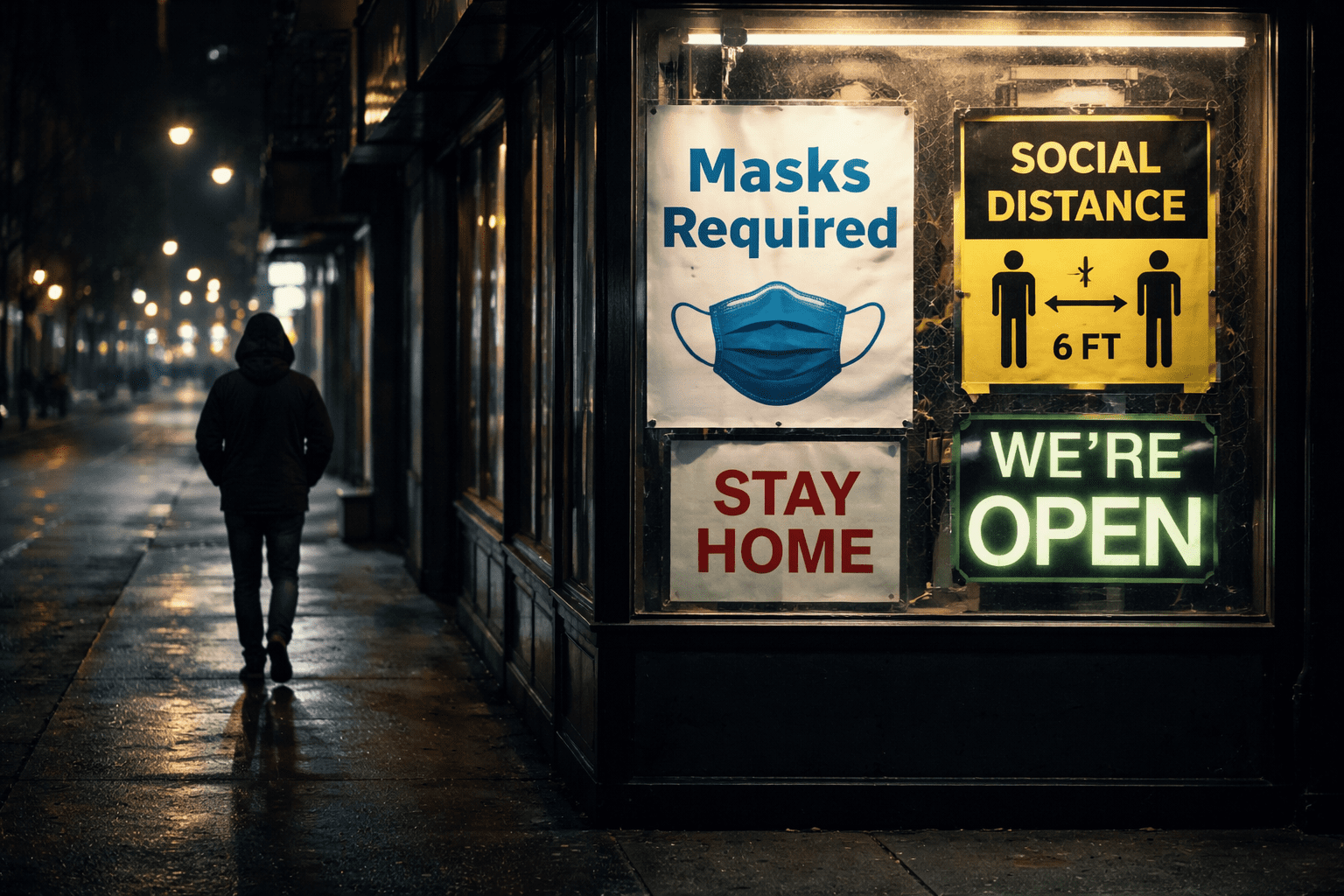
Standing six feet apart in one place, but shoulder-to-shoulder in another. Masks required while walking to a table, but not while sitting. Entire businesses closed, while others remained open without clear explanation.
______________________________________________
🔴 Help keep this independent voice alive and uncensored -> Buy us a Coffee <-
It wasn’t just inconsistency. It was the feeling that consistency didn’t matter.
This becomes clearer when looking at how quickly people adapted—not to the virus itself, but to the shifting instructions around it.
Not because everything made sense.
But because it was easier to comply than to question.
A Pattern That Felt… Deliberate
The COVID compliance test theory suggests something more uncomfortable.
Not that every rule was pointless—but that some may have been intentionally confusing. Not accidental. Not oversight. But useful, in a different way.
Because confusion creates dependency.
When people stop trusting their own judgment, they start waiting for direction. Even when that direction contradicts itself.
A similar pattern appeared in other moments of crisis throughout history—where uncertainty wasn’t just a byproduct, but a condition that shaped behavior.
And once that behavior sets in, it’s hard to reverse.
The Shift Few People Noticed
Something changed during that period.
Not just policies. Not just daily routines.
But the threshold for what people would accept without pushback.
What happened next raised more questions than answers.
Public debate narrowed. Dissent became riskier—socially, professionally. Even quietly asking why something didn’t add up could carry consequences.
So most people didn’t.
They adjusted. They adapted. They moved forward.
Because resisting something unclear is harder than going along with it.
Control, Fear, and the Invisible Line
Fear doesn’t always need to be extreme. Just persistent.
Enough to keep people slightly off balance. Enough to make clarity feel secondary.
This connects to a broader shift in how authority is perceived—not as something to question, but something to interpret and follow, even when it conflicts.
And maybe that’s where the real tension sits.
Not in whether every restriction was justified.
But in how easily uncertainty became normal.
What It Might Have Been Measuring
If it was a test, it wasn’t announced.
There were no results posted. No conclusions shared.
But you can imagine what might have been observed.
How quickly behavior changes under pressure.
How much contradiction people tolerate.
How social pressure reinforces compliance.
Not in theory.
In real time.
The Part That Doesn’t Quite Fade
Even now, there’s a hesitation when people revisit those months.
A sense that something important happened—but wasn’t fully understood.
Not just about health. Or safety.
About behavior.
About limits.
About how far things can shift before most people stop asking why.
And maybe that’s the part that lingers.
Because if it was a test…
It didn’t really end.
Credible Sources Use for Article:
1. Understanding Compliance Behavior During a Pandemic (Frontiers in Psychology)
https://www.frontiersin.org/articles/10.3389/fpsyg.2022.805987/full
This peer-reviewed study examines why people comply with pandemic rules, focusing on psychological needs, coping mechanisms, and behavioral responses under pressure. It shows that compliance is often tied to deeper emotional and psychological drivers—not just logic or agreement.
2. Social Norms and Behavior During COVID-19 (BMC Public Health)
https://bmcpublichealth.biomedcentral.com/articles/10.1186/s12889-022-13744-2
This research highlights how social pressure and perceived norms strongly influence behavior during crises. It found that when people believe others are complying, they are far more likely to follow—even reducing their perception of risk.
3. COVID-19 Preventive Behavior and Psychological Impact (BMC Psychology)
https://bmcpsychology.biomedcentral.com/articles/10.1186/s40359-023-01316-x
This study explores how pandemic restrictions shaped behavior and mental well-being, showing that actions like masking and distancing became normalized behaviors—even when they carried psychological costs or contradictions.
About the Author



1 thought on “The Quiet Logic Behind the Chaos No One Fully Questioned”
Comments are closed.