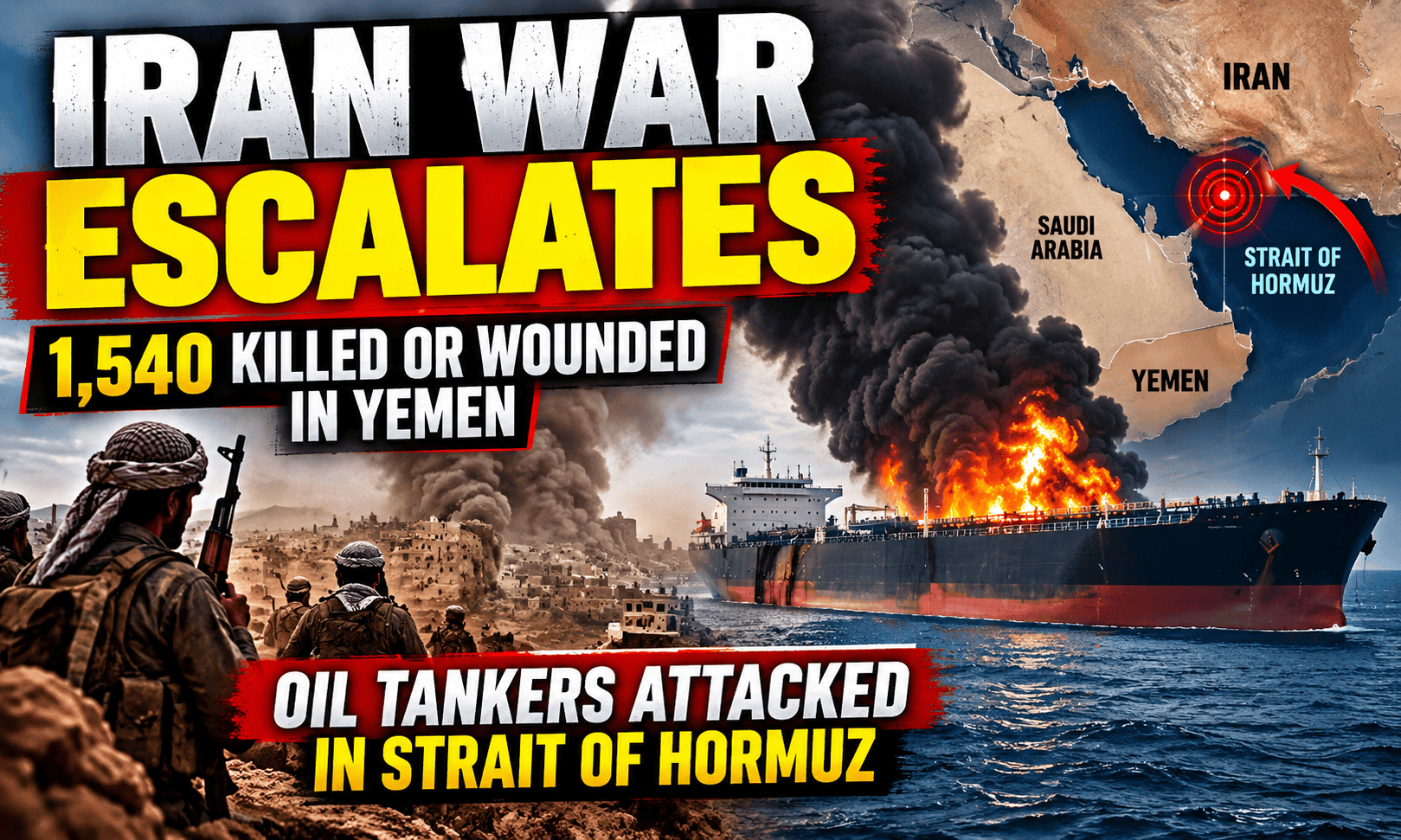
Two oil tankers have been struck in one of the world’s most strategically important shipping corridors. At the same time, fighting in Yemen has intensified dramatically, with military officials reporting more than 1,500 Houthi fighters killed or wounded in just 24 hours.
These are two developments unfolding in the same increasingly dangerous regional conflict. And together, they raise an unsettling question: How much further can the fighting spread before the consequences extend well beyond the Middle East?
Two Oil Tankers Struck in the Strait of Hormuz
According to Al Jazeera’s October 3 live coverage, the United Kingdom Maritime Trade Operations (UKMTO) reported that two oil tankers were struck by unidentified projectiles in separate incidents in the Strait of Hormuz.
The reported attacks immediately raise concerns about maritime security in a waterway central to international energy transportation.
The identity of those responsible has not been established in the available reporting. Nor does the initial information establish the full extent of damage to the vessels.
That uncertainty matters.
An attack on commercial shipping is serious enough. When the location is the Strait of Hormuz, the implications extend beyond the vessels themselves.
The narrow passage connects the Persian Gulf with international shipping routes and serves as a critical corridor for oil exports.
Any sustained disruption could create additional uncertainty for shipping operators, insurers and energy markets.
______________________________________________
🔴 Help keep this independent voice alive and uncensored -> Buy us a Coffee <-
But the immediate question remains unanswered: Who launched the projectiles, and what were they attempting to accomplish?
Yemen Fighting Intensifies as Military Reports 474 Attacks
While attention focuses on the Strait of Hormuz, another extraordinary military development is unfolding in Yemen.
According to the October 3 reporting, armed forces said that 474 attacks over a 24-hour period killed or wounded 1,540 Houthi fighters.
That figure represents a combined reported casualty count, not 1,540 confirmed deaths.
The figures are attributed to the military announcement and have not been independently verified in the information available from the source.
Nevertheless, the reported intensity of the operations points to a substantial escalation in the fighting.
Hundreds of attacks within a single day suggest an exceptionally active battlefield, with serious implications for the armed groups involved and the communities living around contested areas.
The available report does not establish how many civilians, if any, were among the casualties.
That distinction is essential. Military casualty claims do not provide a complete picture of the humanitarian consequences of warfare.
Saudi Arabia Intercepts Three Ballistic Missiles
The fighting is also creating security concerns beyond Yemen.
Al Jazeera reported that the Saudi-led coalition intercepted three ballistic missiles targeting southern Saudi Arabia.
The reported interceptions add another dimension to an already volatile regional situation.
They also demonstrate how military activity associated with Yemen can threaten territory across an international border.
Although the missiles were reportedly intercepted, the incident raises questions about the possibility of further launches and the pressures facing regional air-defense systems.
For Saudi Arabia, repeated missile threats could require continued defensive operations. For Yemen, intensifying attacks and counterattacks could make an already difficult security environment more dangerous.
The information available does not establish who ordered the launches or whether additional attacks are imminent.
Why the Strait of Hormuz Matters Far Beyond the Battlefield
The maritime incidents deserve particular attention because of their location.
The Strait of Hormuz is not an ordinary shipping route. It is a vital passage for international energy trade.
Oil tankers operating in these waters connect producers in the Persian Gulf with customers across the world.
When commercial vessels are attacked, the consequences can extend beyond immediate physical damage.
Shipping companies may reassess routes. Insurers may reconsider exposure. Energy traders may respond to uncertainty about future deliveries.
These are potential consequences, not confirmed outcomes of the two reported incidents.
There is currently insufficient information in the cited report to establish whether the attacks caused a sustained interruption to shipping or measurable changes in oil prices.
Still, the strategic concern is straightforward: maritime insecurity in such an important corridor can become an international economic problem if incidents continue.
Two Flashpoints, One Growing Regional Concern
The simultaneous reports from Yemen and the Strait of Hormuz illustrate the increasingly complicated security environment surrounding the war involving Iran, the United States and Israel.
The two incidents should not automatically be treated as parts of a single coordinated operation. The available reporting does not establish that connection.
However, their occurrence during the same broader conflict highlights the difficulty of containing regional instability.
A military escalation in Yemen creates one set of security and humanitarian concerns.
Attacks on commercial tankers create another.
Ballistic missiles directed toward Saudi territory introduce yet another possibility for confrontation.
Each development carries its own risks, even when direct operational connections have not been demonstrated.
The larger concern is whether continued incidents will make de-escalation more difficult.
The Human Cost Behind the Military Numbers
The reported figure of 1,540 Houthi fighters killed or wounded deserves careful examination.
Military announcements frequently emphasize the scale of operations and reported battlefield losses. Yet such figures do not necessarily reveal how many people were killed, how many were injured or what happened to civilians nearby.
The distinction is particularly important in Yemen, where years of conflict have already placed enormous pressure on civilian life.
An accurate understanding of the latest fighting requires more than a single casualty total.
It requires independently verified information about deaths and injuries, the locations of attacks, damage to civilian infrastructure and the ability of humanitarian organizations to reach affected communities.
Those details are not established in the available October 3 report.
Without them, the full human consequences remain uncertain.
What Happens If the Fighting Continues?
Three unresolved questions now stand out.
First, will investigators identify those responsible for the tanker attacks in the Strait of Hormuz?
Second, will the reported military escalation in Yemen continue at a similar intensity, or will operations diminish?
Third, will missile threats against Saudi territory produce additional regional military responses?
None has a confirmed answer in the available reporting.
The danger lies in the possibility that separate incidents could create overlapping pressures on governments, military commanders and commercial operators.
For international audiences, the situation is not simply about territorial disputes or military statistics.
It is also about the security of energy supplies, the protection of civilians and the possibility of a wider conflict involving additional countries.
A Conflict With No Clear Boundary
The events reported on October 3 illustrate how quickly attention can shift between battlefields and strategic infrastructure.
In Yemen, military officials describe hundreds of attacks and extensive casualties.
In the Strait of Hormuz, two commercial oil tankers have reportedly been struck.
Across the Saudi border, three ballistic missiles have reportedly been intercepted.
What remains uncertain is whether these incidents represent a temporary intensification or the beginning of a more sustained period of regional confrontation.
For now, the most important facts are also the most troubling: fighting is intensifying, commercial vessels have come under attack, and serious questions about responsibility and future escalation remain unanswered.
The world is watching the military developments. But the consequences of continued instability could eventually reach people who live thousands of kilometres from the fighting.
About the Author