A diplomatic dispute between two longtime allies has suddenly moved into economic territory.
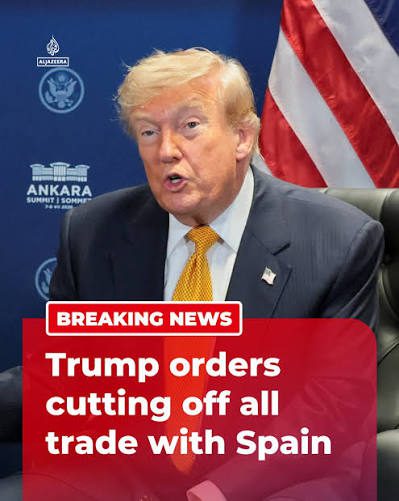
U.S. President Donald Trump announced that he had ordered Treasury Secretary Scott Bessent to cut off all trade with Spain, escalating tensions with a NATO partner already facing criticism from Washington over defense spending and military cooperation.
The Reuters report behind the announcement can be found here: https://www.reuters.com/world/trump-says-he-ordered-cutting-off-all-trade-with-spain-2026-07-08/
The statement, delivered during a NATO summit in Ankara, marked one of the sharpest confrontations between the United States and a European ally in recent years. Trump described Spain as a “terrible partner” within NATO and argued that Madrid had failed to meet expectations on defense commitments.
The move immediately raised questions about how far the dispute could go — and whether a political disagreement inside a military alliance could spill over into a broader economic confrontation.
A NATO Dispute Turns Into a Trade Battle
Trump’s criticism of Spain centered largely on defense spending. He accused the country of refusing to increase its contribution to NATO’s military targets and expressed frustration over Spain’s position during recent U.S. military operations involving Iran.
The decision to target trade represents a significant escalation because economic relationships between allied countries are usually separated from military disagreements.
Trade between the United States and Spain involves thousands of businesses, workers, and industries on both sides of the Atlantic. A complete cutoff would represent a major shift in how Washington manages disputes with its closest partners.
The announcement also comes at a sensitive moment for NATO, an alliance built around cooperation between member nations. Public disagreements among allies can create uncertainty not only for governments but also for companies and financial markets watching for signs of instability.
The Bigger Question: Can Alliances Survive Internal Pressure?
______________________________________________
🔴 Help keep this independent voice alive and uncensored.
Support independent journalism and help keep Chris Wick News going.
👉 Support Chris Wick on GoFundMe
The confrontation with Spain highlights a growing debate inside NATO: how member countries balance national interests with collective security commitments.
Trump has repeatedly argued that European allies should carry a larger share of the financial burden for defense. Spain has faced pressure from other NATO members over its military spending position, while Spanish officials have defended their approach.
But the latest move pushes the dispute into unfamiliar territory.
Using trade as leverage against an ally sends a broader message: disagreements over defense policy may no longer remain limited to diplomatic discussions behind closed doors.
For businesses, the uncertainty itself can become a problem. Companies often react not only to actual policy changes but also to the possibility of sudden restrictions, tariffs, or political decisions that affect supply chains.
A Test for the U.S.-Europe Relationship
The announcement places fresh pressure on the broader relationship between Washington and European governments.
For decades, the United States and European allies have relied on a combination of military cooperation and economic ties to maintain influence around the world. A major trade dispute between partners could test how resilient that relationship remains during a period of global tension.
The immediate impact will depend on whether the announced trade cutoff moves forward, how it would be implemented, and how Spain and other European governments respond.
For now, one thing is clear: a disagreement that began inside NATO has expanded into a much larger diplomatic challenge.
The conflict is no longer only about defense spending.
It is about the future shape of alliances, economic pressure, and how far a partner nation is willing to go when it believes another ally is not carrying its share of the burden.