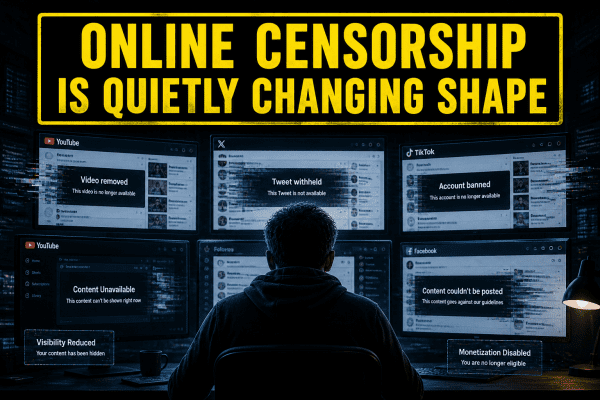
Online censorship is no longer obvious—it’s happening quietly through visibility limits, demonetization, and algorithmic control.
Something has shifted again—and this time, it’s harder to name.
Accounts disappear without warning. Revenue streams dry up overnight. Entire conversations seem to vanish before they even begin. It doesn’t feel like the old version of censorship. It feels… reorganized.
What Actually Happened
Over the past year, major platforms like YouTube, TikTok, and X have quietly adjusted how they moderate content, enforce policies, and distribute visibility.
While public messaging often emphasizes “free expression” or “platform neutrality,” the underlying systems tell a more complex story. hasn’t disappeared—it’s been restructured.
A recent Reuters report highlighted how platforms continue to refine moderation tools under pressure from governments and advertisers, even when leadership publicly signals a shift toward openness
https://www.reuters.com/technology/social-media-regulation-content-moderation-2024-01-15/
Meanwhile, enforcement is no longer just about removing content. It’s about limiting reach, restricting monetization, and subtly reducing visibility—what many creators describe as algorithmic suppression rather than outright bans.
Why This Moment Matters
What’s different now isn’t just the presence of moderation—it’s the perception of who controls it.
For years, debates around censorship focused heavily on one side of the political spectrum. Now, users across multiple viewpoints are reporting similar experiences: demonetization, shadow visibility drops, and sudden account penalties.
According to BBC coverage of evolving tech regulation, platforms are increasingly caught between political pressures, advertiser demands, and regulatory compliance
https://www.bbc.com/news/technology-65139406
______________________________________________
🔴 Help keep this independent voice alive and uncensored -> Buy us a Coffee <-
That tension creates an environment where enforcement becomes less transparent—and more unpredictable.
The Pattern Behind the Event
There’s a pattern emerging across platforms:
- Public messaging promotes openness
- Backend systems tighten control
- Enforcement becomes less visible but more effective
Instead of large-scale bans making headlines, smaller, quieter restrictions shape what people actually see.
This includes:
- Reduced algorithmic reach
- Limited discoverability
- Demonetization without clear explanation
- Temporary or repeated account penalties
The result is a system where speech isn’t always removed—it’s simply deprioritized.
Where the Tensions Are Building
The pressure isn’t coming from just one direction.
Governments are demanding stricter oversight of misinformation. Advertisers want brand-safe environments. Platforms themselves are trying to retain users while avoiding controversy.
The Guardian has reported on how regulatory frameworks in multiple countries are pushing companies to take stronger control over content distribution
https://www.theguardian.com/technology/2024/feb/10/social-media-regulation-laws-global
That creates a layered form of moderation—part legal compliance, part economic strategy, part internal policy.
And users are caught in the middle.
What This Could Signal Next
If current trends continue, the future of online speech may look less like outright censorship and more like controlled visibility.
Content will still exist—but fewer people will see it.
Creators will still post—but fewer will earn.
Debate will still happen—but within narrower boundaries defined by systems few fully understand.
Independent platforms may grow in response, but they face their own challenges: scale, funding, and discoverability.
What’s emerging isn’t a single form of censorship—it’s a decentralized, evolving system that adapts faster than most users can track.
And that may be the most important shift of all.
There’s no clear line anymore between allowed and suppressed—only a moving threshold that keeps changing depending on who’s watching, who’s paying, and who’s pushing back.
About the Author