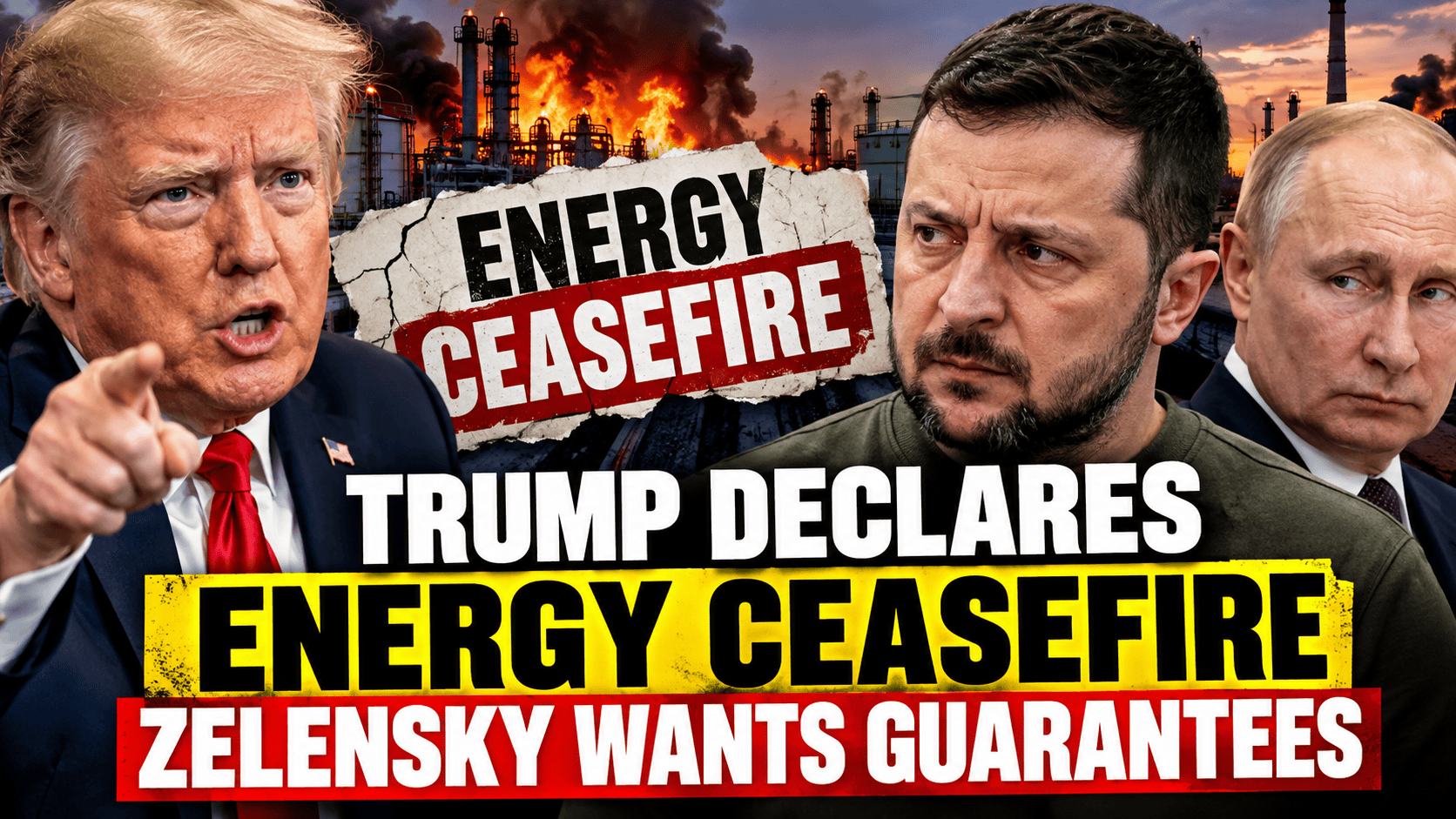
Washington says the shooting over energy infrastructure is supposed to stop. Kyiv says nobody told them a deal had been reached. And somewhere between political announcements, rising fuel prices, and another deadly Russian attack, the truth is getting buried beneath the noise.
A Ceasefire Announced Before Everyone Agreed?
There’s something deeply disturbing about watching a war become a political bargaining chip while the people living through it are still burying their dead.
On Sunday, October 11, U.S. President Donald Trump announced that Russia and Ukraine had agreed to an immediate ceasefire targeting energy infrastructure.
There was just one rather significant problem.
Ukrainian President Volodymyr Zelensky said he wasn’t aware of any finalized agreement.
Instead, Zelensky reiterated a position Kyiv has maintained for some time: Ukraine is prepared to stop attacking Russian oil refineries, but only if Moscow stops attacking Ukraine’s energy infrastructure.
That isn’t an unconditional surrender of military leverage. It’s an offer of reciprocity.
And the distinction matters.
A ceasefire announced on social media might make an impressive political headline. But without clear commitments, verification, and consequences for violations, it risks becoming another promise that collapses the moment the next drone crosses a border.
Trump Wants the Refineries Left Alone
______________________________________________
🔴 Help keep this independent voice alive and uncensored.
Support independent journalism and help keep Chris Wick News going.
👉 Support Chris Wick on GoFundMe
The confrontation intensified Saturday when Trump publicly criticized Ukraine’s attacks on Russian oil refineries.
Those facilities are not merely industrial buildings producing gasoline for civilian motorists. They are part of an energy economy that generates revenue and supplies fuel essential to Russia’s military operations.
Ukraine has spent months attacking these facilities, attempting to weaken Moscow’s economic and logistical capacity to sustain its war.
The strategy has imposed serious costs on Russian refining operations.
But it has also collided with a much larger international energy crisis.
Global diesel prices have risen sharply amid the ongoing conflict involving Iran and disruptions to Middle Eastern oil supplies.
For Trump, the economic consequences are increasingly difficult to separate from domestic politics.
American motorists, truckers, farmers, and businesses are feeling the pressure of expensive fuel. With U.S. midterm elections approaching, rising energy costs are becoming an uncomfortable political liability.
Trump wants relief.
Ukraine wants leverage.
Russia wants its oil industry protected.
And those objectives are not necessarily compatible.
The Uncomfortable Question Nobody Wants to Answer
Here’s what troubles me.
If Ukraine is expected to stop damaging Russian oil infrastructure, what exactly is Russia being required to surrender in return?
That is not a minor diplomatic detail. It is the entire foundation of a credible agreement.
Russia has repeatedly targeted Ukrainian power facilities, contributing to blackouts and disrupting essential services.
As winter approaches, attacks on electricity and heating systems carry consequences far beyond the battlefield.
They affect hospitals, families, elderly residents, and children who have no control over the decisions being made in Moscow, Kyiv, or Washington.
Ukraine’s refinery campaign and Russia’s attacks on Ukrainian energy infrastructure are not identical in their targets or humanitarian consequences. But both are central to the current negotiations.
If one side receives immediate protection for its economically valuable infrastructure while the other remains vulnerable, that is not a balanced de-escalation.
It’s a strategic advantage dressed up as diplomacy.
And no amount of political messaging changes that.
Twenty-Three Dead in Zaporizhzhia
While political leaders debated fuel supplies and ceasefire conditions, another grim development was unfolding in southern Ukraine.
Zelensky reported that the death toll from Saturday’s Russian attack on Zaporizhzhia had climbed to 23, including four children.
Those figures were reported by Ukrainian authorities and had not been independently verified in the reporting reviewed for this article.
Still, the human reality behind the numbers cannot be ignored.
Twenty-three people reportedly killed while world leaders argue about refineries, sanctions, diesel shipments, and political leadership.
It raises a question that deserves more attention than another carefully staged diplomatic announcement.
What does an energy ceasefire actually accomplish if civilians continue dying under missile and drone attacks?
A limited agreement could reduce damage to power supplies and lower the risk of further economic disruption. That would matter.
But it would not end the war.
And it certainly would not guarantee the safety of civilians.
Russia’s Oil Industry Has Become a Pressure Point
Ukraine’s attacks on Russian refining facilities have become one of Kyiv’s most consequential long-range military strategies.
By targeting oil-processing infrastructure, Ukraine seeks to disrupt fuel production, impose repair costs, and weaken an important source of economic strength for Moscow.
Ukrainian officials have claimed that their campaign has disabled a substantial share of Russian refining capacity, although such estimates require caution because temporary shutdowns, damaged equipment, and permanently lost capacity are not the same thing.
The broader strategic picture is clear.
Oil is not simply another commodity in this conflict.
It is revenue, transportation, military logistics, and political influence.
That helps explain why Washington is now pressing Kyiv to reconsider a campaign that Ukrainian leaders view as one of their remaining tools for applying pressure.
And it explains why Moscow would welcome a halt to refinery strikes.
Is Washington Negotiating Peace or Cheaper Fuel?
The Trump administration has also moved toward allowing additional Russian diesel onto international markets, arguing that greater supply could ease the energy crisis.
Critics warn that easing restrictions on Russian petroleum risks generating additional revenue for Moscow while its war continues.
Supporters of the approach argue that reducing global fuel prices could relieve economic hardship and create opportunities for negotiation.
Both arguments deserve examination.
But there is a difference between easing an energy shortage and achieving a durable peace.
Lower diesel prices would be welcome news for consumers.
They would not, by themselves, resolve territorial disputes, security guarantees, or the fundamental causes of the Russia-Ukraine war.
And pressuring one side to make concessions without securing corresponding commitments from the other could make a negotiated settlement even harder to sustain.
A Real Agreement Needs More Than a Presidential Announcement
Zelensky has continued discussions with European leaders about additional air defence support, including ammunition for combat aircraft.
That matters because Kyiv is clearly preparing for the possibility that diplomatic announcements will not stop incoming attacks.
Any meaningful energy ceasefire would need to answer several basic questions.
Which facilities are protected? When do restrictions take effect? Who verifies compliance? What happens if either side violates the agreement?
Without answers, the word ceasefire becomes dangerously flexible.
One government can claim success. Another can deny agreeing. And the fighting can continue while everyone argues about who broke a deal that was never clearly established.
The Chris Wick Perspective: Peace Cannot Be a Public Relations Exercise
I don’t believe Ukraine should receive a free pass for every military decision it makes. I don’t believe Russia’s actions should escape scrutiny either. And I certainly don’t believe Washington should be treated as an unquestionable referee simply because an American president announces a breakthrough.
Every government involved has interests.
Every leader has political pressures.
And every announcement deserves scrutiny.
Trump is under pressure to bring fuel prices down. Zelensky is under pressure to protect Ukraine’s remaining strategic leverage. Putin has every reason to seek protection for Russia’s oil industry without sacrificing military advantage.
Those competing interests make this situation far more complicated than a headline declaring that peace has suddenly arrived.
If Russia genuinely stops attacking Ukrainian energy infrastructure and Ukraine responds by halting refinery strikes, that could be a meaningful step toward reducing destruction.
But until the terms are clear and both sides demonstrably comply, a ceasefire remains a claim rather than an established reality.
The real test isn’t what Trump announces, what Zelensky promises, or what Putin allows his government to say.
It’s what happens when the next drone is launched.
Because peace isn’t measured by the number of politicians claiming credit.
It’s measured by the number of people who get to live through another night.
Sources
Reuters — Ukraine will halt strikes on refineries if Russia stops energy attacks, Zelenskiy says (October 11, 2026)
Associated Press — Trump says Russia and Ukraine reach energy ceasefire but gives no details (October 11, 2026)
https://apnews.com/article/f621fa788196f204448e7f75fcc78c68
AFP — Ukraine to stop refinery strikes when Russia curbs energy attacks (October 11, 2026)
https://www.afp.com/en/ukraine-stop-refinery-strikes-when-russia-curbs-energy-attacks-zelensky
Reuters — Ukraine will hit Russian refineries in response to Moscow’s new doctrine of airstrikes (October 3, 2026)