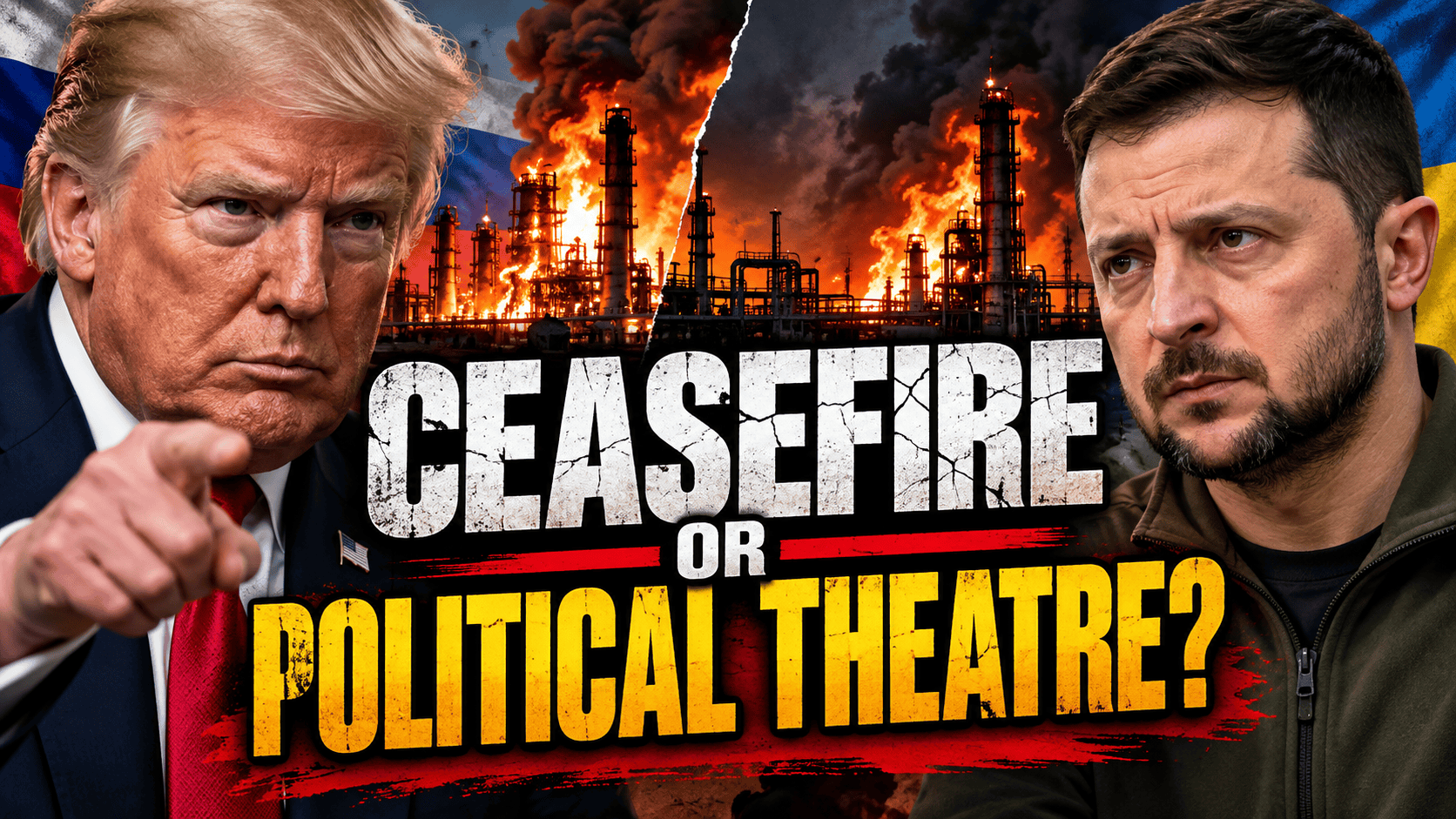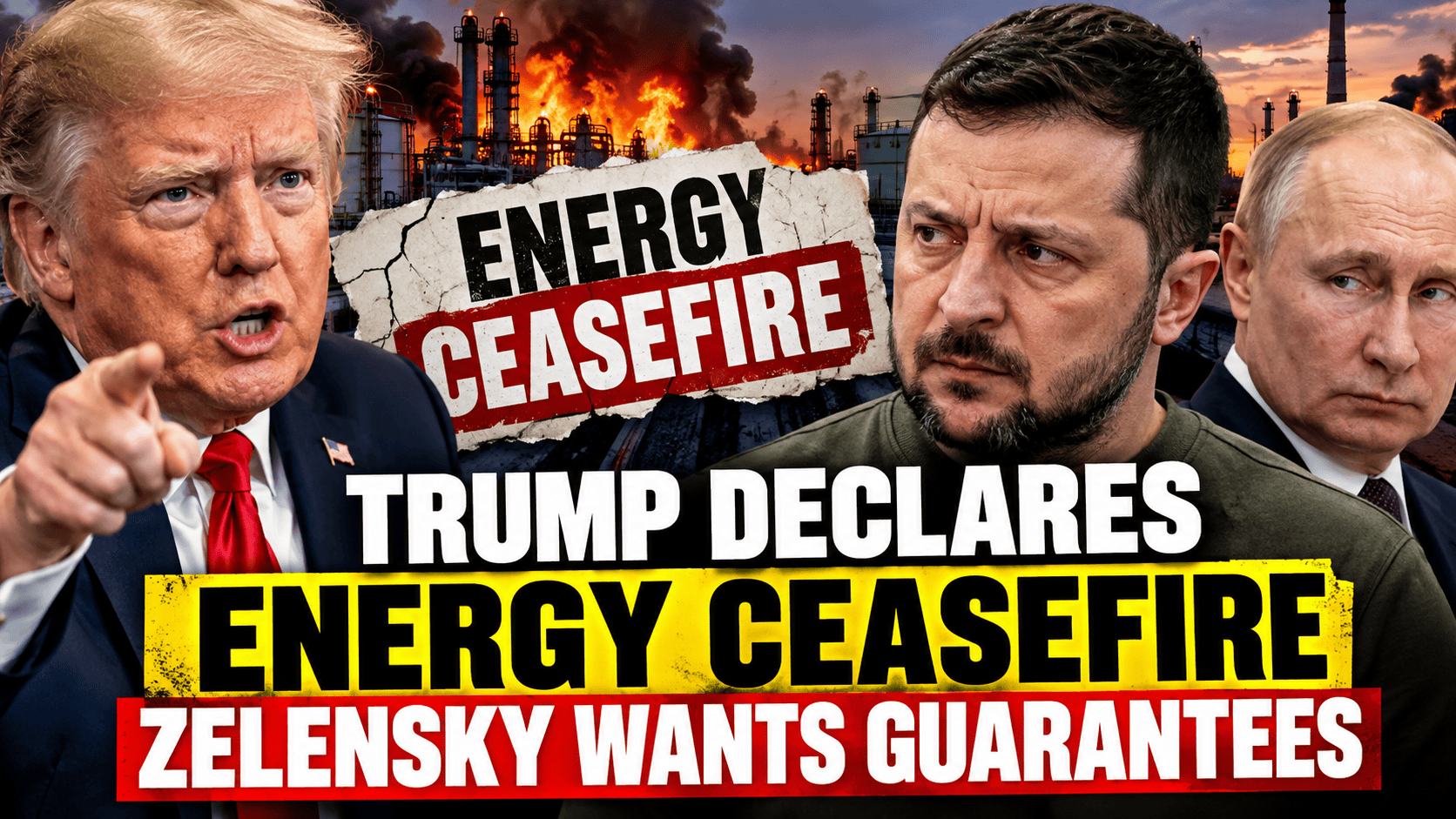
Donald Trump says the energy war between Russia and Ukraine is over. At least for now.
There’s just one rather enormous problem.
Ukrainian President Volodymyr Zelensky is still waiting for the details, Moscow has not publicly confirmed the agreement, and nobody has demonstrated how either side will be held accountable if the bombs start falling again.
Welcome to modern diplomacy, where a ceasefire can apparently be announced before everyone involved has publicly agreed on what it actually means.
Trump Announces a Ceasefire — Kyiv Wants Answers
On Sunday, President Trump announced that Russia and Ukraine had agreed to stop attacking each other’s energy infrastructure, declaring the arrangement effective immediately.
It was a dramatic announcement, particularly after days of increasingly hostile exchanges between Washington and Kyiv over Ukrainian drone attacks on Russian oil refineries.
But Zelensky’s response raised an obvious question: Was there actually a completed agreement, or was Washington announcing something that still needed to be negotiated?
The Ukrainian president said Kyiv supported an energy ceasefire but was awaiting details from the American administration.
Russia had not immediately confirmed Trump’s announcement.
______________________________________________
🔴 Help keep this independent voice alive and uncensored.
Support independent journalism and help keep Chris Wick News going.
👉 Support Chris Wick on GoFundMe
And that distinction matters.
A political announcement is not the same thing as an enforceable agreement. Without clearly defined obligations, verification procedures, and consequences for violations, even the most promising ceasefire can collapse before it begins.
Zelensky’s Message: Russia Must Stop Too
Before Trump’s announcement, Zelensky had made his position clear.
Ukraine would consider ending attacks on Russian oil refineries if Moscow stopped targeting Ukrainian energy infrastructure.
Not before.
And not simply because Washington demanded it.
For Kyiv, Russian oil refineries represent more than industrial facilities. They are part of an economic system that generates revenue and supports the Russian state’s ability to sustain its military operations.
Ukrainian long-range drone strikes have increasingly targeted those facilities, imposing economic costs far beyond the battlefield.
Russia, meanwhile, has repeatedly attacked Ukraine’s electricity generation and distribution infrastructure, leaving civilians exposed to power disruptions and threatening essential services.
Zelensky wants reciprocal restraint backed by credible guarantees.
That is not an unreasonable negotiating position.
But it creates a serious problem for Trump, who is facing a very different crisis thousands of miles away.
The Diesel Crisis Is Now Driving Diplomacy
Here is where this story becomes considerably more complicated.
Trump has sharply criticized Ukrainian strikes on Russian refineries, arguing that the attacks are contributing to soaring diesel prices.
The president has also announced an arrangement intended to bring additional Russian diesel into international markets.
According to Reuters, the proposed initial supply exceeds 300,000 metric tons.
But analysts have questioned whether those volumes could meaningfully reduce global fuel prices for any sustained period.
The larger energy crisis has been intensified by the war involving Iran, which has disrupted international energy markets and increased pressure on fuel supplies.
That creates an uncomfortable political reality.
Washington wants cheaper diesel.
Kyiv wants to weaken Russia’s capacity to finance and sustain its war.
Moscow wants its energy industry protected while retaining military leverage over Ukraine.
Those interests are not automatically compatible, no matter how confidently anyone announces a diplomatic breakthrough.
And ordinary people are caught in the middle.
Farmers pay more to operate equipment. Trucking companies face higher transportation costs. Businesses pass increased expenses along to consumers.
The economic consequences extend far beyond Eastern Europe.
Ukraine’s Refinery Campaign Has Changed the Equation
Ukraine’s refinery attacks are not random acts of retaliation.
They form part of a sustained effort to damage Russia’s refining capacity, disrupt fuel supplies, and increase the economic cost of continuing the war.
An Associated Press report published October 5 described Ukrainian claims that strikes had disabled a substantial share of Russian refining capacity.
Those claims should be distinguished from independently verified, permanent losses of production. Facilities can be repaired, and temporary shutdowns do not necessarily represent lasting destruction.
Nevertheless, the broader strategic point is clear.
Ukraine has developed the ability to impose meaningful costs on Russian energy infrastructure without having to defeat Russian forces across the entire front line.
That gives Kyiv leverage.
If Ukraine agrees to suspend those attacks, it will expect something meaningful in return.
Otherwise, it risks surrendering a military and economic advantage while Russia retains the ability to strike Ukrainian infrastructure.
Trump Is Also Pressuring Zelensky Over Elections
The energy dispute has now spilled into an even more sensitive issue: Ukraine’s political leadership.
Trump has publicly criticized Zelensky and suggested Ukrainians should choose new leadership.
Zelensky responded that elections could be organized if Russia agreed to a 60-day ceasefire.
Ukraine’s martial law currently prohibits national elections, creating substantial legal and security obstacles to holding a vote during the war.
There is a legitimate discussion to be had about democratic accountability during prolonged conflicts.
But there is also a serious question about whether elections can be conducted fairly when millions of citizens have been displaced, soldiers remain deployed, and Russian attacks continue.
The decision ultimately belongs to Ukrainians, not foreign governments.
And Washington’s increasingly public pressure risks turning a difficult peace negotiation into a dispute over political sovereignty.
Who Actually Benefits From an Energy Ceasefire?
An enforceable agreement could benefit everyone.
Ukrainian civilians could face fewer attacks on electricity and heating infrastructure.
Russian energy facilities could experience fewer disruptions.
International fuel markets might gain some stability, although a limited Russia-Ukraine energy ceasefire would not resolve the wider Middle East crisis.
And Trump could claim a diplomatic achievement at a moment when rising fuel prices are creating serious domestic political pressure.
But there is another possibility.
A poorly designed agreement could freeze one dimension of the conflict while leaving the larger war untouched.
Russia and Ukraine could continue fighting elsewhere. Territorial disputes would remain unresolved. Sanctions, security guarantees, reconstruction, and accountability would still be on the table.
A ceasefire protecting refineries and power stations would be a meaningful humanitarian and economic step.
It would not, by itself, be peace.
The Question Nobody Should Ignore
There is something deeply troubling about watching the fate of civilian electricity supplies and international fuel markets become intertwined with political calculations in Washington, Moscow, and Kyiv.
For governments, energy infrastructure represents leverage.
For ordinary families, it represents heat, light, food production, transportation, and survival.
Those are two very different realities.
Trump deserves scrutiny over whether his announcement reflects an enforceable agreement rather than an aspiration.
Zelensky deserves scrutiny over how long Ukraine’s refinery campaign can continue without creating broader economic consequences.
And Putin deserves scrutiny over whether Russia is genuinely prepared to stop attacking Ukrainian energy infrastructure rather than using negotiations to protect its own facilities.
No leader should receive a free pass.
The Bottom Line
If Trump has genuinely secured a reciprocal, verifiable halt to attacks on energy infrastructure, that would be a welcome development.
But until Moscow confirms its obligations, Kyiv receives clear guarantees, and both sides demonstrate compliance, the world has an announcement — not proof of a lasting ceasefire.
And after years of war, the distinction between promises and reality is not a minor detail.
It is everything.
Chris Wick News — Independent Perspective. Uncomfortable Questions. No Political Team Gets a Free Pass.
Sources
Reuters — Trump announces Ukraine energy ceasefire with Russia, surprising Zelenskiy (October 11, 2026)
The Guardian — Trump announces partial ceasefire in Ukraine war as Zelenskyy says deal is news to him (October 11, 2026)
https://www.theguardian.com/world/2026/oct/11/zelenskyy-trump-ukraine-russia-energy-ceasefire
Associated Press — Ukraine claims to have taken out more than half of Russia’s oil refining capacity (October 5, 2026)
https://apnews.com/article/48793b176934f0516b7402c8706a421a
Financial Times — Can Russia meet Trump’s diesel demands? (October 11, 2026)
https://www.ft.com/content/445b2856-a276-4d4c-bdea-44799d771c21