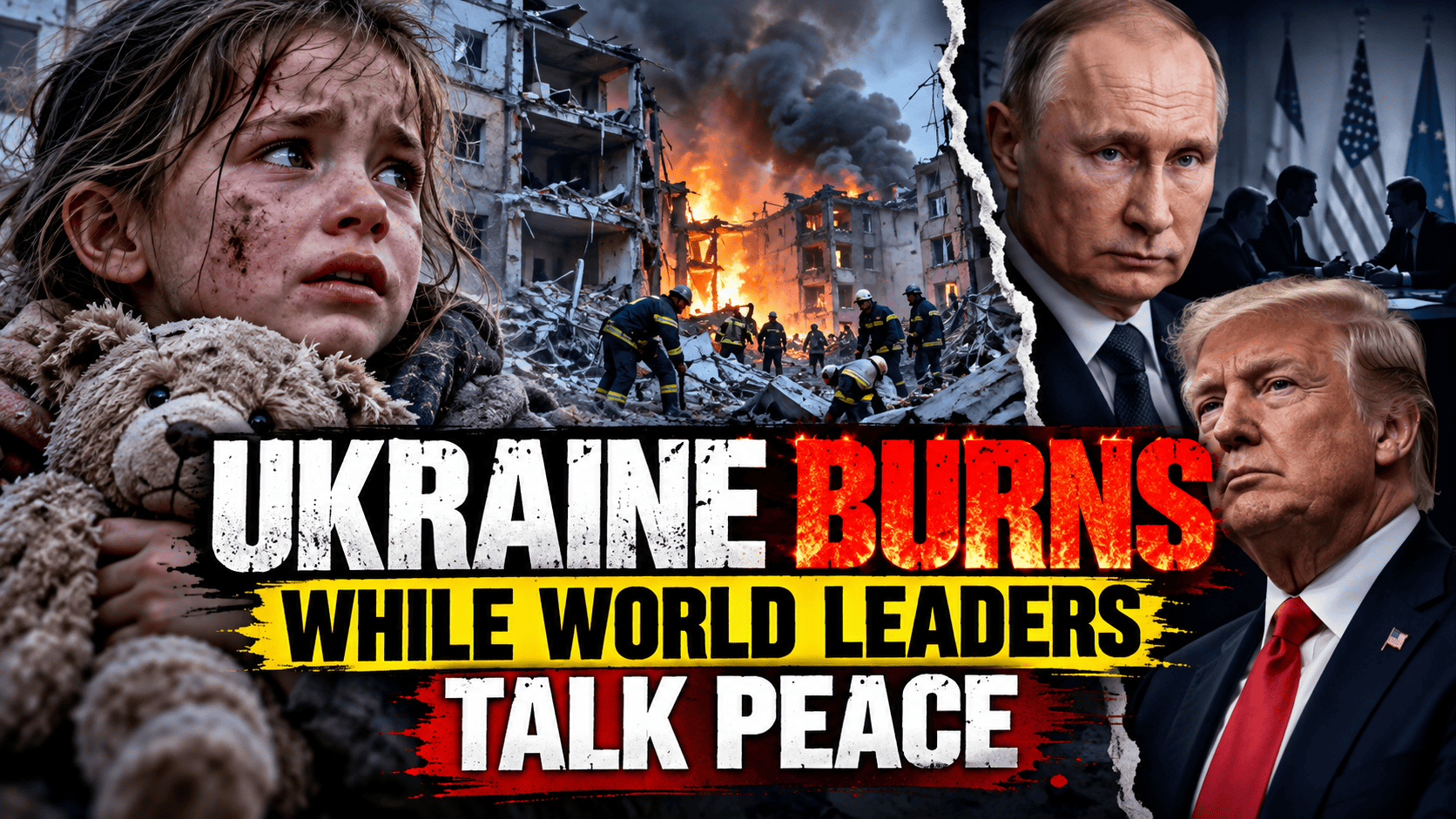
The politicians are talking about peace. The diplomats are negotiating agreements. The cameras are capturing handshakes and carefully rehearsed statements. Meanwhile, ordinary Ukrainians are being pulled from the wreckage of their own homes.
There is something deeply disturbing about watching world leaders discuss the future of Ukraine while the people living there continue to die in the present.
On Saturday morning, October 10, Russian forces struck the southern Ukrainian city of Zaporizhzhia, killing civilians and leaving rescue workers searching through shattered buildings for survivors.
Initial reports from Reuters, citing regional Governor Mykhailo Semikin, confirmed seven people dead and ten wounded. The strikes reportedly hit several locations in the early morning hours.
Later reports indicated a substantially higher death toll, including children.
And that is where the political speeches begin to sound painfully hollow.
Seven Dead Was Only the Beginning
The first reports were grim enough.
Seven people killed. Ten injured. Rescue teams searching through debris, not knowing whether they would find survivors or bodies.
But the tragedy grew as more information emerged.
______________________________________________
🔴 Help keep this independent voice alive and uncensored.
Support independent journalism and help keep Chris Wick News going.
👉 Support Chris Wick on GoFundMe
Subsequent reporting described the death toll rising to more than twenty, with children among the victims.
These are not simply numbers to be inserted into another international news bulletin.
They represent families, homes and ordinary lives violently interrupted.
For people watching from thousands of kilometres away, the war can become a collection of maps, casualty figures and political arguments.
For those living beneath the bombs, it is something entirely different.
It is the possibility that the building you go to sleep in tonight might not be standing tomorrow morning.
And after more than four years of full-scale war, that possibility has become a terrifying part of everyday life.
Peace Negotiations Continue While the Bombs Fall
The timing of the Zaporizhzhia attack deserves particular attention.
Just hours earlier, American, Ukrainian and European representatives had been engaged in diplomatic discussions in Miami, attempting to develop a common proposal for ending the war.
The discussions involved senior American envoys Steve Witkoff and Jared Kushner, alongside Ukrainian and European representatives.
The stated objective was to move toward a proposal that could eventually be presented to Moscow.
Yet while diplomats were searching for a possible breakthrough, the violence continued.
That contradiction should trouble anyone who genuinely wants this war to end.
Diplomacy is necessary. Negotiations are necessary. Eventually, some political arrangement will likely be required to stop the fighting.
But negotiations do not protect civilians simply because they are taking place.
And a peace proposal means very little to a family that has already lost everything.
The Russian Diesel Deal Raises Uncomfortable Questions
Another development has added a deeply controversial economic dimension to the war.
President Donald Trump announced an arrangement involving Russian diesel supplies intended to ease pressure on global fuel markets.
The move involved relaxing restrictions on Russian fuel, drawing criticism from Ukrainian President Volodymyr Zelenskyy and European allies concerned about the economic benefits flowing to Moscow.
Zelenskyy argued that additional Russian energy revenue could help sustain the country’s war effort.
That concern deserves serious examination.
Russia’s energy sector remains an important source of national revenue. Any decision that potentially increases that revenue raises legitimate questions about the relationship between energy policy, sanctions and the war in Ukraine.
Of course, the situation is complicated.
Governments must consider fuel prices, economic stability and the consequences of global supply shortages.
But there is an uncomfortable question beneath those calculations.
If economic pressure is supposed to help bring an end to the war, what happens when that pressure is reduced while the attacks continue?
That is not proof that a particular energy agreement caused the Zaporizhzhia strike. No such direct causal connection has been established.
It is, however, a serious question about whether economic decisions are consistent with the diplomatic objective of ending the conflict.
Civilians Are Paying for a War They Cannot Control
There is a tendency in international politics to reduce wars to competing strategic interests.
Territory. Security guarantees. Military assistance. Sanctions. Energy markets. Negotiating leverage.
All of those issues matter.
But none should obscure the most basic reality.
Civilians are being killed.
Russian attacks on Ukrainian cities have continued to cause extensive casualties, including during the days immediately preceding the Zaporizhzhia tragedy.
Ukraine has also intensified attacks against Russian energy and other infrastructure, attempting to weaken Moscow’s ability to sustain its military campaign.
Both sides are pursuing military objectives. But responsibility for individual attacks, and whether they comply with international humanitarian law, must be judged according to the evidence.
There is no justification for deliberately targeting civilians.
The laws of war require parties to distinguish between civilians and military objectives and to take precautions to minimize civilian harm.
Those obligations do not disappear because a conflict has dragged on for years.
They become more urgent.
The Most Dangerous Thing Is Becoming Used to This
Perhaps the most disturbing aspect of this war is how easily another deadly attack can disappear into the daily news cycle.
A city is bombed.
A death toll is announced.
Political leaders issue statements.
Then another crisis takes over the headlines.
The world moves on.
But the people left behind do not.
They are still burying relatives, searching for missing family members and wondering whether the next attack will destroy whatever remains of their lives.
I find it increasingly difficult to listen to confident predictions about peace when the evidence on the ground continues to tell such a different story.
I want this war to end. I want the killing to stop. And I want the people responsible for decisions that prolong the suffering to face serious scrutiny, regardless of which political side they represent.
That should not be a controversial position.
Peace Cannot Be Measured by Political Announcements
The international community can hold another summit. Washington can announce another initiative. Moscow can issue another statement. European leaders can promise additional measures.
None of those developments should be mistaken for peace itself.
Peace will have to be measured by something far more tangible.
Fewer missiles striking cities.
Fewer families searching through rubble.
Fewer children dying in a war they never chose.
And credible commitments that actually reduce the violence rather than merely rearrange the political arguments surrounding it.
The destruction in Zaporizhzhia is a reminder that the distance between diplomatic ambition and reality remains enormous.
Because while powerful people negotiate the future, ordinary people are still being buried in the present.
And until that changes, the world should be extremely careful about celebrating progress.
Sources
Reuters — Russian attack on Ukraine’s Zaporizhzhia kills seven, governor says (October 10, 2026)
Associated Press — Kyiv pushes back on Trump’s call for a new Ukrainian president as drones hit Russian data hub
https://apnews.com/article/f621fa788196f204448e7f75fcc78c68