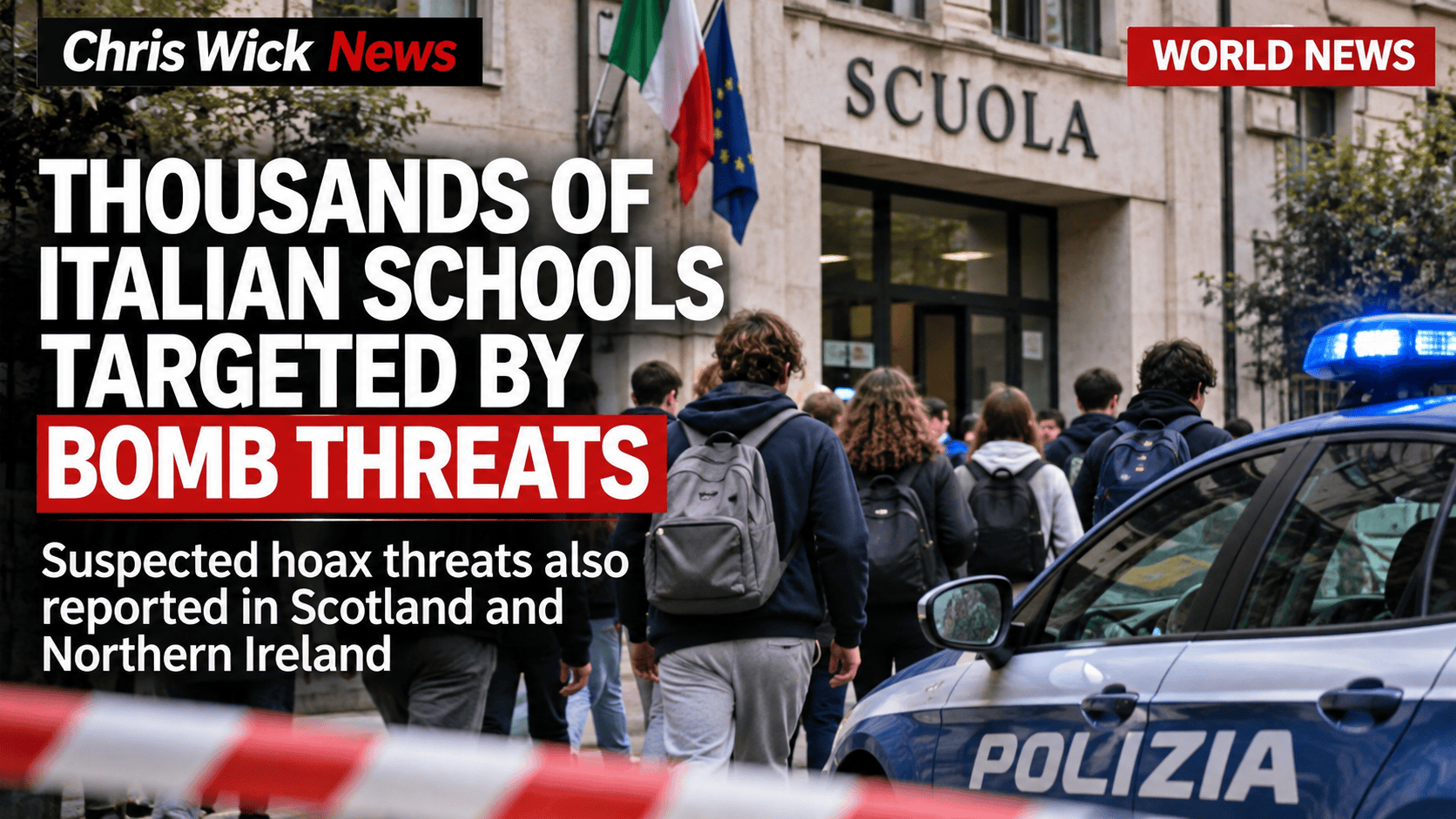
Thousands of schools. Threatening messages. Frightened families. And a disturbing question hanging over Europe: Who is behind this campaign of intimidation?
Italy is confronting a massive wave of suspected hoax bomb threats targeting schools, while hundreds of educational institutions in Scotland and Northern Ireland have also received threatening messages.
According to BBC News, approximately 6,000 Italian schools were affected, alongside more than 700 schools in Scotland and Northern Ireland.
Authorities have not established whether the incidents are connected.
But regardless of who sent the threats, the disruption exposes something deeply troubling: how easily anonymous messages can turn ordinary school days into security emergencies.
Schools Become Targets of Fear
For parents, a bomb threat is never just another headline.
It means wondering whether their children are safe. It means teachers facing potentially dangerous situations while trying to protect students. And it means police and emergency personnel having to respond to threats that may ultimately prove false.
Italian schools in cities including Rome, Naples, Florence, Pisa, Trieste and Vicenza were among those reportedly targeted.
The suspected hoax nature of the messages does not eliminate the seriousness of the situation.
Every credible threat requires assessment. Every unnecessary emergency response consumes resources that could be needed somewhere else.
And every frightened child becomes an unwilling participant in someone else’s campaign of intimidation.
The Dangerous Power of Anonymous Threats
There is something particularly disturbing about targeting schools.
Children have no role in international disputes, political conflicts or ideological battles. Yet schools remain vulnerable to individuals seeking maximum disruption with minimal effort.
A threatening email can travel across borders in seconds. Investigating its origin can take considerably longer.
That imbalance presents an enormous challenge for authorities.
The possibility of coordinated activity deserves investigation, but coordination cannot be assumed simply because similar threats appeared in multiple countries.
Establishing responsibility requires evidence, not speculation.
A Security System Under Pressure
The scale of the reported incidents raises legitimate questions about preparedness.
How quickly can authorities distinguish credible threats from mass-distributed hoaxes? How effectively can schools communicate with families? And what resources are available when large numbers of institutions receive threats simultaneously?
These are not abstract concerns.
A security response must protect children without allowing anonymous troublemakers to paralyse entire education systems indefinitely.
That is a difficult balance, particularly when officials cannot immediately establish whether a threat is genuine.
Fear Should Never Become Routine
The most alarming possibility is not simply that thousands of schools received threatening messages.
It is that repeated incidents could eventually make such threats seem routine.
That would be dangerous.
Schools cannot ignore potential explosives simply because previous warnings proved false. Nor can communities function normally if every anonymous message creates widespread panic.
Whoever is responsible for these threats has demonstrated how much disruption can be caused without a confirmed physical attack.
The unanswered question is whether investigators can identify those responsible before another wave of threats sends families and schools scrambling again.
For now, the essential facts remain straightforward: thousands of institutions have been targeted, authorities are examining suspected hoaxes, and the connection between incidents in different countries remains unproven.
The children caught in the middle deserve something far more important than speculation.
They deserve safety.
Sources
BBC News — Six thousand Italian schools hit by threats in suspected bomb hoax
Verification update: Subsequent reporting by Reuters and AP confirms that more than 6,300 Italian schools received threats, but that does not mean all were evacuated. Italian authorities found no concrete danger, and no government or group has been conclusively identified as responsible. AP News+1