France is facing a crisis that goes far beyond smashed windows and burning streets. As the government moves toward curfews, a more uncomfortable question is emerging: How did a country already struggling with economic pressure and public frustration reach the point where its leaders are considering restricting movement to restore order?
When a Government Starts Talking About Curfews, Something Has Already Gone Wrong
France is entering dangerous political territory.
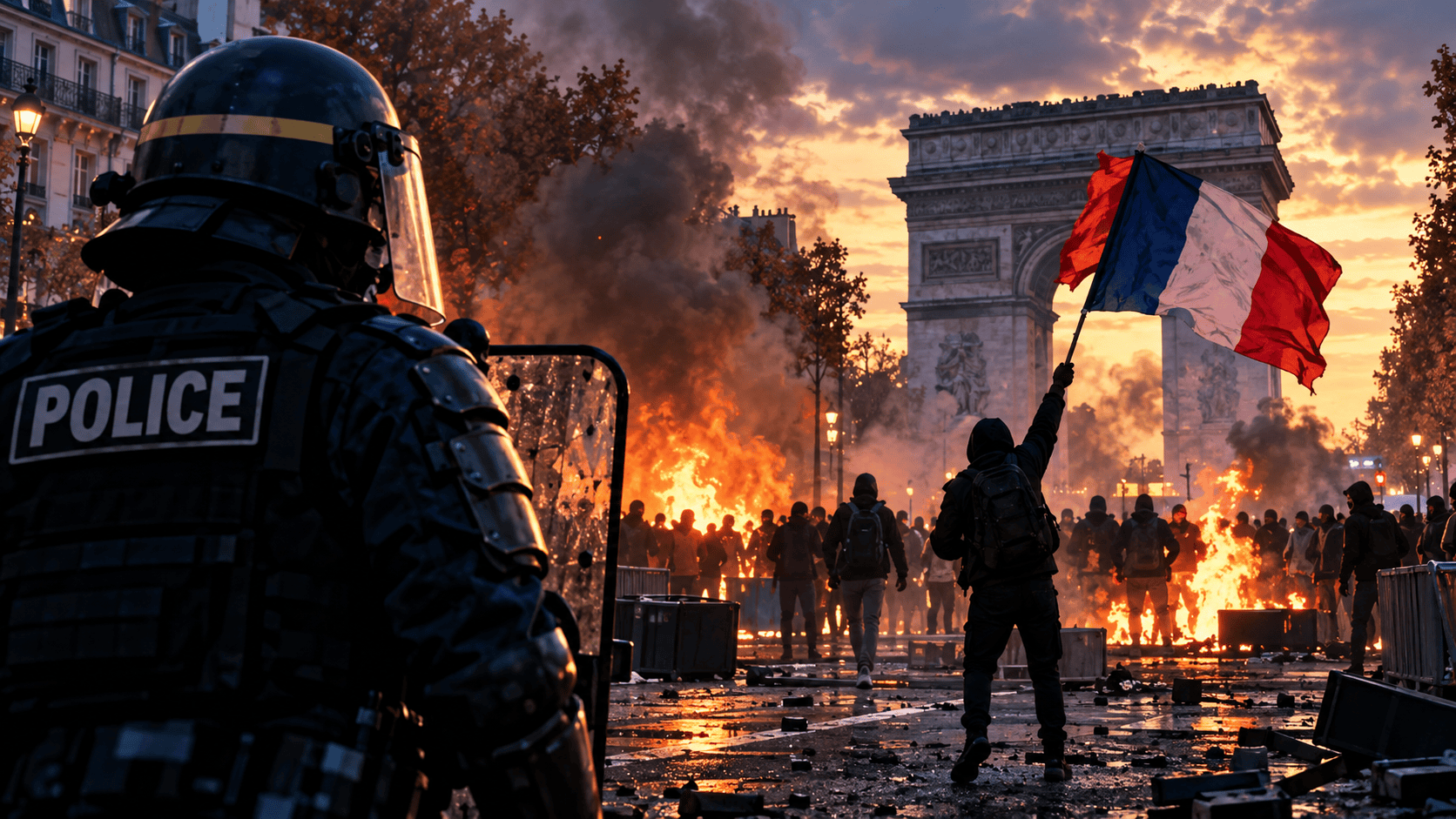
After a weekend of violent unrest, looting, and confrontations with police, Prime Minister Sébastien Lecornu has instructed local authorities to prepare partial curfews in affected urban areas.
The government’s message is straightforward: restore order before the situation deteriorates further.
But beneath that official explanation lies a far more troubling reality.
France is no longer dealing with an ordinary disagreement between protesters and politicians. It is confronting a crisis of public confidence, economic frustration, and increasingly visible failures of government authority.
President Emmanuel Macron now faces a situation in which the streets are becoming a political battleground, businesses are paying the price, and the government’s ability to maintain public order is being openly questioned.
The curfews may suppress some of the violence.
They will not necessarily resolve the grievances that brought hundreds of thousands of people into the streets.
The Streets Erupted. The Government Was Caught Off Guard.
______________________________________________
🔴 Help keep this independent voice alive and uncensored.
Support independent journalism and help keep Chris Wick News going.
👉 Support Chris Wick on GoFundMe
The unrest followed weeks of student demonstrations and growing public anger over living costs and deteriorating public services.
Saturday’s nationwide protests drew hundreds of thousands of participants. Many demonstrated peacefully, but violent groups also attacked public buildings, looted businesses, and clashed with security forces.
The destruction was substantial.
Shops were damaged or ransacked. Public property was attacked. Police struggled to contain rapidly shifting confrontations across multiple cities.
French authorities reported thousands of arrests over the weekend, while local officials demanded explanations for the apparent lack of preparation.
Interior Minister Laurent Nuñez acknowledged that police had lost control in some locations.
That admission deserves attention.
When a senior government official acknowledges that security forces lost control during nationwide unrest, the problem extends beyond individual incidents of vandalism.
It raises questions about intelligence gathering, operational planning, political leadership, and whether authorities understood the scale of public anger building around them.
The violence cannot be justified. But neither should it become an excuse to ignore why so many people were protesting in the first place.
Macron Keeps His Interior Minister as Pressure Mounts
In another revealing development, Nuñez offered his resignation following the security failures.
Macron rejected it.
Instead, the president instructed him to remain in position and develop new operational measures to confront looting and restore control.
The decision may have been intended to preserve continuity within the security establishment.
Politically, however, it creates an uncomfortable contradiction.
If the government’s response was inadequate, who is ultimately accountable?
The police officers on the streets?
The intelligence services that failed to anticipate the scale of disorder?
The minister responsible for internal security?
Or the political leadership overseeing the entire system?
Keeping a minister in office during a crisis is not automatically a mistake. Removing senior officials in the middle of an emergency can create additional instability.
But retaining them cannot become a substitute for accountability.
France’s citizens deserve more than promises that lessons will be learned after the damage has already occurred.
Curfews: Public Protection or a Warning Sign?
Lecornu has emphasized that the proposed curfews would be localized rather than nationwide.
The government has specifically ruled out placing all of Paris under a blanket curfew.
That distinction matters.
A temporary restriction targeting areas experiencing serious violence is not the same as suspending normal public life across an entire country.
Governments have a responsibility to protect residents, businesses, and emergency personnel.
But restrictions on movement also deserve scrutiny.
Who decides which neighbourhoods are affected?
How long will the restrictions remain?
What evidence will determine whether they are necessary?
And what safeguards will prevent peaceful residents and demonstrators from being punished for violence committed by others?
These are not unreasonable questions.
Public safety and civil liberties should not be treated as competing luxuries. A functioning democracy is expected to protect both.
France’s authorities must demonstrate that any curfews are proportionate, temporary, legally justified, and subject to meaningful oversight.
Otherwise, emergency restrictions risk becoming another source of public resentment.
Blaming Extremists Does Not Explain the Entire Crisis
French officials have blamed ultra-left activists and criminal groups for exploiting the demonstrations and turning parts of the protests violent.
There is evidence that organized agitators and opportunistic looters contributed to the destruction.
That distinction is important.
Peaceful demonstrators demanding better living conditions should not automatically be placed in the same category as individuals setting fires, attacking police, or stealing merchandise.
But the government’s explanation also raises another question.
If violent extremists exploited the protests, why were the underlying demonstrations so large?
The grievances did not appear overnight.
France has been struggling with pressure on household budgets, dissatisfaction with public services, political instability, and concerns over government finances.
Those problems existed before the first storefront was smashed.
They will still exist after the streets are cleared.
A government can arrest rioters. It cannot arrest its way out of an economic and political crisis.
That is the distinction Macron’s administration must confront.
The Economic Damage Could Outlast the Riots
France is not experiencing this unrest in isolation from its broader economic problems.
The government faces mounting fiscal pressures and a difficult political environment ahead of the next presidential election.
Businesses damaged during the riots face repair costs, lost revenue, and uncertainty over future operations.
Workers may lose wages or shifts through no fault of their own.
Tourism, retail activity, and investor confidence can also suffer when prolonged instability creates uncertainty about public safety.
The consequences do not stop when the television cameras leave.
A destroyed business may take months to reopen.
A small business owner may never recover financially.
And ordinary taxpayers could ultimately bear part of the cost of repairing damaged public infrastructure.
There is a bitter irony here.
Protests motivated partly by economic hardship have escalated into violence that could deepen hardship for the very communities already struggling.
That does not invalidate peaceful protesters’ concerns.
It demonstrates how quickly legitimate public anger can be hijacked by destructive behaviour.
Six Months Before an Election, France Faces a Test of Leadership
The timing could hardly be worse for Macron’s government.
With France approaching its next presidential election, every decision now carries political consequences.
Opposition parties will scrutinize the government’s handling of the violence.
Business owners will demand protection.
Peaceful demonstrators will want assurances that their right to protest remains intact.
And citizens already frustrated with their economic circumstances will expect answers about whether their government has a credible plan to improve daily life.
There is also a wider European dimension.
France is not the only country confronting dissatisfaction over living costs and government performance.
Its turmoil illustrates a challenge facing democracies across Europe: how to respond when public frustration becomes widespread, political trust weakens, and extremist or criminal elements exploit demonstrations.
The answer cannot simply be more police officers.
Nor can it be an unquestioning acceptance of every demand made in the streets.
It requires competent government, credible economic policies, transparent accountability, and a willingness to distinguish legitimate dissent from criminal violence.
The Real Question Is What Happens After the Streets Go Quiet
The immediate priority is obvious.
Protect lives. Stop the looting. Restore public safety.
But once the curfews end and the barricades disappear, France will face the same questions that existed before the unrest.
Why are so many citizens dissatisfied?
Why were security services apparently unprepared?
Why did peaceful demonstrations become opportunities for widespread destruction?
And what meaningful changes will follow?
The government may successfully restore order in the coming days.
That would be welcome.
But order is not the same as public trust.
And silence is not the same as consent.
A country can look calm on the surface while anger continues building underneath.
That is the danger confronting France.
Macron’s government has the authority to impose security measures within the law. What remains uncertain is whether it can restore confidence in the political institutions responsible for governing the country.
Curfews may buy time.
They cannot manufacture trust.
Chris Wick News — Final Word
France’s streets are sending two very different messages.
One comes from ordinary citizens demanding better living conditions and more responsive government.
The other comes from people willing to use destruction and violence.
Confusing those two messages would be a serious mistake.
So would treating the restoration of public order as proof that the deeper crisis has been resolved.
The real measure of leadership is not how quickly a government can empty the streets. It is whether people still believe their government is listening once those streets are empty.
And right now, France has every reason to ask whether its leaders understand the difference.
Sources
Reuters — French Prime Minister calls for partial curfews after weekend riots https://www.reuters.com/world/french-prime-minister-calls-partial-curfews-after-weekend-riots-2026-10-19/
Reuters — France reels from weekend violence as mayors rebuke government for security failings https://www.reuters.com/world/europe/frances-macron-declines-interior-ministers-offer-resign-2026-10-19/
Associated Press — France’s prime minister calls for localized curfews in cities to curb rioting and looting https://apnews.com/article/75825aafc5412ae389c6d41443b4082e
AFP — Police ‘lost control’ during French protests, says interior minister https://www.afp.com/en/police-lost-control-during-french-protests-says-interior-minister