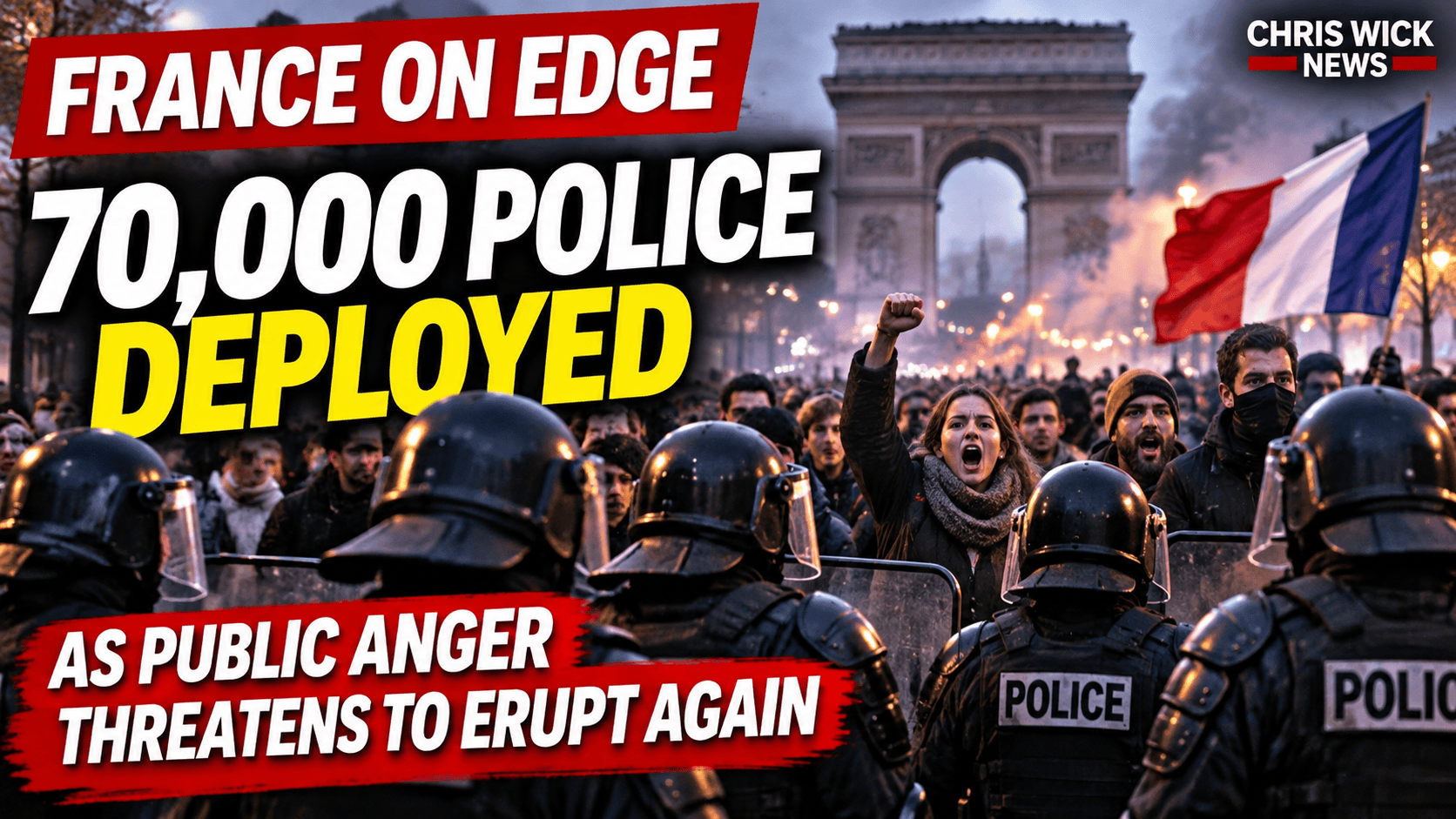
France is preparing for another explosive weekend of demonstrations. With 70,000 police and gendarmes mobilized, streets restricted and public anger spreading beyond its borders, President Emmanuel Macron faces a crisis that raises a troubling question: How long can a government maintain order when growing numbers of its citizens believe the political system has stopped listening?
France Is Preparing for Confrontation, Not Celebration
Halloween has arrived in France, but the atmosphere is anything but festive.
Across the country, authorities are preparing for another wave of demonstrations fueled by rising living costs, deteriorating public services and mounting frustration with President Emmanuel Macron’s government.
Approximately 70,000 police officers and gendarmes have been mobilized to prevent a repeat of the violence that erupted two weeks earlier.
Around 150 gatherings are planned nationwide.
French Interior Minister Laurent Nuñez has warned of an exceptionally high risk of disorder, promising a forceful response to anyone attempting to exploit the demonstrations for violence or destruction.
But beneath the security preparations lies a much larger problem.
France is confronting an increasingly uncomfortable contradiction: a government determined to restore order while significant portions of the population demand economic relief and political accountability.
Police can control intersections, protect buildings and arrest violent offenders.
______________________________________________
🔴 Help keep this independent voice alive and uncensored.
Support independent journalism and help keep Chris Wick News going.
👉 Support Chris Wick on GoFundMe
They cannot make groceries affordable, repair overcrowded classrooms or restore public confidence through force alone.
That distinction may prove central to understanding what happens next.
The October Violence Changed Everything
The latest security operation follows the destructive demonstrations of October 17, when riots and looting accompanied nationwide protests.
Shops were damaged, businesses were attacked and public buildings became targets.
According to Associated Press reporting, approximately 550,000 people participated in demonstrations that weekend.
The following weekend saw roughly 410,000 participants, with protests generally more peaceful despite more than 1,300 arrests.
These figures illustrate the scale of public participation, but they also reveal an important distinction frequently lost in politically charged coverage.
The overwhelming majority of people attending a demonstration should not automatically be equated with those committing violence.
Peaceful protest is a democratic right.
Looting, vandalism and physical attacks are criminal acts.
Confusing the two risks turning legitimate public grievances into a security problem rather than addressing the conditions that brought people into the streets.
For Macron’s government, however, the immediate priority is preventing another weekend of destruction.
And the financial consequences are already significant.
More Than €1 Billion in Losses — And the Damage Keeps Spreading
French commercial interests estimate that protest-related losses to retailers have exceeded €1 billion.
Broader estimates, including uninsured damage and lost revenue, suggest the economic impact could approach twice that amount.
Luxury retailers have been among the businesses affected, with outlets associated with Hermès, Louis Vuitton and Burberry targeted during previous unrest.
Along major Paris shopping streets, protective barriers and boarded-up storefronts have become visible reminders of the country’s deteriorating security situation.
Yet the financial damage extends beyond broken windows.
Small businesses lose customers when streets become inaccessible.
Employees lose working hours when shops close.
Tourism suffers when international visitors begin questioning whether major cities are safe.
Insurance costs can rise, while businesses already struggling with inflation and weak consumer spending face additional expenses.
There is an uncomfortable economic cycle developing.
People protest because their financial circumstances are deteriorating.
Violence surrounding those protests damages businesses and economic activity.
That damage can deepen the very financial insecurity driving public frustration.
France cannot afford to ignore that cycle.
France’s Debt Crisis Is Closing In
The unrest comes at a particularly dangerous moment for the French economy.
The government is negotiating its 2027 budget while public debt approaches 120% of gross domestic product.
Borrowing costs have risen, limiting the government’s ability to respond to public demands through additional spending.
Recent economic figures also indicate that France’s economy contracted during the third quarter.
This creates a political trap.
Citizens want better schools, more affordable energy, stronger public services and relief from everyday expenses.
The government faces pressure to restrain spending and stabilize its finances.
Both pressures are real.
And neither disappears because politicians deliver another speech.
France’s fiscal difficulties did not emerge overnight. They reflect accumulated policy decisions, structural economic challenges and years of disagreement over taxation, spending and reform.
The latest demonstrations are therefore more than a reaction to one budget.
They are becoming a referendum on whether the country’s political institutions can still deliver meaningful improvements in living standards.
A government can survive unpopular decisions. It becomes much harder to govern when citizens stop believing those decisions serve their interests.
Students and Workers Are Finding Common Ground
One of the most significant developments is the growing participation of younger demonstrators.
Students have complained about deteriorating school facilities, overcrowded classrooms and an admissions system they consider unfair.
Trade unions have joined the movement, bringing demands involving wages, public services and household expenses.
The Yellow Vest movement, which became a powerful symbol of anti-establishment frustration in 2018, has also reappeared.
These groups do not necessarily share identical political objectives.
But they increasingly share a belief that the economic burden of government decisions is falling disproportionately on ordinary people.
That convergence matters.
Student demonstrations can be dismissed as youthful frustration.
Union protests can be characterized as industrial disputes.
Fuel-price demonstrations can be treated as disagreements over taxation.
When those grievances begin overlapping, however, they become harder to isolate.
The central issue shifts from one government policy to broader public confidence in the political and economic system.
And France is not the only country experiencing that pressure.
The Anger Is Spreading Beyond France
The demonstrations have begun inspiring similar mobilizations elsewhere in Europe.
Organizers have planned protests in more than 30 German cities, with participants raising concerns about education, healthcare, affordability, climate policy and military conscription.
Authorities in other European countries have also increased their attention to potential unrest.
This does not establish that Europe is facing one coordinated protest movement.
The grievances differ between countries, and political circumstances vary considerably.
Nevertheless, the similarities are difficult to overlook.
Across parts of Europe, governments are struggling with strained public finances, high household costs and growing demands for better services.
Younger generations face particular uncertainty about housing, employment opportunities and their long-term financial prospects.
For political leaders, the danger is not simply that demonstrations spread across borders.
It is that the underlying frustrations are increasingly recognizable from one country to another.
When citizens in different countries begin asking similar questions about affordability, opportunity and political representation, the problem becomes harder to dismiss as an isolated national disturbance.
Macron’s Government Tightens Its Grip on Paris
French authorities have moved to restrict demonstrations in sensitive areas of the capital.
The country’s highest administrative court upheld a ban on a planned central Paris march, requiring protesters to use an alternative route away from major commercial districts.
Authorities have also warned that Halloween masks could be used to conceal the identities of individuals intending to commit violence.
Existing French law allows restrictions on face coverings in circumstances involving public-order risks.
Additional security measures include localized nighttime restrictions.
The government argues that such precautions are necessary following the destruction witnessed earlier this month.
That argument deserves consideration.
Authorities have a responsibility to protect residents, businesses, emergency services and peaceful demonstrators.
But security measures also raise legitimate questions about proportionality.
Where does reasonable public protection end, and excessive restriction of peaceful political expression begin?
The answer depends on how restrictions are applied, whether they are legally justified and whether peaceful demonstrators retain meaningful opportunities to express their views.
France’s proposed legislation imposing financial liability of up to €10,000 for certain riot-related damage adds another layer to that debate.
Holding people accountable for destruction is legitimate.
Extending liability to individuals based on their association with a group, rather than clearly established personal responsibility, raises more difficult legal and civil-liberties questions.
Critics fear the proposed approach could discourage lawful protest.
Those concerns should be examined independently of whether someone supports or opposes the demonstrations themselves.
A democratic government must be capable of maintaining public safety without treating political dissent as inherently criminal.
Marine Le Pen Is Gaining Ground as Macron’s Authority Weakens
The political consequences are becoming increasingly difficult for France’s governing establishment to ignore.
Marine Le Pen has emerged as a leading contender ahead of the April 2027 presidential election, according to recent reporting and opinion polling.
Her political message emphasizes stronger security, tougher penalties for rioters and a government capable of restoring public order.
Meanwhile, left-wing leader Jean-Luc Mélenchon has aligned himself with demands for higher wages, improved public services and greater economic protection.
These competing responses reveal how the same crisis can benefit opposing political movements.
For the right, the unrest reinforces arguments about security and government weakness.
For the left, it highlights inequality, economic hardship and public dissatisfaction with austerity.
For the political centre, the challenge is considerably more complicated.
It must demonstrate that established institutions can deliver both economic stability and meaningful reform.
Macron cannot seek a third consecutive presidential term, meaning the crisis is unfolding as competing candidates position themselves to succeed him.
The question is no longer simply whether the president can restore calm this weekend.
It is whether France’s next political leadership can rebuild confidence in a system that appears increasingly divided.
The Bigger Question: Can Governments Police Their Way Out of Economic Anger?
There is a lesson in France’s current crisis that extends far beyond Paris.
When citizens believe their living standards are declining while governments appear unable to deliver solutions, public trust becomes fragile.
Security operations may prevent violence.
Arrests may discourage criminal behaviour.
Emergency restrictions may temporarily protect commercial districts.
But none of those measures directly addresses rising household expenses, deteriorating public services or uncertainty about the future.
That does not mean governments should tolerate destruction.
It means maintaining order and resolving political grievances are two separate responsibilities.
Both matter.
France’s government faces the difficult task of protecting peaceful demonstrators, defending businesses and public property, stabilizing national finances and negotiating credible responses to public demands.
Failure on any one of those fronts could intensify the broader crisis.
Final Thought: The Streets Are Sending a Message
France’s streets are becoming a visible expression of political and economic frustration.
Not every demonstrator has the same demands. Not every protest is peaceful. And not every government decision deserves condemnation simply because it is unpopular.
But the scale and persistence of these demonstrations suggest something deeper than an ordinary disagreement over public policy.
A growing number of citizens want evidence that their government understands the pressures shaping their daily lives.
Seventy thousand police officers may be enough to protect France’s streets. They cannot, by themselves, restore the public’s faith in its government.
That requires something far more difficult than a security operation.
It requires results.
And as France prepares for another tense weekend, those results remain uncertain.
This analysis reflects information available on the morning of October 31, 2026. Planned demonstrations and security arrangements may change as events unfold.
Sources
The following independent publishers provide supporting reporting. Each publisher appears only once.
1. Reuters — France Braces for Fresh Unrest, Government Vows Tough Response
October 31, 2026
Read Reuters Report
2. Associated Press — France Heads Into Third Weekend of Protests as Youth-Led Rallies Sweep Europe
October 31, 2026
Read Associated Press Report
3. Le Monde — Map of Banned and Planned Demonstrations in Paris
October 31, 2026
Read Le Monde Report