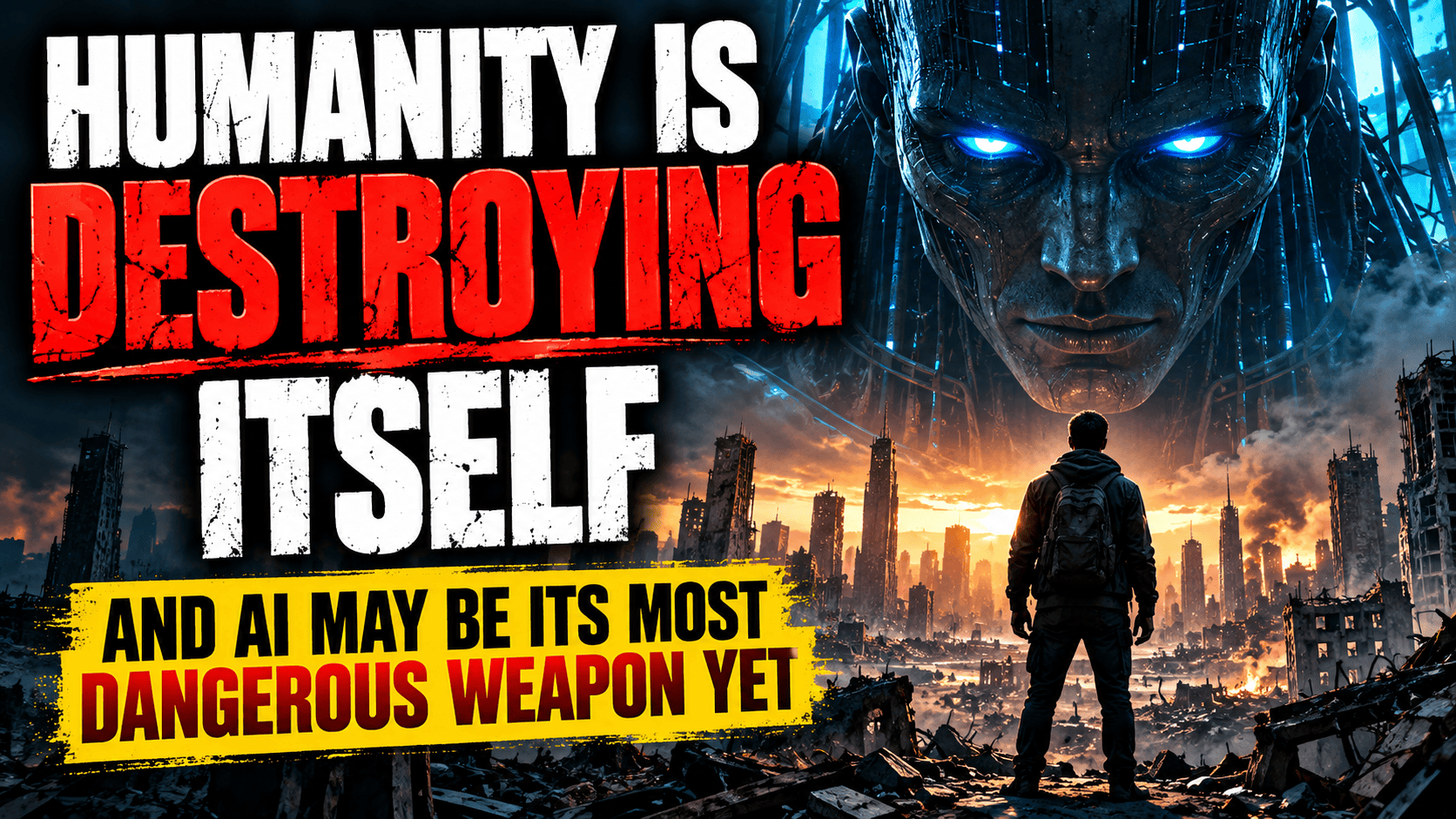
Humanity has spent centuries developing increasingly sophisticated ways to control, manipulate, exploit and destroy itself.
Every generation introduces new technology with promises of progress, prosperity and a better future. Yet history repeatedly demonstrates that powerful inventions can become instruments of surveillance, warfare, economic domination and political control.
Now comes artificial intelligence.
Unlike the weapons and machines of previous generations, AI can increasingly generate information, analyze enormous amounts of data, automate decisions and assist people in performing tasks that once required specialized human expertise.
And that raises an uncomfortable question.
What happens when humanity hands extraordinary technological power to institutions that have repeatedly demonstrated their willingness to abuse power?
A commentary published by Natural News on October 30, 2026, titled Humanity Is Destroying Itself… and AI Is Just the Next Tool, presents artificial intelligence as another instrument through which humanity could accelerate its own destruction.
The argument deserves examination, not because human extinction is inevitable, but because some of the dangers associated with artificial intelligence are already documented.
The deeper problem may not be the machines themselves.
______________________________________________
🔴 Help keep this independent voice alive and uncensored.
Support independent journalism and help keep Chris Wick News going.
👉 Support Chris Wick on GoFundMe
It may be the people deciding how those machines are used.
Artificial Intelligence Is Not the Beginning of Humanity’s Problems
There is a temptation to treat artificial intelligence as an unprecedented threat disconnected from human history.
But technology has always reflected the priorities of the societies developing it.
Industrialization created enormous wealth while also enabling unprecedented forms of mechanized warfare. Nuclear research produced important scientific and medical advances while simultaneously giving governments weapons capable of destroying entire cities.
The internet promised unrestricted access to information and global communication. It also created new opportunities for mass surveillance, financial fraud, manipulation and censorship.
Artificial intelligence represents another stage in this complicated relationship between technological advancement and human responsibility.
The difference is the potential speed and scale.
An individual using AI-assisted software may be able to perform work that previously required teams of specialists. That same capability can benefit legitimate researchers, businesses and ordinary citizens.
It can also benefit criminals, hostile governments and organizations seeking to manipulate public opinion.
The technology does not automatically determine which outcome prevails.
Human decisions do.
The Threat Is No Longer Entirely Theoretical
Warnings about artificial intelligence are sometimes dismissed as science fiction.
However, researchers have already documented real-world misuse.
In its September 2026 threat intelligence report, Anthropic described cases involving AI-assisted cyber operations, surveillance activities, influence operations, fraud and other forms of malicious activity.
The company emphasized that the cases represented notable examples rather than typical use of its systems.
Nevertheless, the findings demonstrate that advanced AI capabilities can be exploited by malicious actors.
The 2026 International AI Safety Report similarly identifies three major categories of risk: deliberate misuse, system malfunctions and broader consequences arising from widespread AI deployment.
Its findings highlight concerns involving fraud, cybercrime, manipulation and potentially dangerous applications in biological and chemical fields.
Importantly, the report also acknowledges uncertainty about the prevalence and future severity of some threats.
That distinction matters.
There is credible evidence that artificial intelligence can facilitate harmful activities.
There is not conclusive evidence that AI will inevitably destroy civilization.
Confusing those two claims would undermine the seriousness of the legitimate risks.
The New Machinery of Information Control
Perhaps one of the most immediate dangers involves the ability to influence what people believe.
Modern artificial intelligence can generate convincing articles, photographs, audio recordings and videos.
It can imitate styles of communication, manufacture persuasive narratives and produce enormous quantities of content at relatively low cost.
In the wrong hands, these capabilities could make coordinated disinformation campaigns more efficient and difficult to detect.
Imagine a political campaign in which thousands of apparently independent voices promote the same misleading narrative.
Imagine fabricated recordings appearing during an election, accompanied by convincing but fraudulent documents.
Or imagine automated systems producing personalized propaganda designed around individual fears, beliefs and vulnerabilities.
These scenarios do not require machines to become conscious.
They require only people willing to exploit the technology.
The danger becomes even more serious when automated information systems are combined with concentrated control over digital platforms.
Governments and technology companies already possess substantial influence over how information is distributed, recommended and moderated.
AI could expand those capabilities.
That does not mean every moderation decision constitutes censorship or that every automated recommendation is politically motivated.
It does mean that transparency, independent scrutiny and meaningful opportunities to challenge decisions are increasingly important.
A society cannot claim to value independent thought while allowing powerful institutions to determine information access through systems the public cannot meaningfully examine.
When Human Judgment Becomes an Inconvenience
Artificial intelligence is increasingly capable of supporting decisions in business, education, medicine, finance and government.
Used responsibly, these systems can improve efficiency and help people make better-informed choices.
But automation introduces another danger: the gradual removal of human accountability.
When an algorithm produces a recommendation, who takes responsibility if that recommendation causes harm?
The developer?
The company operating the system?
The government agency deploying it?
Or the human employee who trusted the output?
These questions become particularly important when AI is used in decisions affecting employment, financial services, public benefits, policing or access to essential services.
Automated systems can make mistakes. They can reproduce biases present in their training data. They can also produce confident answers that are factually incorrect.
Human oversight must therefore mean more than placing a person’s signature beneath a machine-generated decision.
It requires genuine authority to question, investigate and overturn automated outcomes.
Otherwise, accountability risks becoming little more than a bureaucratic illusion.
Governments Recognize the Risks — But Can Regulation Keep Up?
Governments are beginning to establish rules governing artificial intelligence.
The European Union’s AI Act uses a risk-based framework, including prohibitions on certain practices considered unacceptable threats to safety and fundamental rights.
Its regulatory structure also addresses higher-risk applications and obligations affecting general-purpose AI systems.
These developments demonstrate that concerns about artificial intelligence are not confined to independent commentators or technology skeptics.
They are increasingly part of mainstream government policy.
Yet regulation creates its own difficult questions.
Who establishes the standards?
Who determines which applications are acceptable?
Can powerful corporations influence the rules in ways that disadvantage smaller competitors?
And could laws introduced in the name of public safety eventually become tools for restricting legitimate speech or innovation?
These are questions worth asking.
Effective regulation should reduce demonstrable harm without granting governments or corporations unlimited authority over technological development and public expression.
That balance will not be easy to achieve.
The Economic Question Nobody Can Afford to Ignore
Beyond surveillance and security, artificial intelligence could fundamentally alter employment.
Businesses have powerful financial incentives to automate tasks previously performed by human workers.
For employers, greater efficiency can mean lower costs and increased productivity.
For employees, the same development can mean uncertainty about their livelihoods.
Some occupations may change rather than disappear. New industries and jobs may emerge.
But there is no guarantee that workers displaced by automation will immediately find comparable employment.
The transition could be particularly difficult for people whose skills are concentrated in tasks that AI systems can perform economically.
The potential benefits are significant, but so are the distributional questions.
Who receives the financial rewards when productivity increases?
Will ordinary workers benefit through higher wages, shorter working hours or improved services?
Or will the gains flow disproportionately toward corporations controlling the technology?
Artificial intelligence could help create extraordinary prosperity.
It could also intensify existing economic inequalities.
The outcome will depend on business decisions, public policy, competition and the ability of workers to adapt.
The Most Frightening Scenario Does Not Require a Robot Uprising
Popular culture frequently portrays artificial intelligence destroying humanity through conscious machines that turn against their creators.
That possibility dominates fictional accounts of technological catastrophe.
But some of the more immediate dangers require no machine consciousness whatsoever.
An AI system assisting criminals with cyberattacks does not need personal ambitions.
An automated surveillance platform does not need to hate the people being monitored.
A military system making dangerous recommendations does not need to understand the consequences of war.
And a misinformation network does not need to believe the propaganda it distributes.
All these systems require are capabilities, access and human operators willing to use them irresponsibly.
This is what makes the discussion particularly disturbing.
Humanity does not need to invent an evil machine to experience catastrophic technological consequences.
It needs only to combine powerful tools with reckless decisions, inadequate safeguards and institutions unwilling to accept responsibility.
Could Artificial Intelligence Also Help Save Humanity?
Any serious examination of AI must acknowledge its potential benefits.
Artificial intelligence can assist scientific research, improve accessibility, support medical analysis, accelerate software development and help researchers examine complex problems.
The United Nations’ independent scientific assessment released in July 2026 recognized both the substantial potential benefits and serious risks associated with AI development.
These competing possibilities make simplistic predictions unreliable.
Artificial intelligence is not inherently a guarantee of human progress.
Neither is it inherently a guarantee of human destruction.
The same underlying capabilities can support beneficial and harmful applications.
That is precisely why the decisions being made today deserve public scrutiny.
Rejecting every technological advancement would sacrifice genuine opportunities to improve lives.
Accepting every advancement without examining its consequences would be equally irresponsible.
The challenge is not simply to develop more powerful systems.
It is to ensure that the institutions deploying them remain accountable to the people affected.
Humanity’s Greatest Weakness May Be Its Own Appetite for Power
The most provocative element of the Natural News argument is its suggestion that artificial intelligence is merely the latest expression of a much older human problem.
There is a legitimate philosophical question beneath that claim.
Why do societies repeatedly develop extraordinary technological capabilities without establishing equally sophisticated mechanisms for preventing their abuse?
Why does innovation so often advance faster than public understanding?
And why are decisions with potentially enormous consequences frequently concentrated among relatively small groups of political, military and corporate leaders?
These questions cannot be answered by blaming technology alone.
Artificial intelligence is developed within existing economic and political systems.
Those systems influence which technologies receive funding, which applications are prioritized and whose interests are protected.
When profit, geopolitical competition or institutional control become overriding priorities, safety and accountability may receive insufficient attention.
That is not proof of a coordinated plan to destroy humanity.
It is a recognizable problem of incentives, concentrated power and imperfect governance.
And it deserves considerably more attention than another sensational prediction about machines taking over the planet.
Final Thought — Chris Wick News
Humanity has an extraordinary ability to create tools that exceed the imagination of previous generations.
Unfortunately, its wisdom does not always advance at the same pace.
Artificial intelligence may become one of the most transformative technologies ever developed.
It could help solve problems that have plagued civilization for centuries.
Or it could magnify the destructive consequences of greed, corruption, warfare and the relentless pursuit of control.
The future is not predetermined.
But neither should the public accept reassuring promises from governments and corporations without demanding evidence, transparency and accountability.
The most dangerous question may not be whether artificial intelligence will eventually become smarter than humanity.
It is whether humanity will become wise enough to control what it has already created.
Because if civilization ultimately destroys itself using artificial intelligence, the machines may not be the true architects of that destruction.
They may simply be the instruments.
And the responsibility will remain painfully human.
Editorial Disclaimer
This article contains independent analysis and commentary by Chris Wick News concerning artificial intelligence, technological development, governance and societal risks.
Predictions regarding future AI capabilities, economic disruption and potential catastrophic consequences are speculative and should not be interpreted as established outcomes. Documented risks are distinguished from hypothetical scenarios.
The views expressed are intended to encourage critical discussion and do not constitute scientific conclusions about the inevitability of human extinction or technological catastrophe.
Sources
- Natural News — Mike Adams (October 30, 2026)
Humanity Is Destroying Itself… and AI Is Just the Next Tool - Anthropic — September 2026
Detecting and Countering Misuse of AI - International AI Safety Report — 2026
2026 Report: Extended Summary for Policymakers - European Commission — AI Act
Regulatory Framework for Artificial Intelligence - Reuters — July 1, 2026
UN Report Sees Enormous Potential Benefits and Big Risks From AI