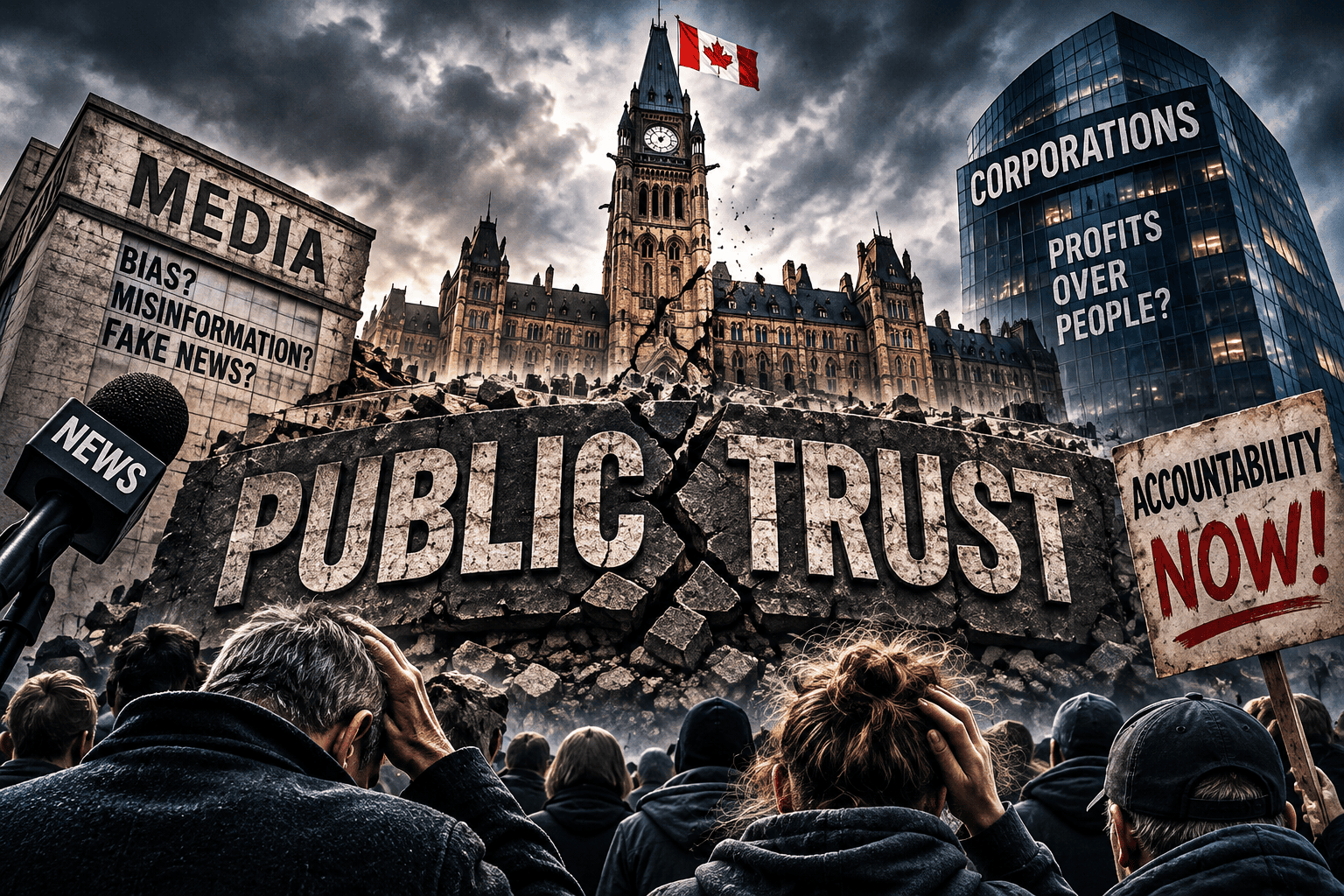
The most dangerous political crisis may not be what governments are doing behind closed doors. It may be that millions of people no longer believe what they’re being told when those doors finally open.
Something is happening across Western democracies that no election campaign, government announcement, or carefully rehearsed press conference can easily repair.
Public trust is deteriorating.
Politicians are questioned. Major news organizations are challenged. Corporations face growing suspicion. Government agencies and international institutions increasingly find themselves defending not just their decisions, but their credibility.
And perhaps the most troubling part is that distrust doesn’t always emerge from nowhere.
When Government Credibility Becomes a Casualty
For decades, citizens have watched political leaders make promises that disappear after elections.
Governments announce ambitious programs, spend enormous sums of public money, and occasionally fail to deliver the results taxpayers were promised.
When mistakes happen, accountability can be slow, incomplete, or buried beneath another round of political messaging.
Eventually, people stop asking whether politicians are telling the whole truth.
______________________________________________
🔴 Help keep this independent voice alive and uncensored.
Support independent journalism and help keep Chris Wick News going.
👉 Support Chris Wick on GoFundMe
They start assuming they aren’t.
That’s a dangerous threshold for any democracy to cross.
Once citizens believe dishonesty is simply part of governing, even legitimate public announcements become objects of suspicion.
The consequences extend far beyond party politics.
The Media Has Its Own Credibility Problem
Traditional news organizations once occupied a powerful position as gatekeepers of public information.
That authority has weakened.
Political polarization, perceived editorial bias, sensational headlines, and mistakes in reporting have contributed to growing skepticism.
Social media has accelerated the transformation.
Independent publishers now challenge established narratives in real time, often uncovering perspectives that larger organizations overlook.
But independence alone does not guarantee accuracy.
Alternative media can also publish misleading information, exaggerate claims, or substitute speculation for evidence.
The uncomfortable reality is that credibility must be earned by everyone, including those who claim to be exposing the establishment.
A journalist’s responsibility isn’t to defend the government or automatically oppose it.
It’s to investigate what can actually be demonstrated.
When Nobody Believes Anything
Here’s where the situation becomes genuinely dangerous.
A society that questions authority can remain healthy.
A society that rejects every source of information faces a different problem entirely.
Facts become harder to establish. Evidence is dismissed whenever it challenges personal beliefs. Rumours spread faster than corrections.
People retreat into information communities that reinforce what they already believe.
And when citizens cannot agree on basic facts, meaningful democratic debate becomes increasingly difficult.
Ironically, widespread distrust can also benefit dishonest political actors.
When everyone is presumed corrupt, genuine wrongdoing becomes harder to distinguish from manufactured accusations.
Transparency Shouldn’t Be Negotiable
Governments frequently respond to declining public confidence with communication campaigns, promises of openness, and warnings about misinformation.
But public relations cannot substitute for accountability.
Nor can censorship or restrictions on legitimate criticism manufacture genuine trust.
If institutions want credibility, they must demonstrate it.
That means explaining decisions, disclosing conflicts of interest, correcting mistakes publicly, and accepting consequences when officials abuse their authority.
It also means protecting independent journalism, freedom of expression, and the public’s ability to challenge official explanations.
Trust should never require obedience.
And skepticism should never mean abandoning evidence.
Final Thought: The Real Crisis Isn’t Disbelief
Perhaps the greatest danger facing modern democracies isn’t simply corruption, political incompetence, or institutional failure.
It’s the possibility that citizens eventually stop believing meaningful reform is possible.
Because when people lose confidence in the institutions meant to represent them, democratic participation itself can begin to feel pointless.
Governments cannot demand their way out of that crisis.
News organizations cannot lecture their way out.
And corporations cannot purchase credibility through advertising campaigns.
Trust must be earned through actions that can be examined, challenged, and verified.
The question isn’t why so many people have become skeptical.
The question is what governments and major institutions are prepared to do to deserve the public’s trust again.
Sources
The following research and institutional resources provide background on public trust, media credibility, and democratic accountability:
- OECD — Trust in Government
- Edelman — Trust Barometer
- Reuters Institute — Digital News Report
- Pew Research Center — Politics and Policy