
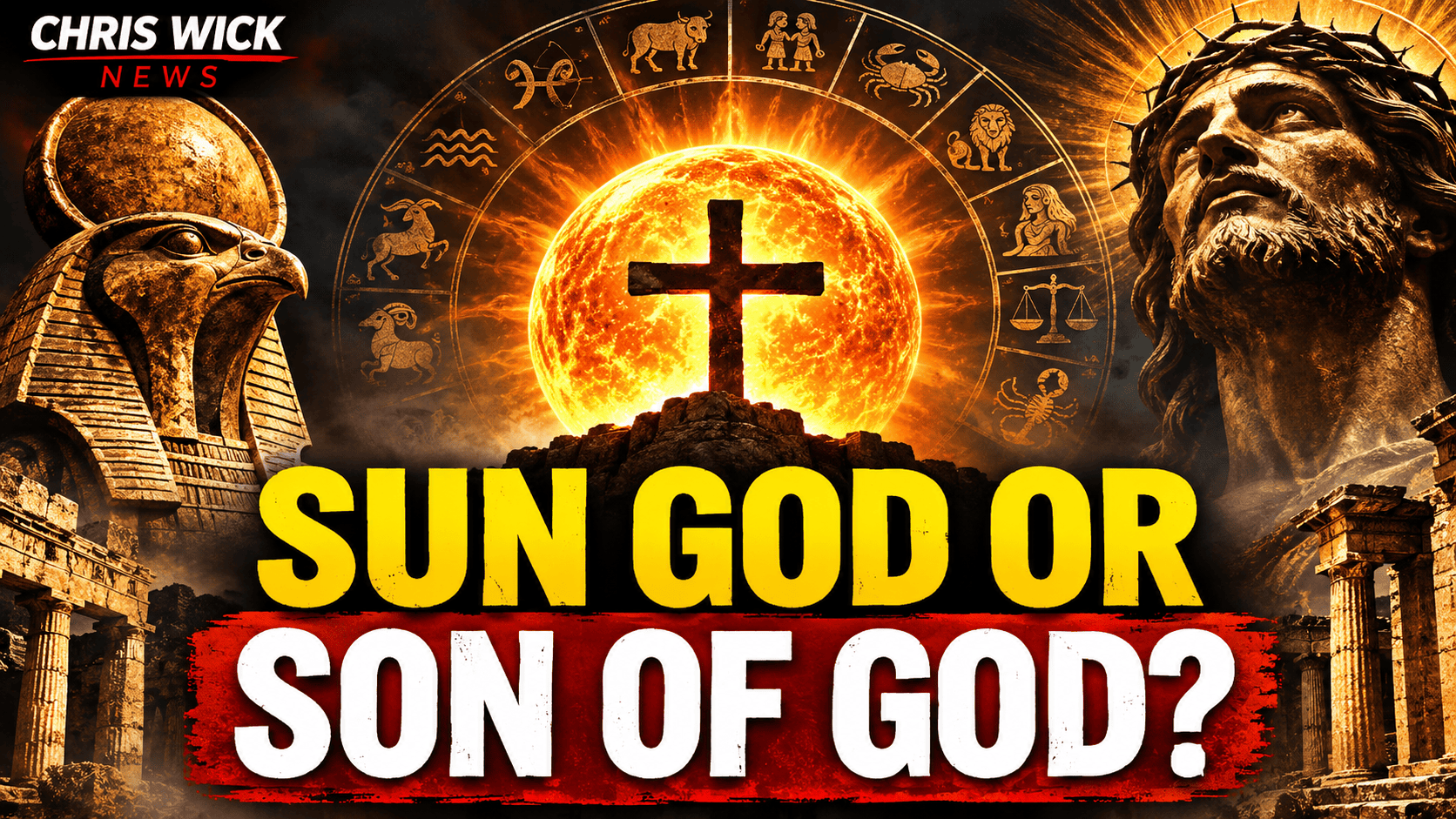
What if one of the world’s most powerful religious traditions carries symbols that are thousands of years older than Christianity itself? What if the sun, the zodiac, and the changing seasons hold clues to how humanity came to understand God?
For decades, controversial researcher Jordan Maxwell challenged audiences to look beyond church walls and examine the sky.
His central argument was explosive: Christianity was not simply a religion influenced by ancient sun worship. He believed its central stories were astronomical allegories, transformed over centuries into religious doctrine.
The theory raises uncomfortable questions about history, religious authority, and the difference between faith and evidence.
But how much of Maxwell’s argument survives historical scrutiny?
Before Christianity, Humanity Worshipped the Sun
Long before the New Testament existed, ancient civilizations were already worshipping celestial gods.
In Egypt, Ra represented the sun’s divine power. In the Roman Empire, Sol Invictus—the Unconquered Sun—became an important religious figure.
The reasoning behind solar worship wasn’t difficult to understand.
Without sunlight, crops fail. Without warmth, life becomes harder to sustain. Every sunrise brings light after darkness.
For ancient people, the sun wasn’t merely something in the sky. It was a visible source of life.
Maxwell believed these observations eventually became the foundations of elaborate religious stories.
And he argued that Christianity inherited far more of this symbolism than most believers realize.
From Sun God to Son of God
One of Maxwell’s most recognizable arguments concerned the relationship between Jesus and the sun.
Christian scripture describes Jesus as the light of the world. Maxwell interpreted that language as evidence of an older solar allegory.
He also connected Jesus’ twelve apostles with the twelve zodiac signs, suggesting that the biblical story mirrored the sun’s annual journey through the heavens.
It’s a striking comparison.
But there is a historical complication.
The English words sun and son sound alike, whereas the ancient Greek words are different. And the twelve apostles have a strong alternative explanation within Judaism: the twelve tribes of Israel.
These distinctions matter because a compelling symbolic resemblance is not necessarily proof of historical borrowing.
December 25: The Birthday of the Sun?
Here’s where the historical connections become particularly fascinating.
In AD 274, Roman Emperor Aurelian promoted the cult of Sol Invictus. December 25 became associated with celebrating the Unconquered Sun.
Centuries of Christian tradition would also identify December 25 as the birthday of Jesus, although the New Testament provides no exact birth date.
Was this coincidence, cultural adaptation, or deliberate religious competition?
Historians continue debating the origins of the Christmas date. Some emphasize Roman solar festivals; others point to early Christian theological calculations.
What is clear is that Christianity developed in a Roman world already rich with solar imagery.
The Ancient Artwork That Changes the Conversation
Beneath St. Peter’s Basilica in Rome lies an extraordinary piece of early religious art.
A third-century mosaic depicts a radiant charioteer associated with the Roman sun god Sol, surrounded by imagery scholars connect to Christianity.
Researchers have interpreted the artwork as an example of solar imagery being adapted to represent Christ.
That is significant.
It provides tangible historical evidence that some early Christians incorporated imagery associated with the sun into representations of Jesus.
It does not, however, establish that Jesus was invented as a sun god.
That distinction separates documented religious history from Maxwell’s broader theory.
Was Religion Created to Control Humanity?
Maxwell went further than interpreting ancient symbols.
He questioned whether religious institutions had transformed humanity’s relationship with the natural world into systems of authority, obedience, and organized belief.
It’s an argument that deserves examination rather than automatic acceptance.
Religious institutions have certainly accumulated political and social power throughout history. But that fact alone cannot establish that Christianity was deliberately fabricated to control populations.
The earliest Christian movement emerged from Jewish religious traditions, and its writings reflect debates about messianic expectations, resurrection, salvation, and the identity of Jesus.
Any serious investigation must account for that history alongside possible solar influences.
Dark Final Thoughts: The Sun Was Real. But What About the Story?
Jordan Maxwell’s greatest challenge was not simply his claim that Christianity originated in sun worship.
It was his insistence that people examine religious claims instead of accepting interpretations solely because an authority figure declared them sacred.
The sun existed before churches, priests, scriptures, and religious institutions.
Ancient civilizations built spiritual traditions around its power. Some of that symbolism undeniably entered Christian art and language.
But the evidence does not establish that Christianity is entirely disguised sun worship.
The deeper question remains: How much of what humanity calls divine revelation reflects something beyond human understanding—and how much reflects human beings interpreting the world around them?
Perhaps the most unsettling possibility is not that every religious story is false.
It’s that millions of people may never have been encouraged to distinguish what history can demonstrate from what faith asks them to believe.
And those are two very different things.
Verified sources
- Project Camelot — Jordan Maxwell conference transcript — Maxwell’s own explanation of Jesus, the sun, and the zodiac.
- Harvard Theological Review — Early Christian adaptation of Roman divine imagery — Scholarly analysis of the Christ-as-Sol mosaic and solar symbolism.
- National Geographic — Christmas and ancient Roman solar festivals — Historical debate surrounding December 25.
- Bible.org — Jesus and the Twelve — The Jewish significance of twelve and the tribes of Israel.
About the Author