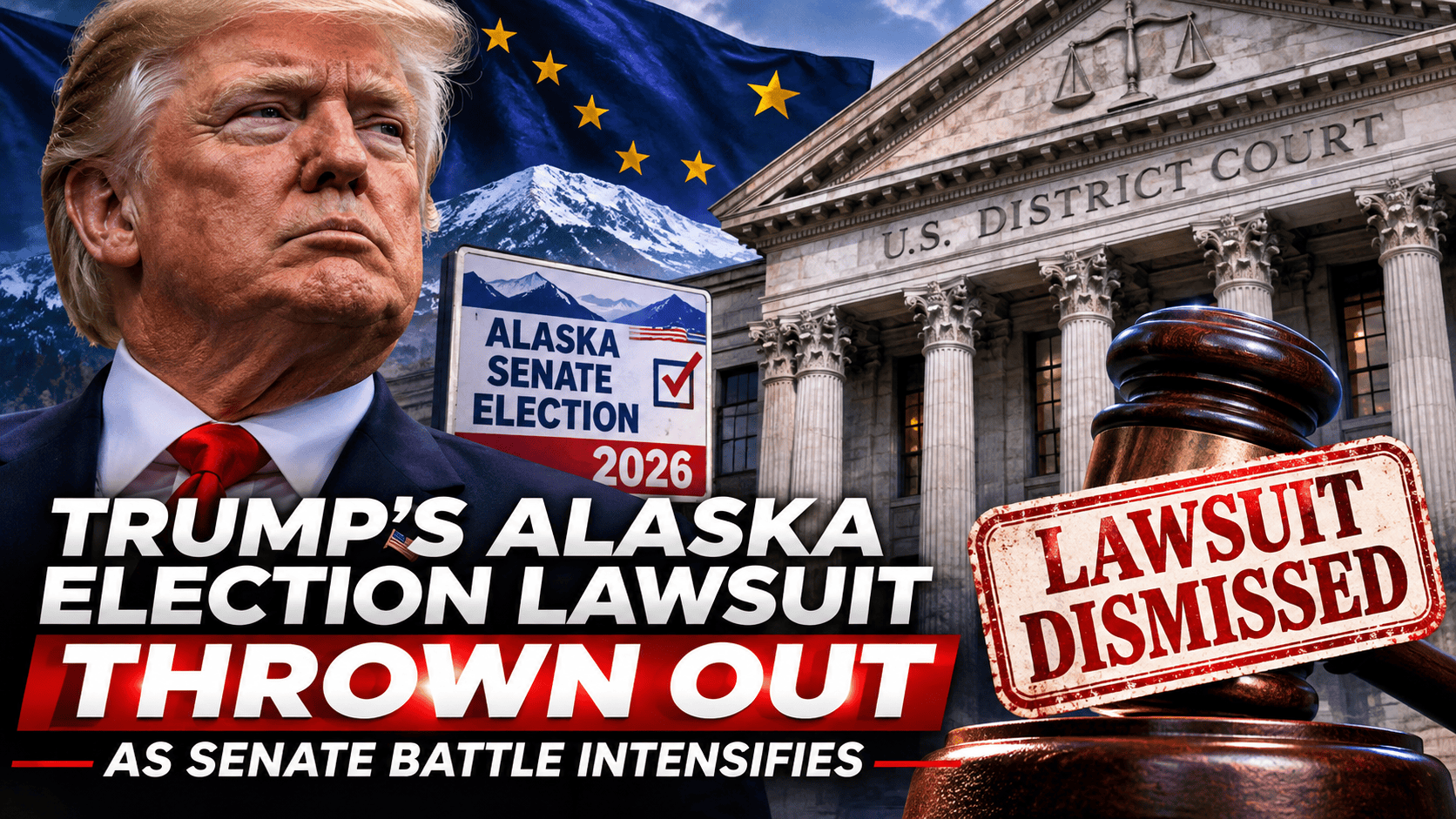
A federal judge has rejected the Trump administration’s attempt to block certification of a potentially unfavorable Alaska Senate election result. But behind the courtroom defeat lies a troubling question: Who gets to decide when an election is legitimate?
With America’s November 3 midterm elections approaching, the fight for control of Washington has taken another controversial turn.
On Sunday, November 1, U.S. District Judge Sharon Gleason dismissed a Justice Department lawsuit seeking to prevent Alaska from certifying its Senate election results under certain circumstances if Republican incumbent Dan Sullivan loses.
The administration argued that voters could be confused by another candidate sharing Sullivan’s name.
The court rejected the federal government’s legal challenge, delivering a significant setback to President Donald Trump’s attempt to intervene in a closely watched Senate contest.
But the controversy surrounding the election is far from over.
Two Candidates, One Name, and Serious Allegations
Republican Senator Dan S. Sullivan faces a competitive challenge from Democratic former Representative Mary Peltola.
However, another candidate, Daniel J. Sullivan Jr., is also appearing on the ballot.
The retired teacher’s candidacy has triggered allegations that Democratic political operatives recruited him to confuse voters and potentially divert support from the Republican incumbent.
______________________________________________
🔴 Help keep this independent voice alive and uncensored.
Support independent journalism and help keep Chris Wick News going.
👉 Support Chris Wick on GoFundMe
The New York Times reported that Democratic campaign operatives were involved in recruiting the second Sullivan.
Peltola’s campaign has denied involvement, while Daniel J. Sullivan Jr. maintains that his candidacy is legitimate.
Federal prosecutors have opened a separate criminal investigation into the allegations.
That investigation remains distinct from the dismissed civil lawsuit.
The allegations deserve examination, but political suspicions and reported campaign tactics do not automatically establish criminal wrongdoing.
The Judge Draws a Line
The Justice Department wanted Alaska to delay certification if votes cast for the second Sullivan could have changed the election’s outcome.
Judge Gleason rejected the attempt.
According to Associated Press reporting, the judge determined that the proposed investigation into individual voter intentions was impractical and raised serious concerns about ballot secrecy.
Alaska officials had also argued that the state’s election procedures already distinguished the candidates.
The Republican incumbent is identified on the ballot, while the other Sullivan appears without a party designation.
Alaska’s ranked-choice voting system also permits voters to rank both candidates.
The legal dispute therefore raised questions extending beyond possible voter confusion.
Could Washington intervene in a state-administered election based on speculation about how voters intended to cast their ballots?
The federal court’s dismissal represents a significant rejection of that approach.
Even Republicans Are Questioning Washington’s Intervention
The administration’s lawsuit has attracted criticism from both sides of the political divide.
Republican Senator Lisa Murkowski publicly opposed the Justice Department’s decision to pursue the case.
Meanwhile, Alaska’s Republican-led state government argued that the federal lawsuit lacked a legitimate legal foundation.
That opposition is particularly significant.
This was not simply a confrontation between Democrats and Republicans.
It was also a dispute between federal political power and the authority of state election officials.
The administration maintains that stronger oversight is necessary to protect election integrity.
Critics argue that attempting to stop certification only when a particular candidate loses risks turning election oversight into a partisan instrument.
Final Thought: Election Integrity Cannot Depend on Who Wins
Americans have every right to demand investigations when credible evidence suggests election misconduct.
If political operatives deliberately manipulated an election through unlawful conduct, the public deserves accountability.
But protecting elections also means respecting lawful ballots, constitutional boundaries, and the authority of state election officials.
The dismissal does not resolve every allegation surrounding Alaska’s Senate race.
Nor does it establish that everyone involved acted appropriately.
It does establish that the administration’s attempt to obtain this particular federal intervention failed.
And as Americans prepare to vote, one question remains impossible to ignore:
If election integrity matters only when your preferred candidate loses, is it really election integrity you’re defending — or political power?
Sources
- Reuters — US Judge Dismisses Trump Election Lawsuit in Alaska
- Associated Press — Judge Dismisses Lawsuit Seeking to Block Alaska Senate Election Certification
- Reuters — Trump Administration Accelerates Criminal Probe Into Alaska Senate Race
- Alaska Public Media — State Says Justice Department Lawsuit Has No Legal Basis