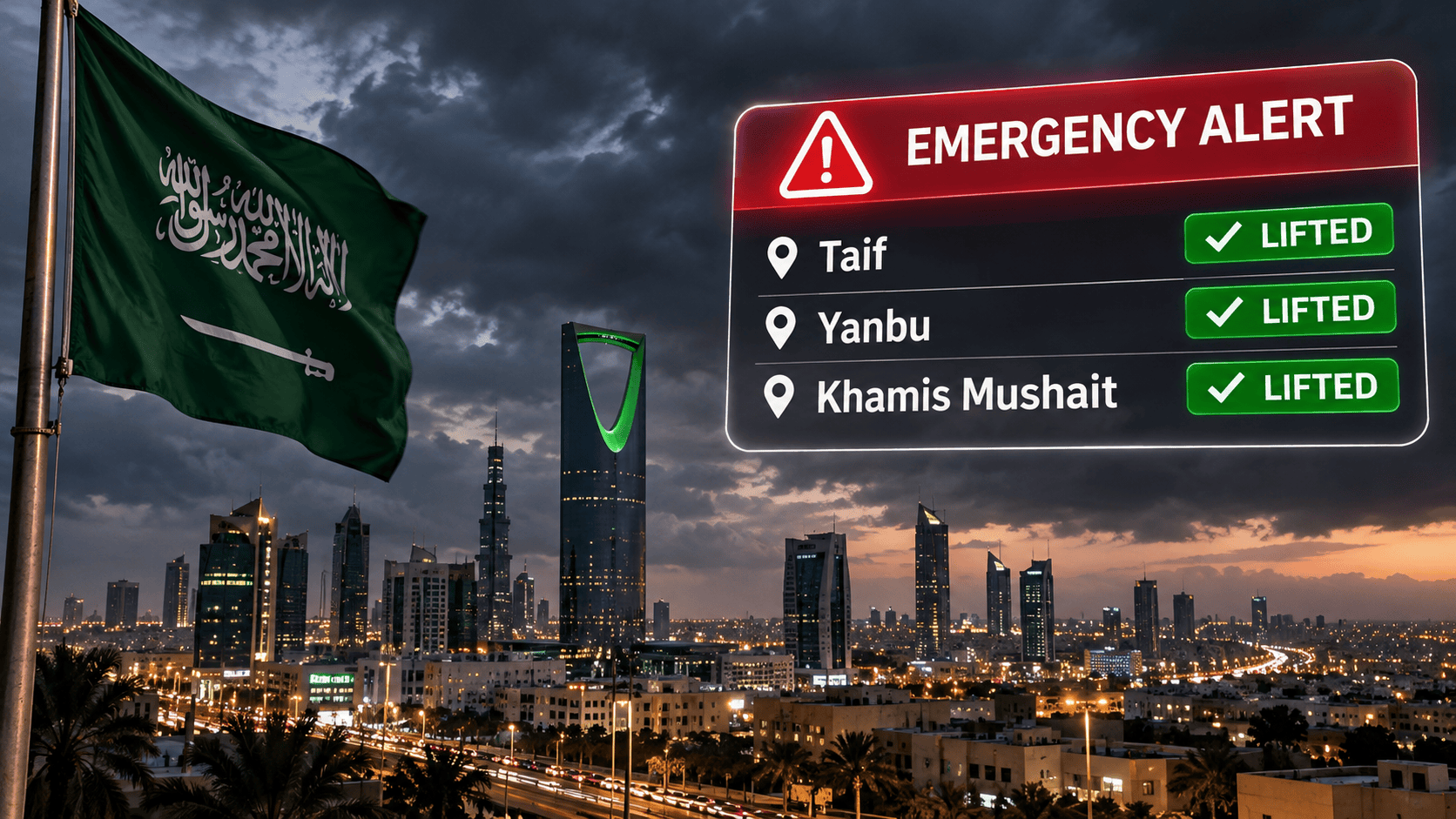
Emergency warnings were issued across three locations in Saudi Arabia before authorities abruptly declared the danger had passed. But what triggered the alerts in the first place?
Saudi Arabia’s Civil Defence has lifted emergency alerts in Taif, Yanbu and Khamis Mushait, just minutes after warnings were issued through the kingdom’s National Early Warning Platform.
Authorities announced that the danger in all three locations had passed, bringing the immediate alert period to an end.
What remains unclear is precisely what prompted the warnings, whether a specific threat had been identified, and why the all-clear followed so quickly.
Three Locations, One Sudden Warning
The alerts affected three geographically separate locations in Saudi Arabia, raising questions about the circumstances that prompted the warnings.
Taif lies in western Saudi Arabia, near the mountainous region surrounding Mecca. Yanbu is a Red Sea port city with significant industrial and energy infrastructure. Khamis Mushait, farther south, is an important urban centre near Abha.
The distance between these locations makes the simultaneous appearance of emergency warnings particularly noteworthy.
However, the issuance of alerts across multiple locations does not, by itself, establish that the warnings were connected to a coordinated attack or a single security incident.
The National Early Warning Platform is designed to communicate urgent safety information to the public. Such systems can be activated in response to different types of emergencies, including security threats and natural hazards.
The All-Clear Came Within Minutes
According to the reported Civil Defence announcement, the emergency warnings were withdrawn within minutes of being issued.
That rapid reversal raises an obvious question: what changed?
Authorities may have determined that an identified danger was no longer present, or that an initial warning no longer required public precautions. But without a detailed explanation, neither possibility can be established as the reason for this particular incident.
There is also no verified information in the supplied report establishing that explosions occurred, missiles were launched, or defensive systems were activated.
Those distinctions matter.
In a region where security developments can attract immediate international attention, speculation can spread much faster than official information.
And when public warnings appear and disappear within minutes, the absence of an explanation can leave people searching for answers.
Public Safety Depends on More Than an All-Clear
Emergency warning systems serve a critical purpose. They give authorities a way to reach large numbers of people quickly when circumstances demand immediate attention.
But public confidence also depends on understanding what those warnings mean.
A notification that danger has passed is reassuring. An explanation of what created that danger would provide considerably more clarity.
For residents of Taif, Yanbu and Khamis Mushait, the immediate message from Saudi Civil Defence was that the emergency alerts were no longer in effect.
For everyone watching the situation unfold, the unanswered question remains the same: what prompted authorities to issue warnings across three separate locations in the first place?
Until additional official information emerges, the responsible conclusion is straightforward: the alerts were issued, the alerts were lifted, and the underlying cause remains unconfirmed.
That may be less dramatic than the speculation circulating around any sudden emergency warning, but it is the distinction between reporting what happened and inventing an explanation.
Sources
- Initial report supplied for this article: Saudi Civil Defence announcement concerning Taif, Yanbu and Khamis Mushait. The exact three-location announcement could not be independently verified.
- Reuters — Saudi coalition reports missile interceptions, November 10
- Anadolu Agency — Earlier emergency alerts, November 2
- Editorial verification note: Reuters confirmed recent missile interceptions and separate Saudi emergency alerts, but those reports do not independently establish the cause of the specific three-location alert described here. The article deliberately avoids attributing it to an attack without confirmation.