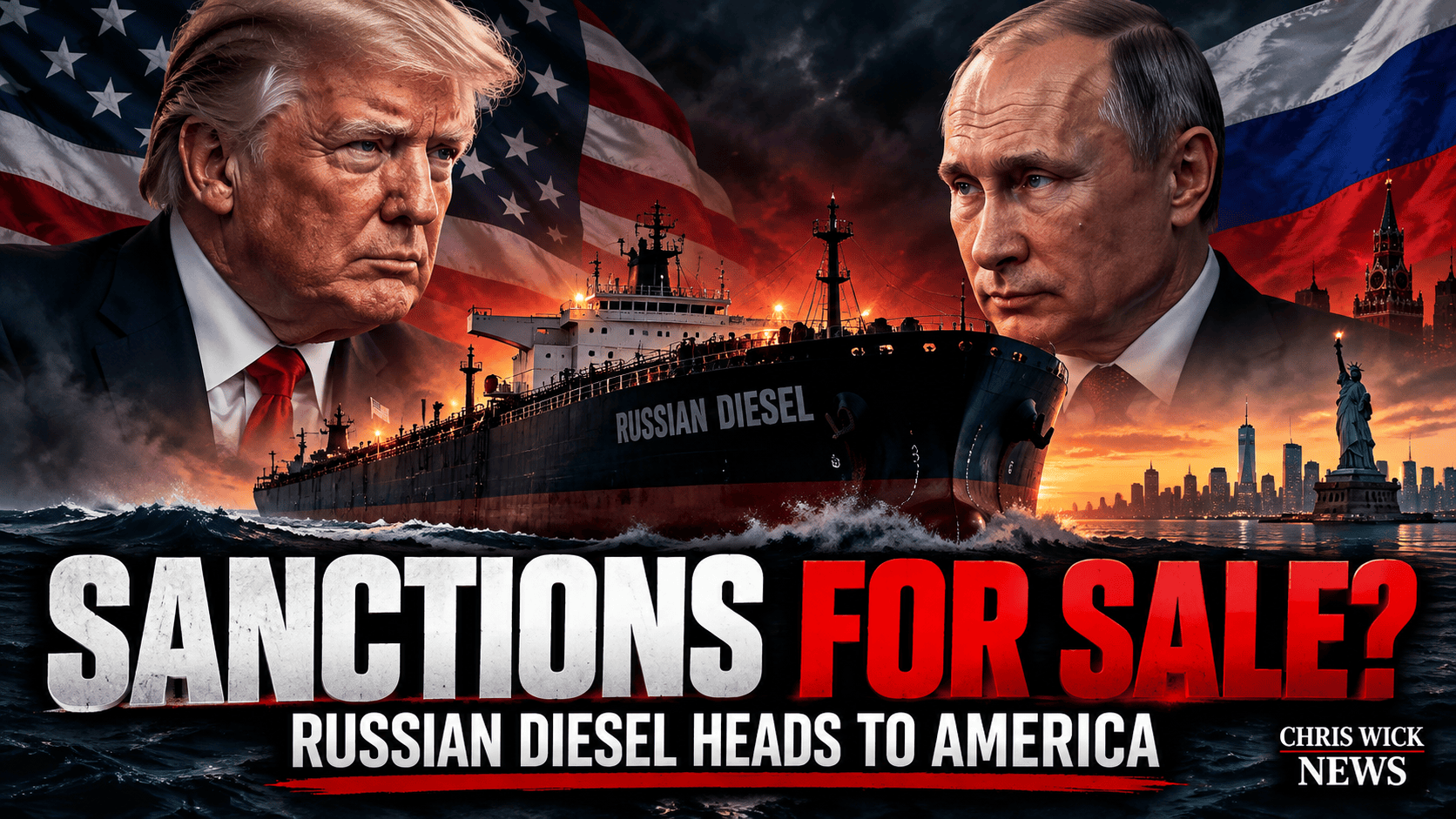
Washington spent years treating Russian oil as a political weapon. Now a tanker loaded with Russian diesel is heading toward New York. The sanctions haven’t disappeared, the war hasn’t ended, but the rules are changing when America’s fuel prices become a political emergency.
The Tanker That Exposes Washington’s Energy Contradiction
A tanker carrying 40,000 metric tons of Russian diesel is making its way toward New York.
Not secretly. Not through some mysterious backdoor operation.
Through an agreement between U.S. President Donald Trump and Russian President Vladimir Putin.
According to Reuters, the Malta-flagged tanker Agioi Fanendes loaded its cargo at Russia’s Baltic port of Primorsk on October 22. Its expected arrival in the United States is November 7.
That would mark the first American import of Russian petroleum products since Washington imposed its ban in 2022.
Think about that for a moment.
For years, Americans were told that restricting Russian energy was essential to confronting Moscow over its war in Ukraine.
Now Washington is preparing to receive Russian diesel while that same conflict remains unresolved.
______________________________________________
🔴 Help keep this independent voice alive and uncensored.
Support independent journalism and help keep Chris Wick News going.
👉 Support Chris Wick on GoFundMe
The political contradiction is impossible to ignore.
And the timing raises even bigger questions.
The Midterm Elections Are Approaching — And Diesel Prices Are Hurting
The United States holds its midterm elections on November 3.
The Russian tanker is expected to arrive four days later.
Trump announced the diesel agreement on October 9 as his administration sought relief from soaring fuel costs.
Under the arrangement, Russia agreed to release substantial quantities of diesel into international markets, including the United States.
The announced volumes include:
- 300,000 metric tons initially.
- Another 500,000 metric tons in November.
- An additional 1 million metric tons afterward.
These are significant volumes, although the agreement does not mean every barrel will end up in American fuel tanks.
Trump has also eased portions of American sanctions restrictions against Russia as part of his broader efforts to address energy prices.
Here is the uncomfortable political reality.
When diesel becomes expensive, everything becomes more expensive.
Trucks transport groceries. Farmers depend on fuel. Construction companies operate heavy machinery. Shipping businesses move the products that keep the economy functioning.
Higher transportation costs can spread through the economy long before consumers understand why their household budgets are being squeezed.
And when voters begin blaming political leaders for those costs, energy policy suddenly becomes an urgent election issue.
Yesterday’s Economic Enemy Becomes Today’s Fuel Supplier
The deeper story is not simply about a tanker.
It is about how quickly economic principles can change when political pressure becomes unbearable.
Russia has faced sweeping Western sanctions since its full-scale invasion of Ukraine in February 2022.
The United States prohibited Russian oil and petroleum imports. The European Union later imposed its own embargo on Russian refined petroleum products.
These restrictions were intended to reduce Moscow’s energy revenues and increase the economic consequences of its military campaign.
Yet the Trump administration is now permitting Russian diesel imports under a new arrangement.
That does not automatically mean the entire sanctions system has collapsed.
It does, however, demonstrate that sanctions are political instruments, not permanent laws of nature.
Governments can tighten them, loosen them, expand exemptions or change their priorities when circumstances demand it.
And that raises a legitimate question.
If Russian energy was too dangerous to purchase yesterday, what changed today — other than the political cost of expensive fuel?
Putin Gains More Than Another Customer
Russia also has reasons to welcome the agreement.
Deputy Prime Minister Alexander Novak has indicated that Moscow intends to increase diesel exports toward its previous levels of approximately 3 million to 3.5 million metric tons monthly by the end of the year.
That would help restore Russian participation in international fuel markets.
Since Europe’s embargo took effect, Russia has redirected significant diesel exports toward countries including Brazil and Turkey.
A renewed opening to American buyers carries economic and diplomatic significance.
For Moscow, the agreement offers an opportunity to demonstrate that Western efforts to isolate Russian energy have limits.
It also creates another channel of cooperation between Washington and Moscow at a time when their relationship remains deeply complicated by Ukraine.
But an important distinction must be made.
The existence of this deal does not establish that Russia has secured broader sanctions relief, nor does it prove that Moscow will obtain major diplomatic concessions over Ukraine.
Those outcomes remain uncertain.
What is already clear is that the two governments have found common ground when energy prices are involved.
Will Americans Actually See Cheaper Diesel?
That is the question that matters most to ordinary Americans.
Political leaders can announce enormous supply agreements.
They can celebrate new trade arrangements and claim they are bringing relief to struggling families.
But announcements do not automatically translate into lower prices at the pump.
Diesel prices are influenced by global crude oil markets, refining capacity, transportation expenses, inventories, regional supply conditions and geopolitical disruptions.
A single 40,000-ton shipment cannot independently transform the American fuel market.
Even larger Russian exports would need to be evaluated against global demand and other disruptions affecting petroleum supplies.
The agreement could help ease some supply pressure, particularly if substantial volumes reach international markets.
But there is no guarantee that American consumers will experience immediate or meaningful savings.
And with the first tanker scheduled to arrive after Election Day, its physical delivery cannot provide direct fuel supplies to American motorists before they vote.
That makes the political messaging surrounding the agreement especially important.
The Ukraine Question Washington Cannot Escape
There is another side to this story.
Ukraine continues to fight a war against Russia.
Its government and European allies have relied heavily on Western economic pressure as part of their strategy to weaken Moscow’s ability to sustain the conflict.
Any easing of restrictions on Russian energy therefore raises difficult questions about Western unity.
Does buying Russian diesel weaken the economic pressure Washington previously considered essential?
Could expanded energy trade eventually provide Moscow with additional revenue?
And what message does this send to European governments that have spent years restructuring their energy relationships to reduce dependence on Russia?
Those are serious questions, not automatic conclusions.
Energy trade and diplomacy are complicated. Governments frequently make uncomfortable compromises to protect domestic economic interests.
But compromises deserve public scrutiny, especially when they involve countries engaged in ongoing wars.
Americans deserve to understand the terms, consequences and long-term objectives of this arrangement.
The Bottom Line: Energy Politics Has No Permanent Friends
A Russian tanker is crossing the Atlantic toward the United States.
Its cargo is diesel.
Its significance is much larger.
The shipment illustrates how energy security, election politics, sanctions and international diplomacy can collide when economic pressure intensifies.
Trump wants lower fuel prices.
Putin wants greater access to international energy markets.
Both governments have reasons to pursue an agreement.
But ordinary Americans are entitled to ask whether the deal will genuinely reduce their costs or simply produce another political headline.
They are also entitled to ask what the agreement means for the sanctions imposed after Russia invaded Ukraine.
Because the real story is not that America needs diesel.
The real story is that Washington’s position on Russian energy has changed dramatically when domestic political and economic pressures demand a different approach.
Yesterday, Russian oil was something America had to reject. Today, Russian diesel is sailing toward New York.
And that leaves one final question:
Are sanctions really about unshakable principles — or do those principles become negotiable when the political price gets too high?
Chris Wick News | Independent Journalism. Unfiltered Questions.
Sources
Reuters — First Russian diesel from Putin-Trump deal heading for US, data shows (October 23, 2026)