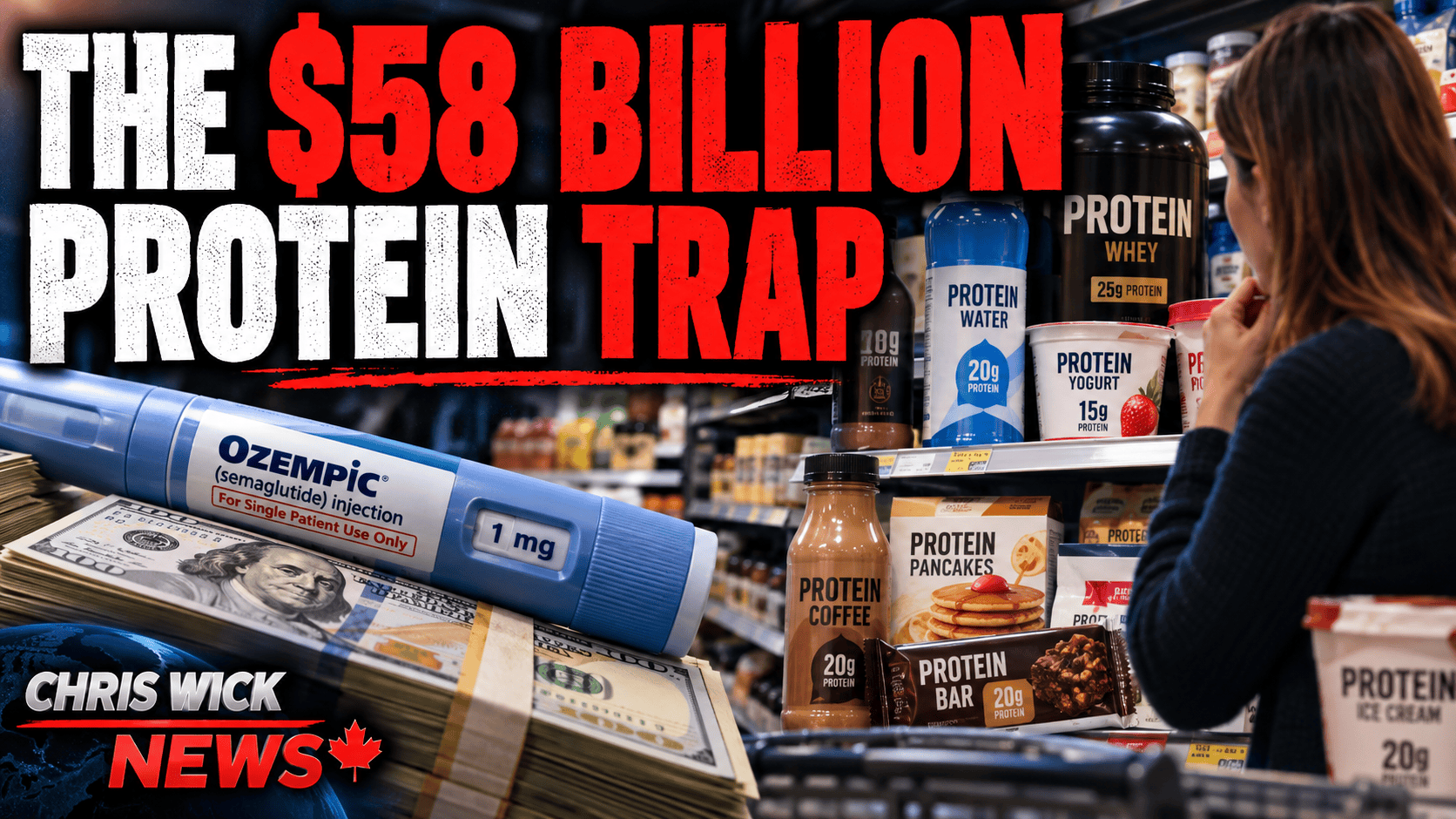
First, they sold us processed food. Then came the weight-loss revolution. Now corporations are selling us protein-packed versions of almost everything. But are consumers getting healthier—or simply paying more for another carefully marketed promise?
The Next Billion-Dollar Health Craze Has Arrived
Walk through almost any major supermarket today, and something becomes painfully obvious.
Protein is everywhere.
Protein water. Protein coffee. Protein ice cream. Protein pancakes. Protein-packed snacks promising better health, stronger muscles and a healthier future.
What used to be an ordinary nutrient found in everyday foods has become one of the hottest marketing weapons in the global food industry.
And behind this transformation sits another booming business: prescription weight-loss medications.
Drugs such as Ozempic, Wegovy and Mounjaro are reshaping how millions of people eat. Their appetite-suppressing effects are changing consumer spending habits, creating enormous opportunities for companies eager to sell specialized nutritional products.
According to Reuters reporting published October 23, 2026, the worldwide protein-enriched food market was estimated at nearly $58 billion in 2025.
That is the estimated market value, not corporate profit. But it illustrates the enormous commercial opportunity.
______________________________________________
🔴 Help keep this independent voice alive and uncensored.
Support independent journalism and help keep Chris Wick News going.
👉 Support Chris Wick on GoFundMe
And the companies selling these products are only getting started.
The question Canadians should be asking is simple:
Are we witnessing a genuine nutritional revolution—or another expensive corporate marketing campaign dressed up as a public health breakthrough?
The Ozempic Effect: When Eating Less Creates a New Market
Weight-loss medications have demonstrated significant benefits for many people struggling with obesity and diabetes.
But there is a complication.
When people lose substantial amounts of weight, some of that weight can come from muscle rather than body fat.
Maintaining adequate protein intake and physical activity can help protect muscle during weight loss.
Food manufacturers have recognized the opportunity.
An August survey from Boston Consulting Group found that people taking GLP-1 medications expected to spend approximately 11% more on high-protein foods than before starting treatment.
Think about that.
A pharmaceutical industry produces medications that change eating habits.
Those changes create new nutritional concerns.
And the food industry responds by developing specialized products to sell to the same consumers.
There is nothing inherently wrong with that business model. Some patients genuinely benefit from convenient, protein-rich foods.
But the commercial incentives deserve scrutiny.
Because once a health concern becomes profitable, marketing can begin to overshadow the actual nutritional needs of consumers.
The Protein Label Game: Are Consumers Being Misled?
Here is where the story becomes particularly troubling.
Reuters identified products advertising impressive protein quantities while using serving sizes substantially larger than those found on conventional versions of similar products.
Consider Nature Valley granola.
Its protein-enhanced oats-and-honey granola advertises 13 grams of protein using a 65-gram serving.
The conventional version uses a 27-gram serving.
That means the advertised serving for the protein product is more than twice as large.
General Mills explained that the products are intended for different eating occasions, with the protein version potentially serving as a more complete cereal meal.
That explanation may be reasonable.
But the comparison raises an important issue.
When shoppers see a large protein number printed across a package, are they getting a meaningful nutritional comparison?
Or are they comparing completely different portion sizes?
A larger serving can naturally contain more protein without necessarily delivering better nutritional value per calorie.
Consumers should not need a calculator to determine whether a supposedly healthier product is actually worth buying.
Canadians Are Already Paying Enough for Groceries
For Canadians struggling with grocery costs, this growing obsession with specialized protein products deserves attention.
Families are already watching the price of eggs, meat, dairy products and other essentials.
Now manufacturers are introducing premium products that promise nutritional advantages over ordinary food.
But consider what people have been eating for generations.
Eggs contain protein.
Chicken contains protein.
Beef, fish, yogurt, cottage cheese, beans and lentils contain protein.
These foods can provide substantial nutritional value without requiring expensive branding or elaborate formulations.
That does not mean every fortified product is worthless.
Protein shakes and convenient meal replacements can be useful, particularly for people with reduced appetites or specific nutritional requirements.
But convenience should not be confused with necessity.
And marketing should never replace honest nutritional information.
For Canadians living on fixed incomes, the difference matters.
Even Consumers Are Beginning to Question the Hype
The food industry may have underestimated something.
Consumers are becoming more skeptical.
Research from NielsenIQ found that approximately 25% of surveyed consumers reported using scanning applications to examine the nutritional value of products, compared with roughly 17% previously.
More than one-third believed the industry was exaggerating the importance of protein.
Another 37% believed certain products contained excessive amounts.
Those findings suggest that shoppers are beginning to look beyond flashy packaging.
They are checking ingredients.
They are comparing nutritional labels.
And they are questioning whether protein-enriched products actually justify their prices.
That is a healthy development.
Because the words “high protein” do not automatically mean low sugar, low calorie, minimally processed or nutritionally balanced.
A candy bar with added protein is still a product whose complete nutritional profile matters.
The Corporate Food Machine Is Changing Its Strategy
Some manufacturers are already responding to growing consumer skepticism.
Danone is exploring products that combine protein with other nutrients, including fibre.
Hormel Foods has expressed caution about relying too heavily on additional protein ingredients and engineered protein isolates.
Meanwhile, major retailers and manufacturers continue expanding their protein-focused offerings.
Reuters reported that Aldi was introducing protein pancakes, while Walmart planned to offer protein-infused Folgers instant coffee during a limited promotional period.
The industry is experimenting with ways to put protein into almost everything.
But there is a fundamental question that deserves more attention.
Does adding protein automatically improve a product—or simply make it easier to sell at a premium?
The answer depends on the ingredients, nutritional composition, serving size and individual consumer needs.
That is not nearly as exciting as a giant marketing slogan.
But it is far more useful.
The Real Danger Is Confusing Marketing With Medicine
Protein is essential.
It supports muscle maintenance, tissue repair and many other bodily functions.
For some people, especially older adults and individuals losing significant weight, adequate protein intake deserves particular attention.
But more is not automatically better.
Individual requirements depend on factors such as body weight, age, activity level, health conditions and overall dietary intake.
A person taking a GLP-1 medication may benefit from professional nutritional guidance rather than simply purchasing whatever high-protein product happens to dominate supermarket advertising.
And consumers should understand that protein content is only one part of nutritional quality.
Calories matter.
Sugar matters.
Fibre matters.
Overall dietary patterns matter.
The food industry has every right to compete for customers.
But consumers have an equally important right to question the promises being made.
The $58 Billion Question: Who Really Benefits?
There is a larger issue beneath this protein boom.
Modern consumers are constantly being presented with new solutions to old problems.
One year, the answer is low fat.
Another year, it is low carbohydrate.
Then come superfoods, detox products, fortified snacks and increasingly specialized nutritional formulas.
Some trends are supported by legitimate science.
Others are driven heavily by marketing.
The challenge is distinguishing between the two.
The global protein boom illustrates how quickly an emerging medical treatment can reshape entire consumer markets.
Pharmaceutical companies develop new therapies.
Food companies adapt their products.
Retailers dedicate more shelf space.
Advertising campaigns create excitement.
And consumers are left trying to determine which products genuinely improve their health.
None of this establishes a conspiracy.
It demonstrates how commercial incentives can shape the way health and nutrition are presented to the public.
And those incentives deserve careful examination.
The Bottom Line: Don’t Buy the Promise. Read the Label.
The protein revolution is not necessarily a bad thing.
Greater awareness of nutrition can help people make better dietary decisions.
Convenient protein-rich products can serve legitimate purposes.
But Canadians should be cautious about assuming that expensive fortified foods are automatically healthier than ordinary alternatives.
A large protein number on a package is not a guarantee of nutritional quality.
A premium price is not proof of superior ingredients.
And a marketing campaign is not a substitute for medical or dietary advice.
The companies competing for a share of the nearly $58 billion global protein-enriched food market have enormous financial incentives to keep consumers interested.
But shoppers have something equally powerful.
The ability to question what they are being sold.
Because when corporations turn nutrition into another gold rush, the smartest thing consumers can do is stop buying the hype and start demanding the facts.
What do you think? Are protein-enriched products genuinely improving our diets, or are food companies turning another health trend into an expensive marketing opportunity?
Sources
1. Reuters — Weight-loss drugs fuel protein boom, but with more consumer scrutiny (October 23, 2026)