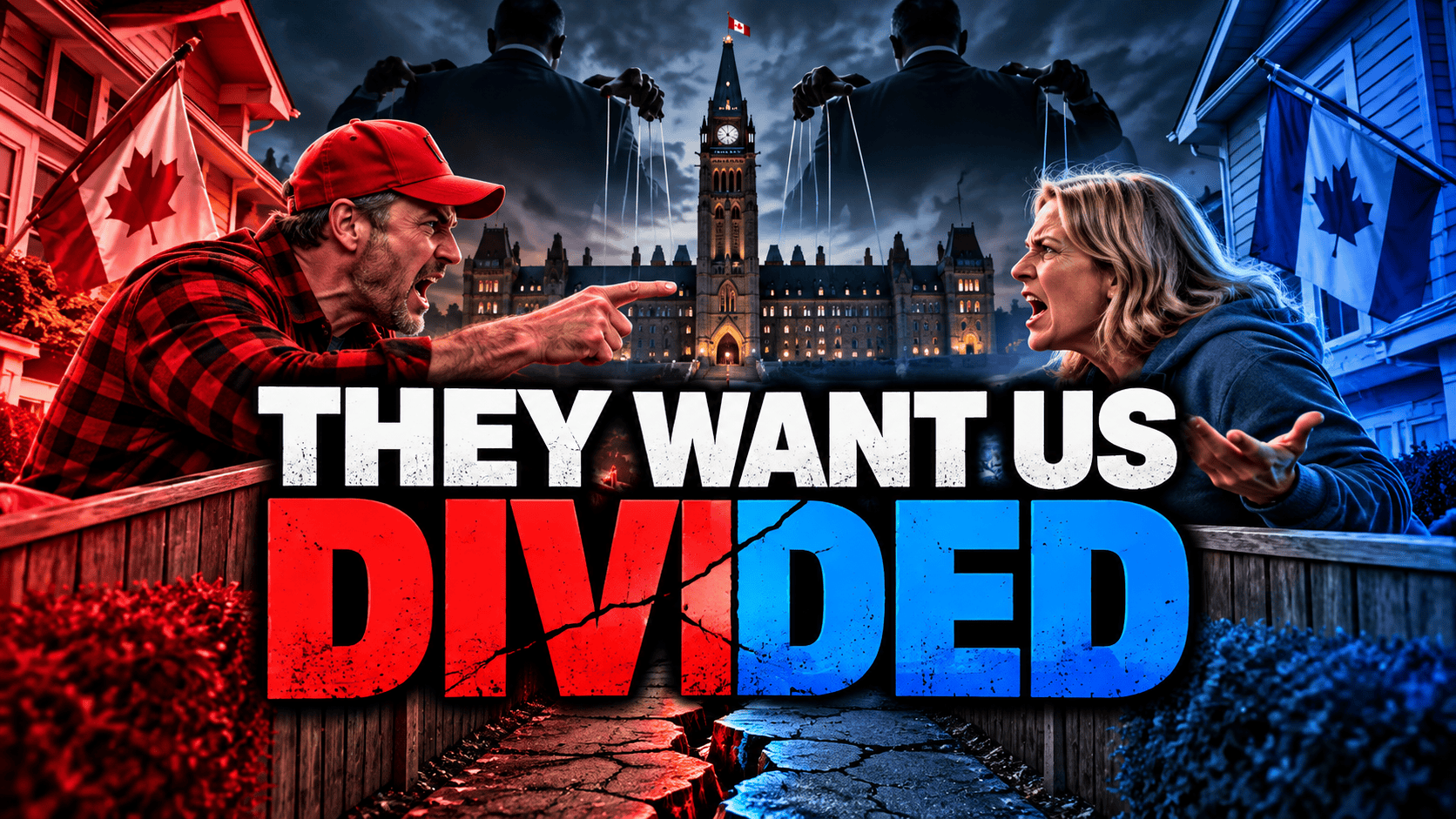
First, they convinced you that the person next door was the problem.
Not the rising bills.
Not the promises that never seem to materialize.
Not the institutions that demand public trust while struggling to maintain it.
No. The enemy, apparently, is your neighbour.
The person who votes differently. The person who watches another news channel. The person who believes something you don’t.
And somewhere in the noise, a question gets buried:
Who benefits when ordinary people spend more time fighting each other than demanding answers from those in power?
The Political Divide Has Become a Battlefield
Left versus right.
______________________________________________
🔴 Help keep this independent voice alive and uncensored.
Support independent journalism and help keep Chris Wick News going.
👉 Support Chris Wick on GoFundMe
Liberal versus conservative.
Red versus blue.
Every disagreement becomes another battle. Every headline becomes another reason to pick a side. Every political argument risks turning friends, families, and communities against one another.
But here’s what makes this especially troubling.
While people argue about which political team deserves their loyalty, many of the everyday problems they face remain unresolved.
Housing affordability. Grocery prices. Healthcare access. Government spending. Public accountability.
These problems do not disappear because one side wins an argument on social media.
And they certainly do not become easier to solve when disagreement turns into personal hatred.
The question is whether political conflict is helping citizens demand better government — or simply consuming the energy they could use to demand results.
Division Is More Than a Political Problem. It’s an Attention Economy.
Anger attracts attention.
Outrage keeps conversations moving.
Conflict encourages people to return, respond, and share.
For media organizations, political commentators, online personalities, and digital platforms, public attention has economic value.
That does not mean every disagreement is manufactured or that every journalist or politician deliberately promotes division.
It does mean there are incentives worth examining.
A thoughtful discussion about healthcare reform may require patience, evidence, and compromise.
A furious argument over something a political opponent said can spread within minutes.
One demands careful thinking.
The other can generate instant emotional reactions.
When outrage becomes the product, the public deserves to ask whether understanding has become secondary to engagement.
Your Neighbour Isn’t Responsible for Every Broken Promise
Consider two ordinary Canadians.
One votes Liberal.
The other votes Conservative.
Both worry about paying the mortgage or rent.
Both see the cost of groceries.
Both want reliable healthcare, safe communities, and some confidence that tomorrow will be better than today.
They may disagree profoundly about how those goals should be achieved. Those disagreements matter, and they deserve serious debate.
But does either person benefit when that debate becomes personal hostility?
Does shouting at someone across the street lower the price of food?
Does insulting a stranger online shorten a hospital waiting list?
Does treating everyone with different political beliefs as an enemy make elected officials more accountable?
Political disagreement is necessary in a democracy. Personal hatred is not.
And confusing the two can make it harder to identify where responsibility actually belongs.
Who Benefits When the Public Stops Asking Questions?
There is no need to imagine a secret room where powerful people coordinate every political argument.
The reality is more complicated — and worth examining.
Political parties can benefit when supporters remain emotionally committed to their side.
Media businesses can benefit when controversial stories attract audiences.
Social media creators can benefit when heated exchanges generate engagement.
And public officials may face less sustained scrutiny when attention shifts away from measurable policy outcomes toward the latest partisan confrontation.
These are potential incentives, not proof of a coordinated conspiracy.
But the incentives raise a legitimate question:
When public anger is directed primarily at fellow citizens, who is still being held responsible for decisions made by people in authority?
Accountability Shouldn’t Depend on Political Colour
If a government promises affordable housing, citizens should be able to examine the results.
If politicians promise fiscal responsibility, the public should be able to inspect the spending.
If leaders promise better healthcare, voters should be able to evaluate what actually improved.
Those standards should not change because the person making the promise belongs to a preferred political party.
Loyalty to a party is a personal choice.
Accountability is a public responsibility.
A functioning democracy requires both disagreement and the willingness to examine evidence, challenge officials, and acknowledge failures — including failures by people we support.
Otherwise, political identity risks becoming more important than political performance.
The Most Uncomfortable Question of All
Imagine what public debate might look like if more people stopped asking which side had won the latest argument and started asking what had actually changed.
What was promised?
What was delivered?
What did it cost?
Who made the decision?
Who is responsible when it fails?
These questions do not belong exclusively to the left or the right.
They belong to everyone who pays taxes, follows the law, uses public services, and lives with the consequences of government decisions.
Your neighbour may disagree with you about nearly everything.
But that neighbour is not automatically your enemy.
And the next time a political controversy demands your outrage, consider asking one question before joining the fight:
Are we arguing about the people responsible for the problem — or have we become so busy fighting one another that we’ve stopped demanding an answer?
Chris Wick News — Independent commentary. No political team gets a free pass.
Sources and supporting research
The article is opinion commentary. These studies provide background evidence on political polarization and how divisive content attracts engagement.
- Pew Research Center — The Impact of Partisan Polarization (2023) https://www.pewresearch.org/wp-content/uploads/sites/20/2023/09/PP_2023.09.19_views-of-politics_REPORT.pdf
- PNAS Nexus — Engagement, User Satisfaction, and the Amplification of Divisive Content on Social Media (2025) https://doi.org/10.1093/pnasnexus/pgaf062
- Reuters — When Facebook Blocks News, Studies Show the Political Risks That Follow (2024) https://www.reuters.com/technology/when-facebook-blocks-news-studies-show-political-risks-that-follow-2024-04-14/