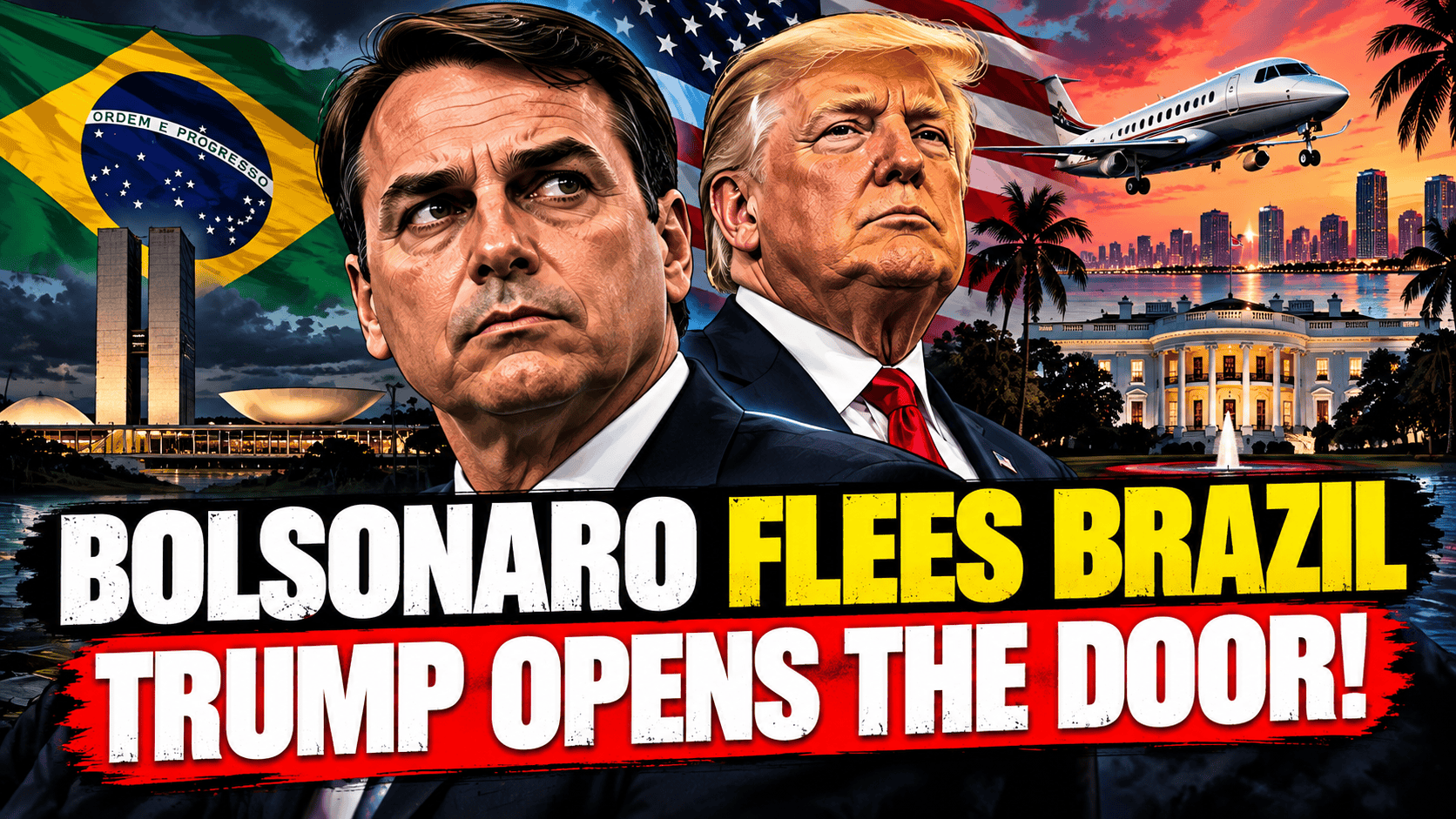
He lost the election. Refused to accept the result. Faced a court order to surrender his passports. Then, with help from political allies, Flávio Bolsonaro crossed international borders and landed in Donald Trump’s America. Now he claims to be Brazil’s rightful leader.
Brazil’s political crisis has taken an extraordinary international turn.
Senator Flávio Bolsonaro, the defeated right-wing presidential candidate and son of former President Jair Bolsonaro, arrived in Miami on October 28, 2026, after leaving Brazil under circumstances that have raised serious questions about judicial authority, political influence, and American involvement in another country’s domestic affairs.
The 45-year-old politician lost Brazil’s October 25 presidential runoff to incumbent President Luiz Inácio Lula da Silva by approximately 4.5 million votes.
Rather than concede defeat, Bolsonaro challenged the result and subsequently left the country despite a Brazilian Supreme Court order requiring him to surrender his passports.
The order was connected to an ongoing money-laundering investigation. Bolsonaro denies wrongdoing and maintains that he is being politically persecuted.
His departure was facilitated through a journey involving Argentina and Ecuador before he arrived in Florida aboard a private aircraft.
The Trump administration authorized entry visas for Bolsonaro and his family.
And once safely on American soil, Bolsonaro escalated the confrontation by declaring himself Brazil’s rightful leader.
______________________________________________
🔴 Help keep this independent voice alive and uncensored.
Support independent journalism and help keep Chris Wick News going.
👉 Support Chris Wick on GoFundMe
The result is a political spectacle that goes far beyond one defeated candidate refusing to accept an election.
It raises a much larger question: What happens when a powerful foreign government offers political refuge to a candidate challenging another country’s internationally recognized election result?
From Election Defeat to a Private Jet Bound for Miami
The sequence of events unfolded with remarkable speed.
On Sunday, October 25, Brazilian voters returned Lula to the presidency following a fiercely contested runoff election.
Bolsonaro, who had entered the contest with significant support from Brazil’s conservative movement, refused to accept the outcome.
He alleged that decisions by Brazil’s Supreme Court had improperly influenced the election.
However, those accusations have not been supported by credible evidence establishing widespread electoral fraud.
Brazilian electoral authorities recognized Lula’s victory, as did international observers and foreign governments.
Even Bolsonaro’s own political party accepted the result.
The situation deteriorated further when Brazil’s Supreme Court ordered Bolsonaro to surrender his passports.
The order related to an investigation into alleged financial misconduct, including money laundering.
Bolsonaro denies committing any crime.
But instead of complying with the passport order, he disappeared from public view.
By Tuesday evening, he and his family had crossed into Argentina.
From there, they boarded a private aircraft that traveled through Ecuador before continuing to Miami.
The journey ended Wednesday morning at Miami-Opa Locka Executive Airport.
Bolsonaro arrived with his wife and two daughters.
It was an extraordinary escape from an increasingly complicated political and legal situation.
And it immediately raised questions about who helped organize the departure.
Trump’s Administration Opens the Door
The United States government confirmed that Bolsonaro and his family would receive visas allowing them to enter the country.
President Donald Trump publicly indicated that he supported their arrival.
Bolsonaro also thanked Argentine President Javier Milei for helping him make the journey.
The involvement of two prominent conservative leaders gives the episode significance beyond Brazilian domestic politics.
Trump has maintained a close political relationship with the Bolsonaro family.
He has previously criticized the treatment of former President Jair Bolsonaro, who was convicted in Brazil of attempting to overturn the country’s democratic order.
The elder Bolsonaro was sentenced to more than 27 years in prison following proceedings related to the attempted coup after his 2022 election defeat.
Flávio Bolsonaro campaigned in part on the promise of freeing his father.
Now the younger Bolsonaro has followed a remarkably similar political path.
An election defeat.
Allegations of fraud.
A confrontation with Brazilian institutions.
And a journey to the United States.
But this time, the situation is complicated by an outstanding judicial order and an American administration openly sympathetic to the defeated candidate.
The United States has the authority to decide whom it admits. That does not eliminate the diplomatic consequences of admitting someone facing unresolved judicial proceedings abroad.
Bolsonaro Claims He Is Brazil’s Rightful Leader
After arriving in Miami, Bolsonaro issued a statement challenging the legitimacy of Lula’s victory.
He claimed that Brazil’s election had effectively been stolen through actions involving the Supreme Court and the president.
He also portrayed himself as the country’s legitimate political leader.
These are Bolsonaro’s allegations, not established facts.
The official election result remains in place.
Lula won the runoff by millions of votes, and independent observers have not substantiated Bolsonaro’s claims of widespread electoral fraud.
One of Bolsonaro’s central complaints concerned a Supreme Court decision extending voting hours.
But according to reporting on the election, the extension affected fewer than 35,000 ballots.
That number is dramatically smaller than Lula’s approximately 4.5-million-vote margin.
Even if every affected ballot had been cast for Bolsonaro, it would not have been enough to reverse the result.
This is an important distinction.
Political candidates have the right to question electoral procedures and pursue legitimate legal challenges.
But alleging that an election was stolen requires evidence capable of supporting that accusation.
Simply refusing to accept defeat does not invalidate millions of votes.
And receiving support from a foreign president does not confer electoral legitimacy.
Is This Political Persecution or Accountability?
Bolsonaro insists that the legal proceedings against him are politically motivated.
That claim deserves examination rather than automatic acceptance or dismissal.
Brazil has experienced intense political polarization, and disputes involving its judiciary have become a defining feature of the country’s recent political environment.
Critics of Brazil’s Supreme Court have accused certain judges of exercising excessive authority and becoming deeply involved in political controversies.
Supporters of the court argue that strong judicial action has been necessary to defend democratic institutions against attempts to undermine elections.
Both arguments concern legitimate questions about institutional power.
But the existence of political controversy does not establish that every investigation is illegitimate.
Bolsonaro faces allegations involving financial misconduct.
Those allegations must be evaluated through evidence and lawful judicial procedures.
He is entitled to defend himself and challenge the accusations.
He is also entitled to the presumption of innocence.
However, a politician’s claim of persecution does not automatically excuse noncompliance with a court order.
The real test is whether Brazil’s institutions can enforce the law fairly, transparently, and consistently, regardless of political affiliation.
That standard should apply to Lula, Bolsonaro, and every other political figure.
Why Washington’s Involvement Matters
The Trump administration’s decision to welcome Bolsonaro has created another potential source of tension between Washington and Brasília.
Lula has accused the United States of interfering in Brazil’s political affairs.
Washington denies improper interference.
The dispute arrives at a sensitive moment in relations between the two largest countries in the Americas.
Brazil is a major agricultural exporter, an important regional diplomatic power, and a significant participant in international organizations and emerging-market economic partnerships.
The United States has substantial commercial and strategic interests in maintaining relations with Brasília.
Those interests do not disappear because American and Brazilian leaders disagree politically.
But publicly supporting a defeated candidate who refuses to recognize an election creates diplomatic complications.
It can reinforce suspicions that Washington prefers ideological allies over established democratic outcomes.
At the same time, providing entry visas does not necessarily mean the United States has formally endorsed Bolsonaro’s claim to the presidency.
That distinction matters.
There is a difference between allowing a foreign political figure to enter the country and officially recognizing that person as another nation’s legitimate head of state.
Trump has not established Bolsonaro as Brazil’s president.
Lula remains the recognized winner of the election.
Nevertheless, the political symbolism is impossible to ignore.
The Bolsonaro Family’s Troubling Political Pattern
The similarities between Flávio Bolsonaro’s actions and those of his father are striking.
After losing Brazil’s 2022 election, Jair Bolsonaro also traveled to Florida.
His refusal to accept the election outcome helped fuel an atmosphere of confrontation between his supporters and Brazilian democratic institutions.
On January 8, 2023, Bolsonaro supporters stormed government buildings in Brasília.
The attacks targeted Brazil’s Congress, presidential palace, and Supreme Court.
Jair Bolsonaro was subsequently convicted in connection with an attempted coup.
His son has now lost another presidential election and departed for the United States while challenging the result.
That does not mean Flávio Bolsonaro has committed the same offences as his father.
Nor does it establish that another attempted coup is underway.
But the historical similarities are politically significant.
Brazil’s democratic institutions have already endured one major confrontation over a disputed election.
The country now faces another challenge involving the same political family.
The question is whether this confrontation remains a legal and diplomatic dispute or develops into a broader campaign against the legitimacy of Brazil’s elected government.
What Happens to Bolsonaro’s Legal Troubles?
Leaving Brazil does not automatically eliminate Bolsonaro’s legal obligations.
The investigations involving him remain unresolved.
His departure may also complicate his ability to defend himself through normal judicial proceedings.
Whether Brazilian authorities seek additional legal measures will depend on future decisions by prosecutors and courts.
Any attempt to secure his return from the United States would involve separate legal and diplomatic questions.
An American visa does not, by itself, establish political asylum.
Nor does it automatically provide immunity from Brazilian legal proceedings.
The distinction is important because political rhetoric surrounding the case has already moved faster than the confirmed legal developments.
Bolsonaro has described his departure as necessary for his safety and ability to continue political activity.
His critics characterize the journey as an attempt to avoid judicial scrutiny.
Neither political characterization should replace a careful examination of the applicable law and evidence.
The next steps taken by Brazilian authorities will be crucial.
Can Bolsonaro Challenge the Election From America?
Bolsonaro’s political future is now uncertain.
He remains a prominent figure among Brazilian conservatives, but his departure has complicated his position.
His own party has accepted Lula’s election victory.
International observers have not identified evidence sufficient to invalidate the result.
And Bolsonaro has not demonstrated that his allegations could overcome the millions of votes separating him from Lula.
Legal challenges to election results require more than political statements.
They require admissible evidence, valid legal arguments, and decisions from competent electoral authorities.
Operating from Miami may allow Bolsonaro to maintain international visibility and communicate with supporters.
But it does not give him authority to overturn the election.
Nor does American political support replace Brazil’s constitutional process.
For the country’s conservative opposition, the situation creates a difficult choice.
Should it continue supporting Bolsonaro’s attempt to challenge the election?
Or should it accept the result and focus on rebuilding a credible opposition movement?
That decision could shape Brazilian politics for years.
The Bigger Question: Who Gets to Decide Brazil’s Future?
The controversy surrounding Bolsonaro’s arrival in Miami exposes a fundamental tension in international politics.
Powerful governments frequently speak about defending democracy, sovereignty, and the rule of law.
But those principles become more complicated when political allies face defeat or judicial scrutiny.
Brazilian voters participated in a presidential election.
Their electoral authorities declared a winner.
The losing candidate rejected the outcome and left the country.
The American government then permitted him to enter the United States.
Each development raises separate legal and political questions.
Together, they create a confrontation over democratic legitimacy and international influence.
Brazilian authorities must demonstrate that their investigations are fair and legally justified.
Bolsonaro must substantiate his accusations rather than rely solely on political rhetoric.
And Washington should be clear about whether its involvement is limited to granting entry or extends to supporting efforts to challenge Brazil’s government.
Because political alliances should not become substitutes for evidence, constitutional procedures, or the decisions of voters.
Final Thought: Democracy Cannot Depend on Who Wins
There is something deeply troubling about the spectacle unfolding between Brazil and the United States.
A presidential candidate loses by millions of votes.
He refuses to accept the outcome.
He faces a judicial order, leaves the country, and arrives in America with the approval of a politically sympathetic president.
Then he declares himself the rightful leader.
Bolsonaro insists he is defending democracy against political persecution.
His opponents argue that he is attempting to escape accountability.
Those competing claims must be evaluated against the evidence.
But one principle should remain nonnegotiable.
Elections cannot become legitimate only when the preferred candidate wins.
Nor should governments be permitted to use the justice system as a political weapon against their opponents.
Both standards matter.
Both must be defended.
And both require something increasingly absent from modern political confrontations: credible evidence and respect for the rule of law.
Flávio Bolsonaro may continue his political campaign from Miami.
Donald Trump may continue expressing sympathy for the Bolsonaro family.
Lula may continue condemning the departure.
But none of those political positions changes the central fact.
Brazil held an election, and Lula won.
If Bolsonaro possesses credible evidence capable of overturning that result, it belongs before the appropriate legal authorities.
Until then, declaring himself Brazil’s rightful leader from American soil is a political statement, not a constitutional reality.
And that leaves one uncomfortable question hanging over Washington: Is America offering refuge to a political ally, or allowing itself to become part of another country’s struggle over democratic legitimacy?
Disclaimer
This article contains independent political analysis and editorial commentary published by Chris Wick News. Reporting concerning Flávio Bolsonaro’s departure, Brazil’s presidential election, judicial investigations, and United States government actions is based on publicly available information as of October 29, 2026.
Bolsonaro denies wrongdoing in the investigations involving him. Allegations of electoral fraud and political persecution are presented as claims rather than established facts.
Editorial interpretations and questions concerning political accountability, democratic institutions, and international relations represent independent commentary.
SOURCES
1. Reuters — October 28, 2026
After landing in US, Flavio Bolsonaro declares himself Brazil’s rightful leader.
2. Associated Press — October 29, 2026
What to know about Brazil’s Bolsonaro’s departure to the US after his electoral defeat.
https://apnews.com/article/a50cc25f2611a287fa34085f4c53b0c9
3. The Washington Post — October 28, 2026
Flávio Bolsonaro lands in Miami, declares himself Brazil’s true leader.