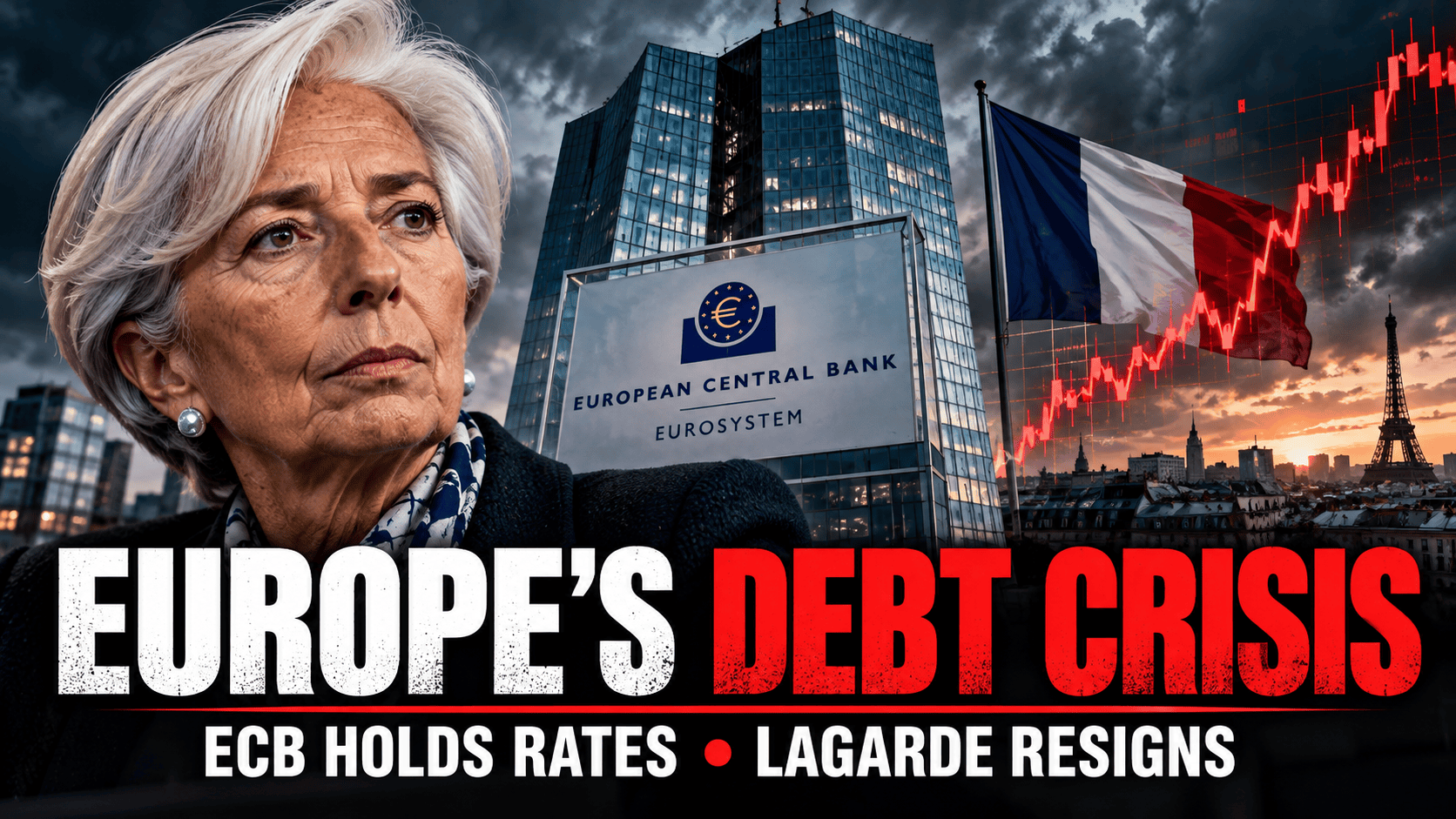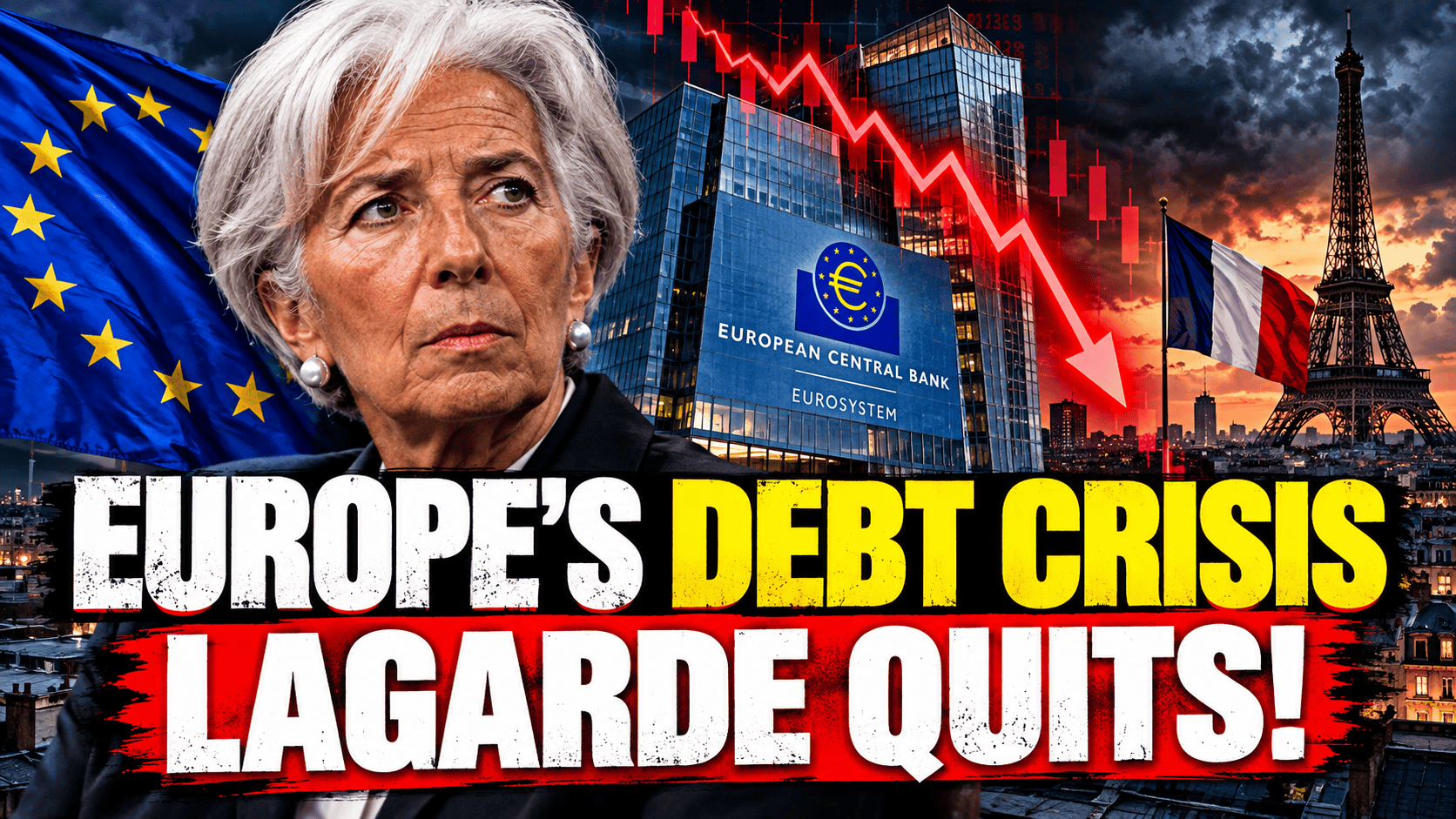
Europe’s financial establishment is facing an uncomfortable reality. Government borrowing costs are climbing, inflation threatens another comeback, and the woman leading the European Central Bank is preparing to leave. Behind the reassuring language of monetary policy lies a far more troubling question: How much economic pressure can Europe absorb before something breaks?
The European Central Bank (ECB) is confronting one of its most difficult policy environments in years.
Investors expect the central bank to keep its key deposit rate unchanged at 2.5% during its October 29 monetary policy meeting. But the decision itself may prove less significant than the financial instability developing around it.
France, one of Europe’s largest economies, is struggling with rising government borrowing costs. Energy prices have surged amid the war involving Iran, threatening to push inflation higher. Meanwhile, the ECB must prepare for a leadership transition following confirmation that President Christine Lagarde will leave office early.
The central bank is being pulled in opposite directions.
Raise interest rates to fight inflation, and already struggling borrowers face additional pressure.
Keep rates unchanged for too long, and rising prices could become more deeply embedded in the European economy.
Neither option offers an easy escape.
And the consequences extend far beyond the financial markets.
Christine Lagarde Is Leaving the ECB Early
______________________________________________
🔴 Help keep this independent voice alive and uncensored.
Support independent journalism and help keep Chris Wick News going.
👉 Support Chris Wick on GoFundMe
On October 29, the European Central Bank confirmed that Christine Lagarde will step down as president on February 7, 2027.
Her eight-year term had originally been scheduled to conclude in October 2027.
The announcement ends months of speculation surrounding her future, including reports suggesting that she could become chair of the World Economic Forum.
That possible appointment has not been established as the confirmed reason for her departure.
Nevertheless, the timing creates another complication for European policymakers.
The ECB is responsible for monetary policy across the eurozone, making its president one of the most influential economic officials in Europe.
Lagarde’s successor will inherit an institution attempting to control inflation while managing growing concerns about sovereign debt and financial stability.
Former central bank governors Klaas Knot of the Netherlands and Pablo Hernández de Cos of Spain have been identified in reporting as potential successors.
But replacing a central bank president is not simply an administrative exercise.
The ECB’s leadership influences expectations about future interest rates, inflation policy, and how aggressively the institution might respond to financial turmoil.
Europe is approaching a period when confidence in monetary leadership could matter almost as much as the interest-rate decisions themselves.
France’s Borrowing Costs Are Flashing Warning Signs
Perhaps the most troubling development is occurring in France.
Investors have become increasingly concerned about the country’s debt burden, fiscal outlook, and political instability.
Those concerns have pushed French government bond yields sharply higher.
French 10-year borrowing costs recently climbed above 5%, reaching levels not seen in roughly 24 years.
The premium investors demanded to hold French debt rather than comparable German bonds also widened significantly.
That difference matters.
German government bonds are commonly treated as a benchmark for relatively low-risk eurozone borrowing.
When investors demand substantially higher yields to lend to France, they are effectively requiring additional compensation for perceived risk.
This creates a dangerous financial problem.
As borrowing costs increase, governments must devote more resources to servicing debt.
That can leave less room for public services, infrastructure, tax relief, and other spending priorities.
Higher yields can also influence borrowing costs throughout the economy, affecting businesses and households.
But rising bond yields do not automatically mean a country is approaching default.
They do indicate that investors are becoming more demanding about the risks they are willing to accept.
And in France’s case, those demands are becoming increasingly expensive.
The ECB Faces an Inflation Trap
The European Central Bank has already raised interest rates twice since June.
Its deposit facility rate currently stands at 2.5%, following increases intended to contain renewed inflationary pressure.
The latest threat comes partly from energy markets.
The conflict involving Iran has helped push oil prices above $100 per barrel, creating concerns that higher energy costs could spread throughout the European economy.
Energy prices affect much more than motorists.
Manufacturers require energy to operate factories. Transportation companies depend on fuel. Agricultural producers face costs associated with machinery, fertilizer, and distribution.
When those costs rise, businesses may attempt to pass them along to customers.
Workers may subsequently demand higher wages to compensate for lost purchasing power.
Central bankers worry about this process because temporary price shocks can become more persistent if they influence wages and broader inflation expectations.
But raising interest rates introduces another problem.
Higher rates can slow borrowing, investment, construction, and consumer spending.
They can also place additional pressure on governments already struggling with expensive debt.
The ECB is effectively being asked to fight inflation without pushing vulnerable parts of Europe’s economy closer to financial distress.
That is a difficult assignment, regardless of who occupies the president’s office.
Could Europe’s Central Bank Be Forced to Rescue France?
One of the most consequential questions concerns whether the ECB might eventually intervene in government bond markets.
The institution has mechanisms designed to address certain forms of financial instability.
Among them is the Transmission Protection Instrument, or TPI.
Introduced in 2022, the instrument is intended to counter unwarranted and disorderly market conditions that threaten the effective transmission of monetary policy across eurozone countries.
In simpler terms, it can potentially help prevent destabilizing bond-market pressures from interfering with the ECB’s ability to conduct monetary policy.
But it is not an unconditional bailout mechanism.
Countries must satisfy eligibility requirements, and the ECB retains discretion over whether intervention is justified.
The instrument has never been activated.
Current market conditions do not establish that the ECB is preparing to use it for France.
Indeed, analysts have suggested that intervention remains unlikely unless financial instability becomes substantially more severe or begins spreading across the eurozone.
That distinction is important.
There is a significant difference between a country facing higher borrowing costs and a financial crisis requiring extraordinary central bank action.
Still, the existence of such emergency mechanisms raises an uncomfortable question.
If Europe’s largest economies encounter increasingly serious debt problems, how much responsibility should fall on the central bank to contain the damage?
The answer has enormous implications for taxpayers, investors, and the credibility of European monetary policy.
Why France’s Problems Matter Beyond France
France is not an isolated economy.
It is deeply integrated into Europe’s banking system, financial markets, and commercial networks.
French government bonds are held by financial institutions and investors throughout the region.
A sustained deterioration in their value could affect investment portfolios, bank balance sheets, and broader market confidence.
That does not mean a systemic crisis is inevitable.
But it explains why financial markets closely monitor the difference between French and German bond yields.
If investors begin questioning the financial stability of additional eurozone governments, borrowing costs could rise elsewhere.
The ECB would then face an even more complicated challenge.
It might need to contain financial fragmentation while maintaining an interest-rate policy designed to control inflation.
Those objectives can conflict.
Measures that support bond markets may ease financing conditions, while higher interest rates are intended to restrain demand and inflation.
The central bank must therefore distinguish between legitimate market concerns about government finances and destabilizing conditions that threaten monetary policy.
That distinction becomes increasingly difficult when political uncertainty is involved.
Europe’s Political Leaders Cannot Expect the ECB to Fix Everything
There is a broader problem that deserves more attention.
Central banks control monetary policy.
They do not control government budgets, taxation, structural economic reforms, or national spending priorities.
Those responsibilities belong primarily to elected governments.
When a country accumulates significant debt and investors demand higher borrowing costs, politicians cannot reasonably expect central bankers to eliminate every consequence.
The ECB can address threats to monetary transmission and financial stability within its mandate.
It cannot permanently substitute for credible fiscal management.
This is where the political conversation becomes uncomfortable.
Governments often prefer discussing central bank decisions because interest rates provide a convenient explanation for economic difficulties.
But debt sustainability also depends on spending decisions, economic growth, taxation, and investor confidence in public finances.
France’s problems cannot be understood solely through the ECB’s next interest-rate announcement.
They reflect deeper questions about how European governments manage their financial obligations.
And no amount of carefully worded central bank reassurance can make those questions disappear.
What Does This Mean for Ordinary Europeans?
For households and businesses, the consequences are more immediate than debates about monetary policy might suggest.
If inflation remains elevated, purchasing power suffers.
If interest rates rise, borrowers may face higher financing costs.
If governments must spend more on debt servicing, difficult budget decisions may follow.
Businesses considering major investments could delay projects until financing conditions become more predictable.
Homebuyers may find mortgages less affordable.
And governments facing fiscal pressure may struggle to balance public expectations with financial constraints.
None of these outcomes is guaranteed.
But they illustrate why developments in Frankfurt and Paris matter to people who have never purchased a government bond or followed a central bank press conference.
The financial system ultimately influences the cost of everyday life.
What Investors Should Watch Next
Several developments will help determine whether Europe’s current difficulties remain manageable or become more serious.
The first is the ECB’s interest-rate guidance.
Markets are watching for indications that another increase could arrive in December.
The second is France’s bond market.
Continued increases in borrowing costs, particularly relative to Germany, could indicate deteriorating investor confidence.
The third is energy inflation.
If oil prices remain elevated, European policymakers may face additional pressure to tighten monetary policy despite weaker financing conditions.
Finally, the ECB’s leadership transition will attract increasing attention.
Investors will want to understand whether Lagarde’s successor intends to maintain the institution’s current approach or advocate a different balance between inflation control and financial stability.
These are interconnected developments.
None should be interpreted in isolation.
Final Thought: Europe Is Running Out of Easy Answers
For years, European political and financial institutions have relied on a familiar message.
The situation is difficult, but manageable.
Markets are functioning. Policymakers are monitoring developments. Appropriate tools remain available.
Sometimes those reassurances are justified.
But confidence is not a substitute for sound economic fundamentals.
France’s rising borrowing costs are a warning about the consequences of deteriorating fiscal credibility.
Renewed inflation pressure is a reminder that central banks cannot control every force affecting consumer prices.
And Christine Lagarde’s early departure introduces another layer of uncertainty at a particularly sensitive moment.
The ECB is not powerless.
Europe is not necessarily approaching a financial collapse.
But dismissing these developments as routine market turbulence would be equally misguided.
Europe is confronting a difficult combination of expensive debt, inflation risks, political uncertainty, and changing central bank leadership.
The question is no longer simply whether the ECB raises interest rates again.
It is whether European governments can restore financial confidence without relying on central bankers to absorb the consequences of political decisions.
Because when debt becomes more expensive, inflation erodes purchasing power, and economic growth comes under pressure, someone ultimately pays.
And more often than not, ordinary citizens discover the cost long after the politicians have finished explaining why everything is under control.
SOURCES
1. Reuters — October 29, 2026
ECB President Lagarde resigns at time of mounting challenges for Europe.
2. Banque de France — Official ECB Interest Rates
Historical and current European Central Bank policy rates.
https://www.banque-france.fr/en/policy-rates
3. European Central Bank — Monetary Policy
Official information concerning eurozone monetary policy, inflation, and financial stability.
Disclaimer
This article contains independent financial and political analysis published by Chris Wick News. It distinguishes reported economic developments from editorial interpretation and potential future risks. Statements about financial instability, monetary policy, and government debt should not be interpreted as predictions of an inevitable financial crisis. This article is provided for informational and commentary purposes and does not constitute investment or financial advice.