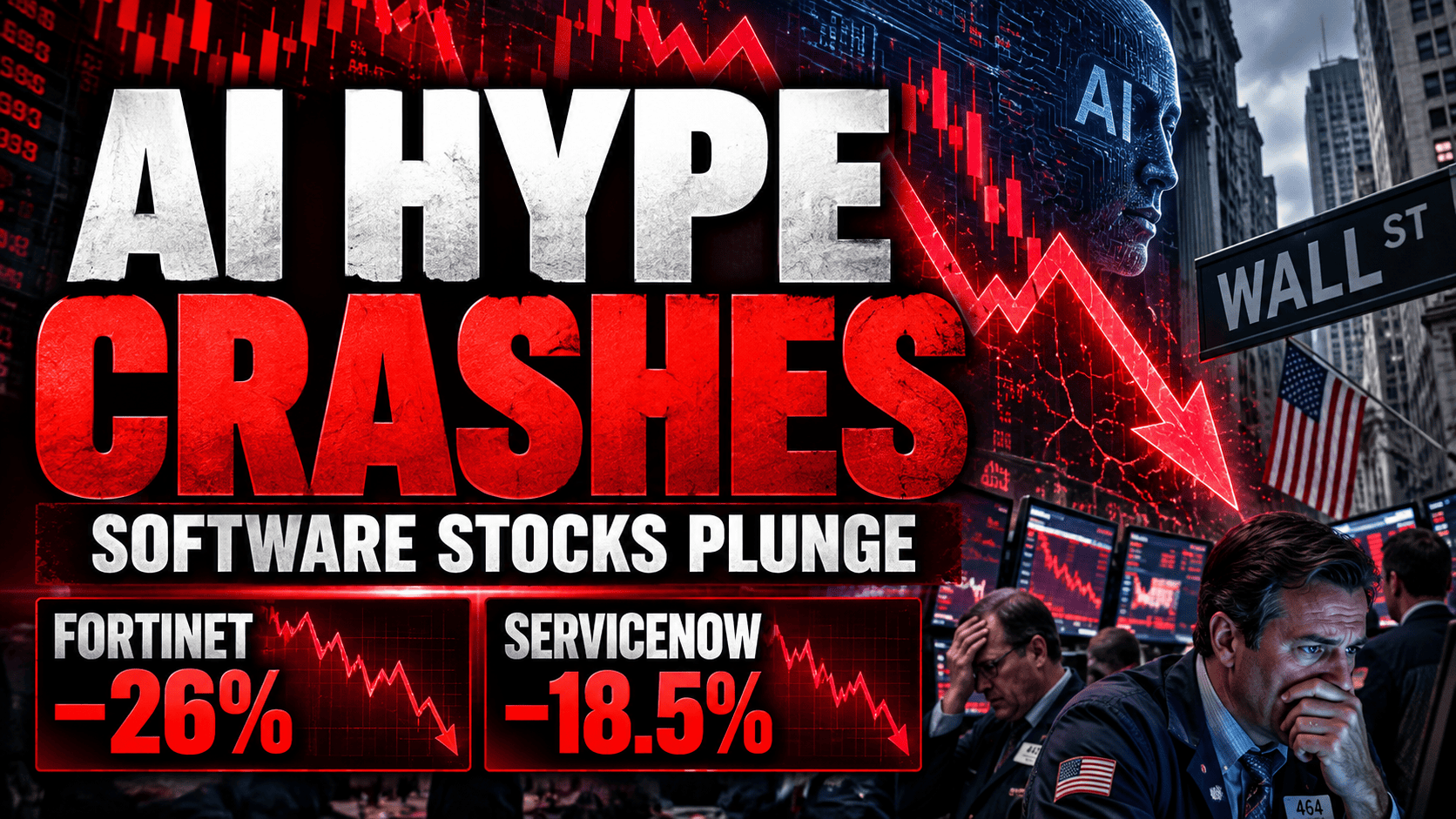
Wall Street spent months celebrating artificial intelligence as the next great wealth machine. Now, investors are discovering that extraordinary promises come with extraordinary expectations — and even profitable technology companies can be punished when reality fails to match the hype.
The artificial intelligence gold rush is running into an uncomfortable reality.
On Thursday, October 29, shares of major American software companies plunged in premarket trading as disappointing investor reactions to earnings from cybersecurity giant Fortinet and enterprise software provider ServiceNow sent shockwaves across the technology sector.
Fortinet shares dropped approximately 26%, while ServiceNow fell 18.5%, according to Reuters.
The selloff spread beyond those two companies, dragging down other prominent software and cybersecurity stocks.
But the real story isn’t simply that two technology giants disappointed Wall Street.
It’s that investors are beginning to question whether the AI revolution can deliver the financial returns already reflected in some technology stock valuations.
And that question could become increasingly uncomfortable for an industry that has spent years selling investors a vision of seemingly limitless growth.
Fortinet’s 26% Collapse Exposes Wall Street’s Impossible Expectations
Perhaps the most revealing part of Thursday’s market turmoil is what happened to Fortinet.
______________________________________________
🔴 Help keep this independent voice alive and uncensored.
Support independent journalism and help keep Chris Wick News going.
👉 Support Chris Wick on GoFundMe
The California-based cybersecurity company didn’t announce a financial disaster.
Quite the opposite.
According to its official third-quarter earnings announcement, Fortinet reported:
- Quarterly revenue of $2.08 billion, representing 20% annual growth.
- Product revenue growth of 37%.
- Total billings growth of 29%.
- Operating cash flow of $946 million.
- Free cash flow of $865 million.
- An increase in its full-year revenue outlook.
For an ordinary business, those numbers might be considered impressive.
On Wall Street, they weren’t enough.
Fortinet shares had already climbed approximately 119% during the year before Thursday’s selloff.
That extraordinary rally created expectations that the company would deliver not merely strong results, but evidence of sustained growth capable of justifying its elevated valuation.
Analysts also expressed concern about slowing growth in Fortinet’s services business.
At least 14 brokerages reduced their price targets following the results, according to Reuters.
The message from investors was unmistakable.
Being profitable isn’t enough. Growing rapidly isn’t enough. Even raising financial guidance isn’t necessarily enough.
When expectations become detached from what investors believe a company can realistically deliver, the punishment can be brutal.
And Fortinet just demonstrated how quickly market enthusiasm can turn into financial destruction.
ServiceNow Falls as AI Promises Meet Earnings Reality
ServiceNow experienced its own punishment.
The enterprise software company saw its shares tumble approximately 18.5% in premarket trading after third-quarter earnings disappointed investors.
Yet its underlying business continued to grow.
According to ServiceNow’s financial disclosures, the company reported third-quarter subscription revenue of approximately $3.99 billion, an increase of 21% from the previous year.
Total quarterly revenue reached approximately $4.11 billion.
ServiceNow also raised its full-year subscription revenue and free cash flow margin outlook.
Nevertheless, the company missed analysts’ quarterly profit expectations.
Investors were also concerned about the outlook for subscription revenue growth and remaining performance obligations, a measure of contracted revenue that has not yet been recognized.
Those concerns matter because enterprise software companies depend heavily on predictable subscription income.
Their valuations frequently assume that customers will continue renewing contracts, expanding services and increasing spending over many years.
If those assumptions weaken, even slightly, investors may begin questioning the prices they are willing to pay for future earnings.
ServiceNow has also been promoting its expanding artificial intelligence business.
The company raised its annual AI contract value target to $1.7 billion for 2026.
That figure suggests meaningful commercial demand.
But a target is not the same thing as realized revenue or profit.
And Thursday’s market reaction suggests investors want stronger evidence that AI-related spending will translate into durable financial performance.
The AI Revolution Has Created a Dangerous Valuation Problem
For years, investors have rewarded technology companies for attaching themselves to artificial intelligence.
AI-powered cybersecurity.
AI-driven business automation.
AI-assisted software development.
AI-powered customer service.
Almost every corner of the technology industry has discovered a reason to describe its future in terms of artificial intelligence.
Some of these applications are already delivering measurable benefits.
Others remain expensive experiments whose long-term profitability is uncertain.
The problem isn’t necessarily the technology.
The problem is the enormous financial expectations surrounding it.
When investors purchase shares based on assumptions of extraordinary future growth, companies have very little room for disappointment.
A business can remain financially healthy while its stock suffers a devastating decline.
That distinction is important.
Thursday’s selloff does not establish that Fortinet or ServiceNow is failing as a business.
It demonstrates that investors are reassessing how much they are prepared to pay for their future earnings.
Those are two very different things.
And confusing them is one of the easiest ways to misunderstand a stock market crash.
Google Adds Another Threat to Traditional Software Companies
The pressure on software stocks comes as artificial intelligence developers continue expanding into markets traditionally dominated by established technology companies.
On Wednesday, Google introduced Gemini 4 Carbon, intensifying competition in AI-assisted software development and cybersecurity applications.
The development raises another uncomfortable question.
What happens when increasingly capable AI systems begin performing tasks that businesses currently pay specialized software providers to handle?
Traditional enterprise software companies often generate recurring revenue by charging customers for access to applications, services and individual user accounts.
More capable AI tools could potentially change how businesses purchase and use those products.
Some organizations may consolidate software subscriptions.
Others may replace specialized tools with broader AI platforms.
Still others may increase spending because AI creates new security, compliance and management requirements.
There is no certainty about which outcome will dominate.
But the possibility of disruption is already influencing how investors evaluate established software companies.
The threat isn’t necessarily that artificial intelligence will eliminate the software industry.
It is that AI could redistribute profits, weaken certain business models and force companies to compete in markets where their historical advantages are less secure.
The Selling Spreads Across the Technology Sector
Thursday’s market reaction extended well beyond Fortinet and ServiceNow.
Reuters reported the following approximate premarket declines:
| Company | Share decline |
|---|---|
| Fortinet | 26% |
| ServiceNow | 18.5% |
| Atlassian | 7% |
| Palo Alto Networks | 6.5% |
| Zscaler | 5.8% |
| Salesforce | 5.4% |
Figures reflect reported premarket trading on October 29, 2026, and may change during regular market hours.
The broader S&P 500 Software & Services Index had gained approximately 6% during the year, roughly half the increase recorded by the wider S&P 500.
That relative underperformance suggests investors have become more selective about the software industry’s prospects.
The distinction matters because technology stocks are frequently discussed as though they all benefit equally from advances in artificial intelligence.
They don’t.
Companies developing foundational AI models face different financial pressures from cybersecurity providers, enterprise software vendors and businesses supplying the infrastructure required to operate AI systems.
Some may emerge stronger.
Others could face shrinking margins or intensified competition.
And investors are increasingly demanding evidence rather than accepting promises.
Why This Matters Beyond Wall Street
For ordinary investors, Thursday’s turmoil provides an important reminder about the difference between a successful business and a successful investment.
A company can generate billions in revenue, maintain healthy margins and continue expanding while its stock price declines sharply.
That happens when the price investors previously paid assumed even stronger performance.
Consider a simplified example.
If investors value a business as though its profits will grow 30% annually for several years, but later expect growth of only 20%, the company’s shares could fall substantially even though the business remains profitable.
The underlying company hasn’t necessarily collapsed.
The assumptions supporting its valuation have changed.
That is particularly important in technology markets, where much of a company’s share price may reflect earnings expected years into the future.
Higher expectations create greater vulnerability when forecasts change.
For retirement investors, pension funds and people holding technology-heavy investment portfolios, these valuation shifts can have consequences beyond the trading floors of Wall Street.
The lesson is not that every software stock should be avoided.
It is that extraordinary growth narratives do not eliminate ordinary investment risks.
Is the Artificial Intelligence Bubble Finally Cracking?
The temptation is to declare Thursday’s selloff proof that the AI bubble has burst.
That conclusion would be premature.
Fortinet and ServiceNow continue reporting substantial revenue growth.
AI adoption is expanding across multiple industries.
And businesses are still investing in cybersecurity, automation and cloud infrastructure.
Those developments cannot simply be dismissed.
However, Thursday’s market reaction highlights a growing contradiction.
Investors want companies to spend aggressively on artificial intelligence while simultaneously delivering exceptional profits, accelerating revenue growth and maintaining attractive margins.
Those objectives do not always move together.
Developing and deploying advanced AI systems can require substantial investment.
Competition can increase costs.
Customers may adopt new technologies more slowly than anticipated.
And the financial benefits may take longer to materialize than optimistic forecasts suggest.
None of that means AI is a technological failure.
It means technological progress and investment returns are not interchangeable.
A revolutionary technology can transform the world without making every company associated with it a winning investment.
History has demonstrated that distinction repeatedly.
The internet transformed global commerce, communications and media.
But many companies that attracted enormous investor enthusiasm during the dot-com boom ultimately disappeared or failed to justify their valuations.
The technology succeeded.
Not every investment did.
Artificial intelligence could follow a similarly uneven path, although its eventual economic impact remains uncertain.
What Investors Should Watch Next
The next phase of this market reassessment will depend on whether software companies can demonstrate that their growth strategies justify current valuations.
Three developments deserve particular attention.
First, recurring revenue growth.
Investors will be watching whether enterprise customers continue expanding their software subscriptions or begin reducing spending as AI alternatives become more capable.
Second, actual AI profitability.
Announcements about AI partnerships, new products and contract targets will increasingly need to be supported by measurable revenue, margins and cash flow.
Third, competitive pressure.
The growing capabilities of major AI developers could create new opportunities for established software providers while simultaneously threatening portions of their existing businesses.
Fortinet and ServiceNow will need to demonstrate that their products remain valuable in an increasingly competitive market.
Strong quarterly results alone may no longer satisfy investors who have already priced extraordinary growth into company valuations.
That is the uncomfortable reality now confronting much of the technology sector.
Final Thought: Wall Street Is Discovering That Hype Has a Price
For years, artificial intelligence has been marketed as the next great economic transformation.
Investors poured money into companies promising automation, productivity, efficiency and revolutionary new business models.
Some of those promises are already producing real results.
Others remain projections.
And projections have a dangerous habit of looking much less impressive when quarterly earnings arrive.
Thursday’s punishment of Fortinet and ServiceNow reveals something fundamental about modern financial markets.
Wall Street doesn’t simply reward success.
It rewards success relative to expectations.
When expectations become excessive, even profitable companies can find themselves punished for failing to deliver the extraordinary.
The companies may recover.
The AI revolution may continue.
But the assumption that every business connected to artificial intelligence deserves an ever-rising valuation is becoming harder to defend.
The technology may be revolutionary. That doesn’t mean every stock carrying the AI label deserves a revolutionary price.
And Wall Street is beginning to send the bill.
Disclaimer: This article contains financial news, independent commentary and market analysis. It is provided for informational purposes only and does not constitute investment, legal or financial advice. Stock prices and market conditions can change rapidly. Readers should conduct their own research and consult a qualified financial professional before making investment decisions.
Sources
Reuters — Software stocks slide as Fortinet, ServiceNow fail to meet lofty investor expectations
https://www.reuters.com/technology/software-stocks-slide-fortinet-servicenow-fail-meet-lofty-investor-expectations-2026-10-29/
Fortinet Investor Relations — Fortinet Reports Strong Third Quarter 2026 Financial Results
https://investor.fortinet.com/news-releases/news-release-details/fortinet-reports-strong-third-quarter-2026-financial-results/
U.S. Securities and Exchange Commission — ServiceNow Reports Third Quarter 2026 Financial Results
https://www.sec.gov/Archives/edgar/data/1373715/000137371526000095/erq3fy262.htm