



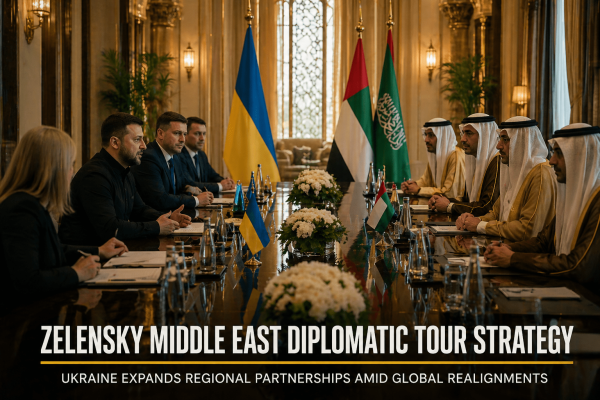
The Ukrainian president’s latest diplomatic movement through the Middle East is drawing attention not for what was publicly announced—but for what wasn’t said at all. Behind the carefully staged meetings and short statements, a more complex effort appears to be unfolding.
There is a growing sense among analysts that this is not just another diplomatic stop. It may be a recalibration of where Ukraine is trying to anchor its support network as the war enters a more uncertain phase.
What Actually Happened
President Volodymyr Zelensky’s recent tour across parts of the Middle East included meetings focused on energy cooperation, humanitarian coordination, and broader political alignment discussions.
Public messaging remained tightly controlled. Statements emphasized neutrality in tone, focusing on bilateral cooperation rather than military implications.
Coverage from Reuters noted that Ukraine’s diplomatic outreach beyond its traditional Western partners has steadily expanded since the early stages of the war, particularly toward states that maintain flexible positions between global blocs.
Meanwhile, reporting from BBC News highlighted that Ukraine is increasingly seeking economic and logistical partnerships outside Europe, especially in regions capable of influencing energy markets and reconstruction funding.
Did you see this Video about the shooting at a Trump conference?
Why This Moment Matters
This trip arrives at a time when global attention is shifting between multiple conflicts and political crises.
For Ukraine, the challenge is no longer only military support. It is also about sustaining long-term political relevance among countries that are not fully aligned with Western sanctions frameworks.
______________________________________________
🔴 Help keep this independent voice alive and uncensored -> Buy us a Coffee <-
The Middle East, in particular, has become a zone of strategic balancing. Countries in the region maintain ties with both Western governments and Russia, making them potential intermediaries—but also unpredictable partners.
This is where Zelensky’s outreach becomes more than symbolic. It suggests an attempt to diversify Ukraine’s diplomatic dependencies at a time when Western political unity shows signs of strain.
The Pattern Behind the Event
This is not the first time Ukraine has expanded its diplomatic map.
Over the past year, there has been a noticeable pattern of outreach toward:
- Gulf states with sovereign wealth influence
- Energy exporters with global market leverage
- Regional powers positioned between competing blocs
The logic appears consistent: reduce overreliance on a narrow set of allies while broadening economic survival pathways.
What stands out in this case is timing. These engagements are happening alongside slower Western aid decisions and shifting domestic political debates in key NATO countries.
Where the Tensions Are Building
Behind closed doors, the Middle East itself is not a neutral backdrop.
Several governments in the region are balancing:
- Energy partnerships with Europe
- Security relationships with the United States
- Economic ties that remain indirectly linked to Russia
This creates a diplomatic environment where Ukraine’s messaging must be carefully calibrated.
Any perceived alignment shift risks triggering unintended consequences in markets, alliances, or regional diplomacy.
At the same time, Ukraine is under pressure to secure long-term reconstruction commitments—something that cannot rely solely on wartime emergency aid structures.
What This Could Signal Next
If this diplomatic direction continues, Ukraine may be entering a new phase of external positioning—one less defined by wartime alliances alone and more by economic survival strategy.
That does not indicate a shift away from its core Western partnerships. Rather, it suggests an attempt to build parallel channels of influence that could matter more in a prolonged conflict scenario.
The key question now is whether these efforts translate into tangible agreements—or remain symbolic gestures in a rapidly shifting global landscape.
For now, the Middle East tour stands as another signal that Ukraine’s diplomacy is expanding outward, even as the center of the war remains unchanged.