









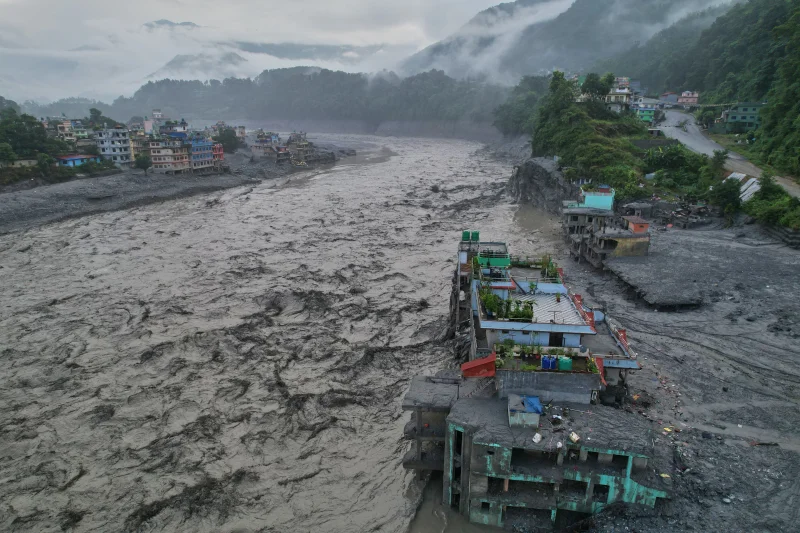
Hundreds of workers are trapped underground in Nepal, and now a difficult question is being raised about whether crucial rescue time was lost before international help was allowed in.
The disaster has already become one of the country’s worst recent catastrophes. But as rescue crews fight to reach people buried inside hydropower tunnels, criticism is growing over Nepal’s initial hesitation to bring in foreign teams with specialized equipment and expertise.
The original NPR report is available here.
The scale of the disaster is staggering. Nepalese authorities said Monday that 903 people had died and another 4,247 were considered missing following floods and mudslides triggered by an ice-and-rock avalanche in the Himalayan border region.
Among those missing are at least 85 Americans, according to the U.S. State Department.
But another emergency is unfolding beneath the surface.
Nine hydropower tunnels in Nepal’s Rasuwa and Nuwakot districts have been blocked by debris, leaving 933 workers from Nepal, South Korea and China trapped underground. Rescue crews have been using drills and excavators as they attempt to locate and reach the tunnels.
The challenge is not simply getting people out.
In some locations, rescuers reportedly spent days just trying to determine where the buried tunnel entrances were.
______________________________________________
🔴 Help keep this independent voice alive and uncensored.
Support independent journalism and help keep Chris Wick News going.
👉 Support Chris Wick on GoFundMe
That is why officials within Nepal’s private power industry say international assistance should have been accepted sooner.
Bhim Gautam, chief executive of the Independent Power Producers Association of Nepal, said Nepal does not have enough technology, equipment or specialized expertise to handle a rescue operation of this magnitude.
His warning is blunt: Nepal has experience dealing with smaller flooding emergencies, but not a disaster of this scale involving buried hydropower infrastructure.
According to Gautam, industry leaders pressured the government to permit foreign rescue teams to enter the country. Nepal eventually approved teams from China, India and Australia late last week.
The criticism now centers on whether that decision came too late.
Nepal’s government has pushed back against reports that it simply rejected foreign assistance. Finance Minister Swarnim Wagle said assistance had been accepted based on what was needed on the ground.
Prime Minister Balen Shah also said Sunday that Nepalese army and police personnel were working alongside experts from India, China and South Korea at several hydropower tunnel sites.
That distinction matters.
The issue is no longer simply whether foreign countries offered help. The more consequential question is whether specialized assistance was brought into the rescue operation quickly enough to make a difference.
Every hour can matter when people are trapped underground, particularly after landslides have destroyed access routes and altered the surrounding landscape.
The disaster also exposes how vulnerable Nepal’s rapidly developing hydropower infrastructure can be when extreme natural events strike with little warning.
The tunnels were under construction, but they became unexpected shelters and traps when enormous quantities of rock, ice and mud swept through the region.
The rescue effort is therefore confronting several problems at once: locating buried entrances, clearing massive amounts of debris, reaching workers underground and determining whether the tunnels remain accessible and safe.
And while attention remains focused on Nepal, questions are also being raised across the border in China.
Chinese officials denied reports that authorities had ignored early warnings or understated the scale of the disaster. Beijing said information about the flooding and mudslide near the Nepalese border had been released transparently and in a timely manner.
Yet China’s reported casualty figures have not changed since Saturday.
State news agency Xinhua reported 16 confirmed deaths and 546 people missing. Those numbers had not been updated for more than 48 hours as of Monday.
For Nepal, however, the immediate priority remains the people still underground.
The rescue operation has become a race against time — and a test of whether the country’s own capabilities, combined with international expertise, can overcome the extraordinary destruction left behind by the floods and mudslides.
The growing criticism over foreign assistance adds another layer to an already devastating disaster.
When the ground itself has shifted, tunnels have disappeared beneath debris and hundreds of people are waiting underground, the cost of lost time can become impossible to measure.