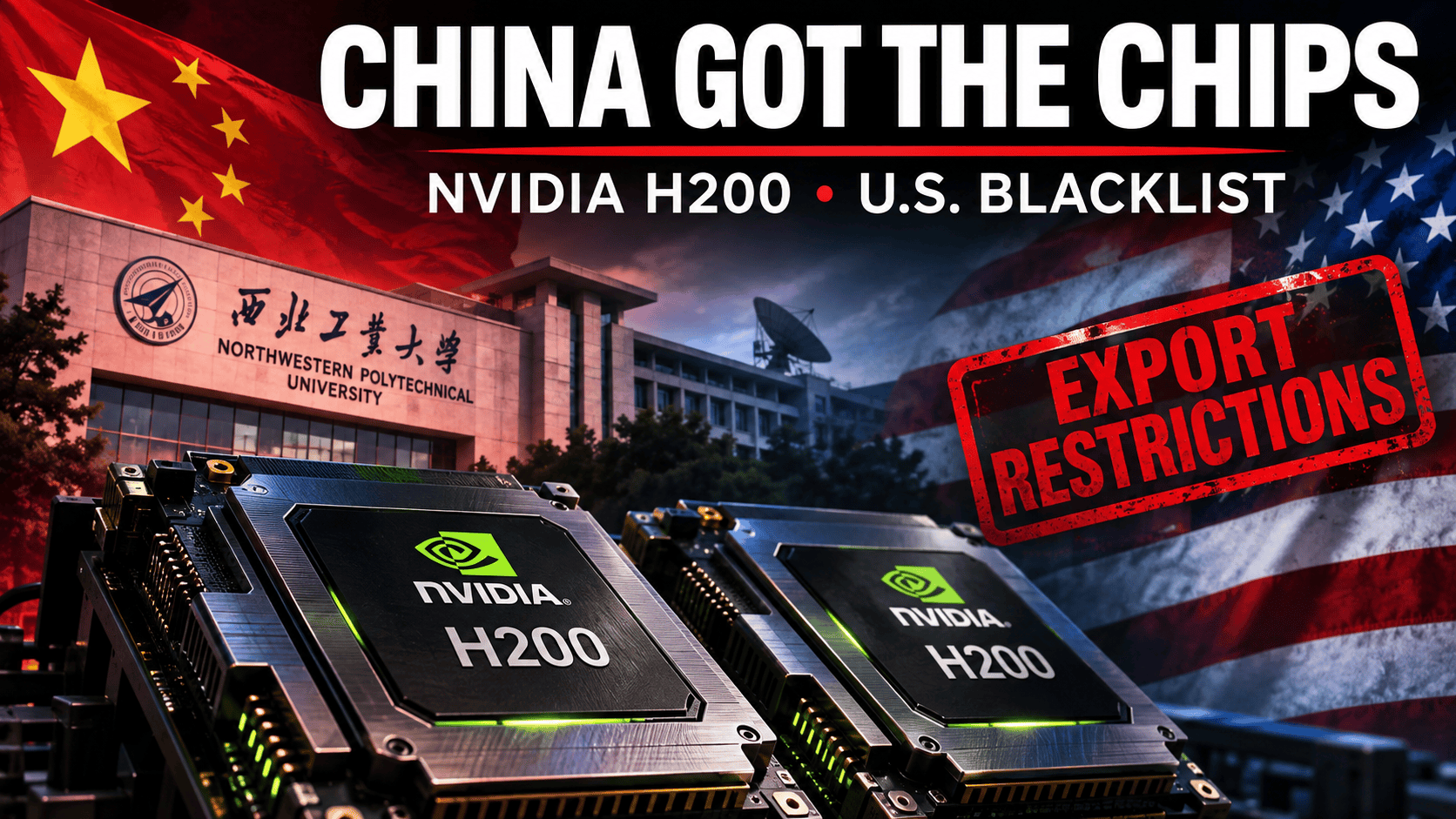
WASHINGTON — The United States has spent years trying to keep its most powerful artificial intelligence technology away from Chinese institutions linked to military research. Yet a university on Washington’s own export blacklist has reportedly purchased advanced American AI chips anyway.
And the disturbing part? The transaction appeared in ordinary procurement records.
According to a November 11 Reuters investigation, Northwestern Polytechnical University, a Chinese institution with deep ties to the People’s Liberation Army (PLA), purchased two Nvidia H200 processors in October for 874,700 yuan, approximately $123,000.
The university has been on the U.S. Commerce Department’s Entity List since 2001.
That raises an uncomfortable question: What exactly is an American technology blacklist worth if restricted institutions can still obtain the computing power Washington is trying to keep out of their hands?
The Chips Washington Wanted to Control
Northwestern Polytechnical University is no ordinary academic institution. Based in Xi’an, it belongs to China’s so-called Seven Sons of National Defense, universities closely associated with the country’s military and defence industries.
Its research includes military aircraft, missile technology and satellites.
The Nvidia H200 is a powerful processor designed for demanding artificial intelligence workloads. Such technology can support civilian scientific research, but lawmakers fear it could also accelerate military applications, including intelligence analysis and weapons development.
Reuters reported that the university purchased the two processors through Shaanxi Bosuan Network Technology, a Chinese supplier, rather than directly from Nvidia.
There is no established evidence that Nvidia knowingly supplied the blacklisted university or that these particular chips were used for military purposes.
Nevertheless, the procurement raises serious questions about the effectiveness of American export restrictions.
Buying Computing Power Without Buying the Chips
The investigation uncovered something potentially more significant than two processors.
Northwestern Polytechnical also obtained access to advanced Nvidia computing systems through rental contracts with domestic Chinese technology companies.
Its cybersecurity school awarded two seven-month contracts in January involving servers equipped with eight H200 processors each.
Those arrangements covered AI model fine-tuning and reinforcement-learning training.
Reuters examined 26 Chinese procurement and corporate records involving restricted Nvidia hardware or access to computing services powered by such processors.
Other institutions, including Shenzhen University and Beihang University, appeared in the findings.
The broader issue is straightforward: restricting direct semiconductor exports does not automatically prevent institutions from accessing processors already circulating through suppliers or remote computing services.
Trump’s China Chip Policy Faces Another Test
President Donald Trump’s administration began permitting certain H200 exports to China under case-by-case licensing arrangements in January 2026.
But those changes did not remove the restrictions covering blacklisted institutions such as Northwestern Polytechnical.
Meanwhile, Nvidia CEO Jensen Huang has argued that maintaining American semiconductor sales to China helps preserve U.S. technological leadership and discourages Chinese customers from abandoning American technology.
Critics in Congress see a different danger.
They worry that advanced American processors could strengthen China’s military capabilities, regardless of whether those chips reach restricted institutions through direct purchases, intermediaries or rented computing infrastructure.
Both Republican and Democratic lawmakers have pushed for tighter oversight.
The Real Problem Is Enforcement
Washington can announce restrictions, expand blacklists and promise tougher export controls.
But the Reuters findings suggest that controlling the final destination and use of advanced computing technology remains extraordinarily difficult.
Important questions remain unanswered, including where the processors originated, how suppliers obtained them and whether any U.S. export-control violations occurred.
Nvidia, Northwestern Polytechnical University and the U.S. Bureau of Industry and Security did not respond to Reuters’ requests for comment.
The evidence does not establish corporate wrongdoing. It does, however, expose a potentially serious enforcement weakness.
America is trying to control who gets access to its most powerful AI technology. The question now is whether Washington can actually enforce the restrictions it has written.
Sources
- Reuters — November 11, 2026: Military-linked Chinese university bought Nvidia H200 chips despite US blacklist, records show