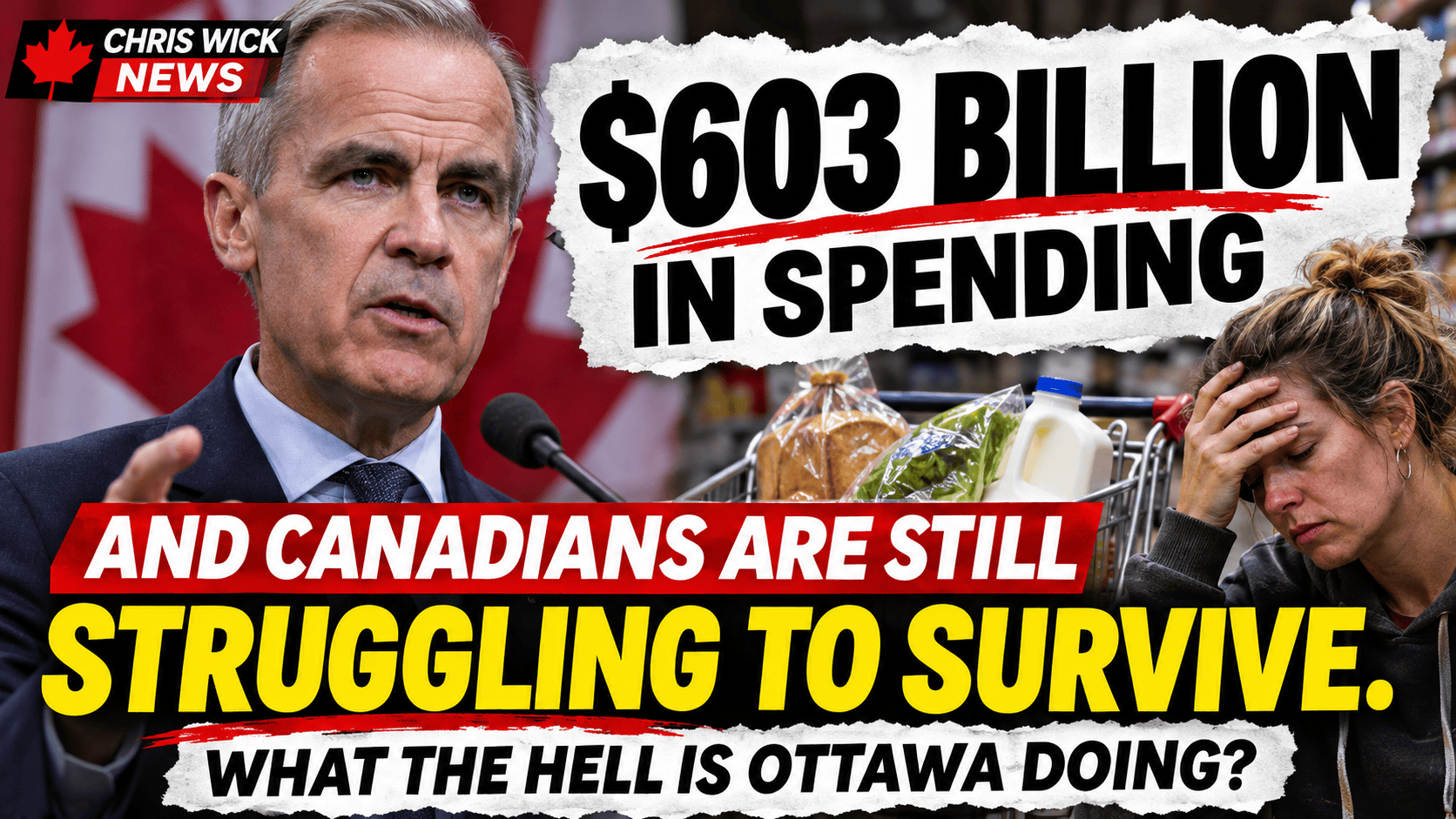
Mark Carney is taking his federal budget on the road. But Canadians struggling with groceries, rent and debt may have a very different message for Ottawa.
Canada’s federal government is preparing to spend an estimated $603 BILLION in the 2026–27 fiscal year.
And somehow, the question that matters most is still hanging over the country:
When does all this government spending actually make life affordable for ordinary Canadians?
Prime Minister Mark Carney and Finance Minister François-Philippe Champagne are hitting the road Friday, November 6, promoting a federal budget that promises major investments in infrastructure, business development and economic security.
Carney is scheduled to appear in Winnipeg alongside Manitoba Premier Wab Kinew to highlight homelessness initiatives, while Champagne heads to Montreal to promote the government’s economic agenda.
Ottawa calls it a plan for Canada’s future.
But for Canadians staring at grocery receipts, rent increases and credit card balances, the future isn’t the only concern.
They’re trying to survive the present.
BILLIONS MORE IN SPENDING. BILLIONS MORE IN DEFICITS.
______________________________________________
🔴 Help keep this independent voice alive and uncensored.
Support independent journalism and help keep Chris Wick News going.
👉 Support Chris Wick on GoFundMe
The federal budget projects a $62.3 billion deficit for 2026–27.
It also contains approximately $142.1 billion in multiyear spending and tax measures intended to encourage investment and strengthen Canada’s economy.
The government argues these commitments are necessary to respond to economic uncertainty, weak growth and the damage caused by American trade policies.
There is a legitimate argument for investing in Canada’s long-term economic independence.
But investment announcements and improvements in household living standards are two very different things.
A new factory might strengthen the economy years from now.
A family struggling to afford groceries needs relief today.
And that is where Ottawa’s political sales pitch faces its toughest test.
THE NUMBERS OTTAWA CANNOT IGNORE
A Salvation Army survey released earlier this week found that 31% of respondents reported skipping meals or reducing portion sizes because they couldn’t afford groceries.
Among respondents aged 18 to 34, that figure reached 41%.
Meanwhile, Food Banks Canada’s 2026 HungerCount recorded approximately 2.35 million food bank visits in a single month, an increase of nearly 9% from the previous year.
These are different measures, and food bank visits do not represent 2.35 million unique individuals.
Nevertheless, both point toward an affordability problem that deserves far more than another carefully staged political announcement.
A wealthy country should not be comfortable with this level of food insecurity.
CARNEY’S BIG PROMISE — BUT WILL IT WORK?
The government is also proposing $11.2 billion over four years toward homelessness measures, with $17.8 billion planned over a decade.
The stated ambition is to end homelessness within ten years.
It’s an extraordinary promise.
But promises must eventually be measured against results.
How many people will actually find stable housing? How quickly will assistance reach them? And how will Canadians know whether the spending is working?
Opposition politicians are already arguing that the budget falls short on immediate cost-of-living relief.
Now that the Liberals hold a parliamentary majority, the government has considerable freedom to implement its agenda.
That also means greater responsibility for the outcome.
Here’s the uncomfortable truth:
Canadians don’t eat economic forecasts.
They don’t pay rent with political speeches.
And they cannot purchase groceries with promises of prosperity ten years down the road.
Ottawa is asking Canadians to believe another enormous spending plan will deliver a stronger future.
Fair enough.
But after billions upon billions in public spending, Canadians deserve measurable improvements in their lives.
If a government can spend $603 billion in one year while so many people struggle to afford basic necessities, isn’t it reasonable to demand a clear explanation of where the money is going — and when ordinary Canadians will finally feel the benefits?
Sources
- Associated Press — Carney unveils budget to strengthen Canada’s economy
- The Canadian Press via CityNews — Carney and Champagne travel across Canada to promote federal budget
- Global News — Nearly a third of Canadians skipping meals due to food insecurity
- Food Banks Canada — 2026 HungerCount report