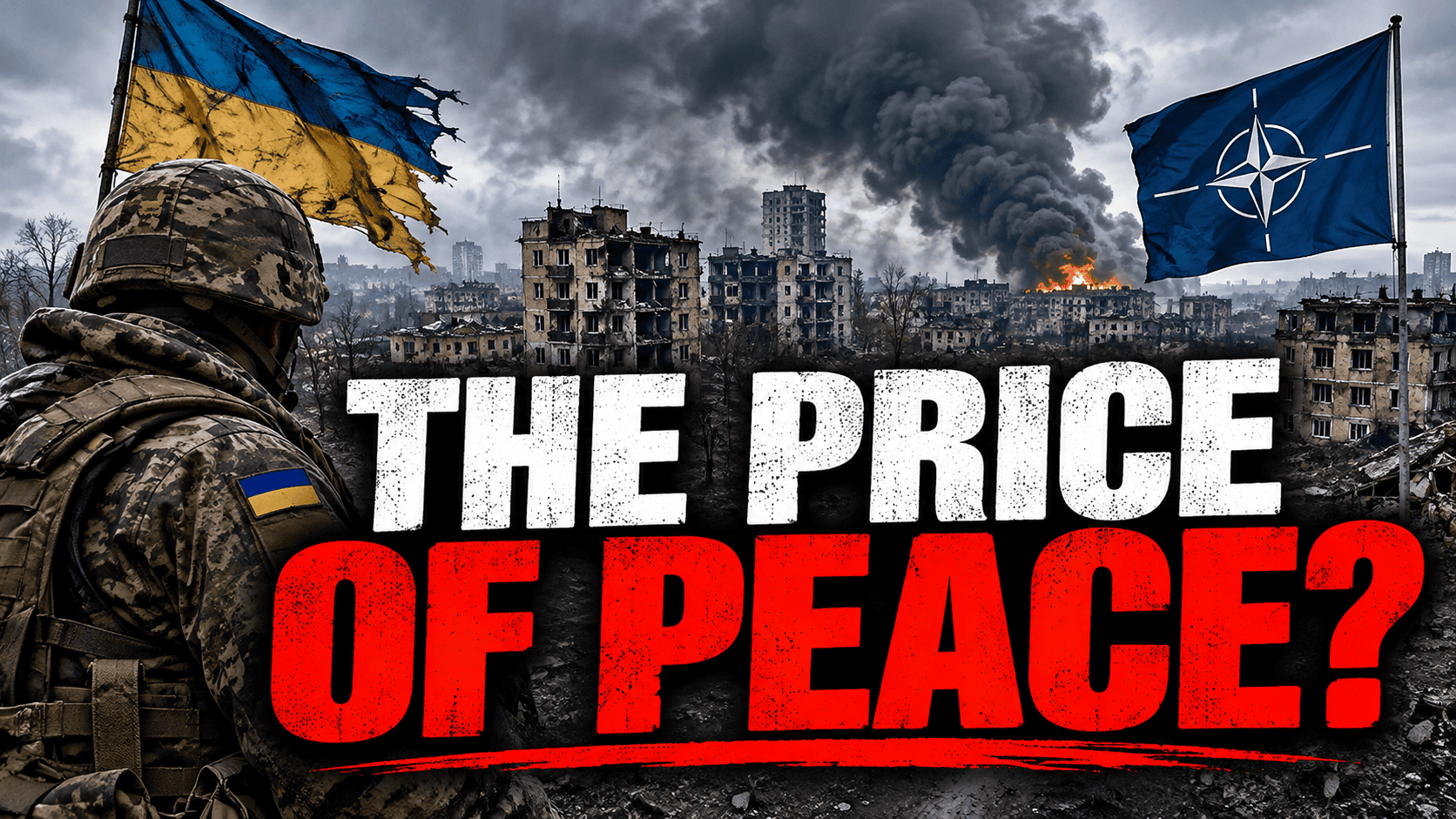
Washington’s latest reported negotiating idea raises a disturbing question: after years of bloodshed and billions in Western assistance, is Ukraine being pushed toward surrendering territory in exchange for a seat at NATO’s table?
There is something profoundly disturbing about the possibility that, after years of war, Washington is now discussing a deal that could require Ukraine to surrender territory to Russia in exchange for NATO membership.
According to Ukrainian President Volodymyr Zelensky, American negotiators raised the possibility of Ukraine withdrawing from the Donbas region in exchange for joining the military alliance during recent US-brokered peace discussions in Abu Dhabi.
It is an extraordinary proposition.
After years of fighting, enormous casualties, destroyed cities, displaced families, and billions of dollars in Western military and financial assistance, the future of Ukrainian territory is apparently becoming part of a negotiating equation.
But there is a much bigger question lurking beneath this latest development.
What exactly has this war been building toward?
THE PRICE OF A SEAT AT NATO’S TABLE
The reported proposal presents Ukraine with an extraordinarily difficult dilemma.
Zelensky says American negotiators asked whether Ukraine would withdraw from Donbas if NATO membership were offered in return. He described this as the first time the two issues had been directly linked during negotiations.
However, Zelensky has made clear that Ukraine is not prepared to simply surrender its territory.
He has also indicated that a comprehensive agreement involving security guarantees, a strong Ukrainian military, and reconstruction assistance could potentially be presented to the Ukrainian public for a referendum.
That distinction matters.
This is not an announced agreement, nor has Washington publicly confirmed the precise proposal described by Zelensky. But the fact that such an arrangement is reportedly being discussed raises serious questions about the direction of American diplomacy.
For Moscow, control of Donbas has been a central objective. For Kyiv, surrendering the remaining territory it controls would represent an enormous political and strategic concession.
And for NATO, accepting Ukraine as a member would carry consequences extending far beyond the current battlefield.
This is not simply a land-for-membership transaction. It could reshape Europe’s security architecture for generations.
BILLIONS SPENT. LIVES DESTROYED. AND NOW WHAT?
Western governments have repeatedly justified their support for Ukraine as essential to defending sovereignty, protecting democracy, and preventing territorial conquest through military force.
Those arguments have been used to justify enormous financial commitments, weapons deliveries, sanctions, and years of escalating confrontation with Moscow.
Yet now, according to Zelensky, Washington has raised the possibility of Ukraine withdrawing from territory as part of a potential arrangement.
That creates an uncomfortable contradiction.
If territorial sovereignty was such a fundamental principle throughout this conflict, how does surrendering territory become an acceptable negotiating instrument?
There may be legitimate arguments for compromise when the alternative is continued bloodshed. Wars do not always end with one side achieving everything it wanted.
But the Ukrainian people deserve to know precisely what is being negotiated in their name.
They deserve more than vague promises, diplomatic language, and another package of assurances that may or may not survive the next political crisis.
Security guarantees are only meaningful if someone is prepared to enforce them.
And NATO membership is not a simple bargaining chip. It comes with enormous strategic implications for every member of the alliance.
PUTIN’S OBJECTIVES HAVE NOT DISAPPEARED
The Kremlin has consistently opposed Ukraine joining NATO and has demanded broader changes to Europe’s security arrangements.
Russia’s position has extended beyond the immediate territorial dispute, including demands concerning NATO’s military presence in countries that joined the alliance after 1997.
Those demands raise concerns extending well beyond Ukraine.
If negotiations ultimately involve both territorial concessions and changes to Europe’s wider security structure, the consequences could reach countries that have nothing to do with the fighting on the ground.
European governments also have a legitimate reason to be concerned about decisions that could fundamentally alter their security environment.
There is a danger that negotiations focused on ending the immediate war could become negotiations over the future balance of power across the entire continent.
That is an enormous responsibility.
WHO GETS THE FINAL SAY?
Perhaps the most important question is also the simplest.
Who has the authority to decide whether Ukrainian territory should be surrendered?
Not Washington.
Not Moscow.
And certainly not NATO officials negotiating behind closed doors.
Ukraine is a sovereign country. Its people are the ones who have endured the destruction, the casualties, and the displacement.
Zelensky has acknowledged that such a comprehensive agreement could require a public referendum rather than a decision made by him alone.
That is an important distinction.
If a territorial compromise is ultimately considered, Ukrainians must understand exactly what they are being asked to accept, what security guarantees they would receive, and what happens if those guarantees are broken.
There can be no blank cheque.
THE WAR MACHINE MUST EVENTUALLY GIVE WAY TO REALITY
There is a point at which governments must confront the consequences of their decisions.
The endless cycle of weapons, sanctions, military escalation, diplomatic threats, and political promises cannot continue indefinitely without someone asking what the final destination actually looks like.
Ukraine has paid an enormous price.
Russia has paid an enormous price.
And ordinary people across Europe and beyond have been forced to live with the economic and geopolitical consequences.
If a negotiated settlement can prevent further deaths, it deserves serious consideration. But peace cannot simply be declared a victory by politicians eager to escape responsibility for what came before.
A deal that exchanges Ukrainian territory for NATO membership would represent one of the most consequential decisions in this conflict.
It would also raise questions that cannot be buried beneath diplomatic announcements.
After all the lives lost and all the money spent, is this what victory was supposed to look like?
And perhaps the most uncomfortable question of all:
If surrendering territory is now being discussed as part of the path to peace, why did it take so many years, so much destruction, and so many dead people to get here?
The people of Ukraine deserve answers. They deserve a future that does not depend on another round of political promises.
And the rest of the world deserves to know whether this is genuinely the beginning of peace—or simply another geopolitical bargain whose consequences have yet to be understood.
SOURCES
Reuters — US floated idea of Ukraine ceding Donbas for NATO membership, Zelenskiy says (November 14, 2026)
CBS News — U.S. floated exchanging Ukrainian territory for NATO membership, Zelenskyy says (November 15, 2026)
https://www.cbsnews.com/news/ukraine-russia-war-nato-us-donbas
The Washington Post — Russia seeks NATO pullback; Zelensky says U.S. asked about ceding territory (November 14, 2026)