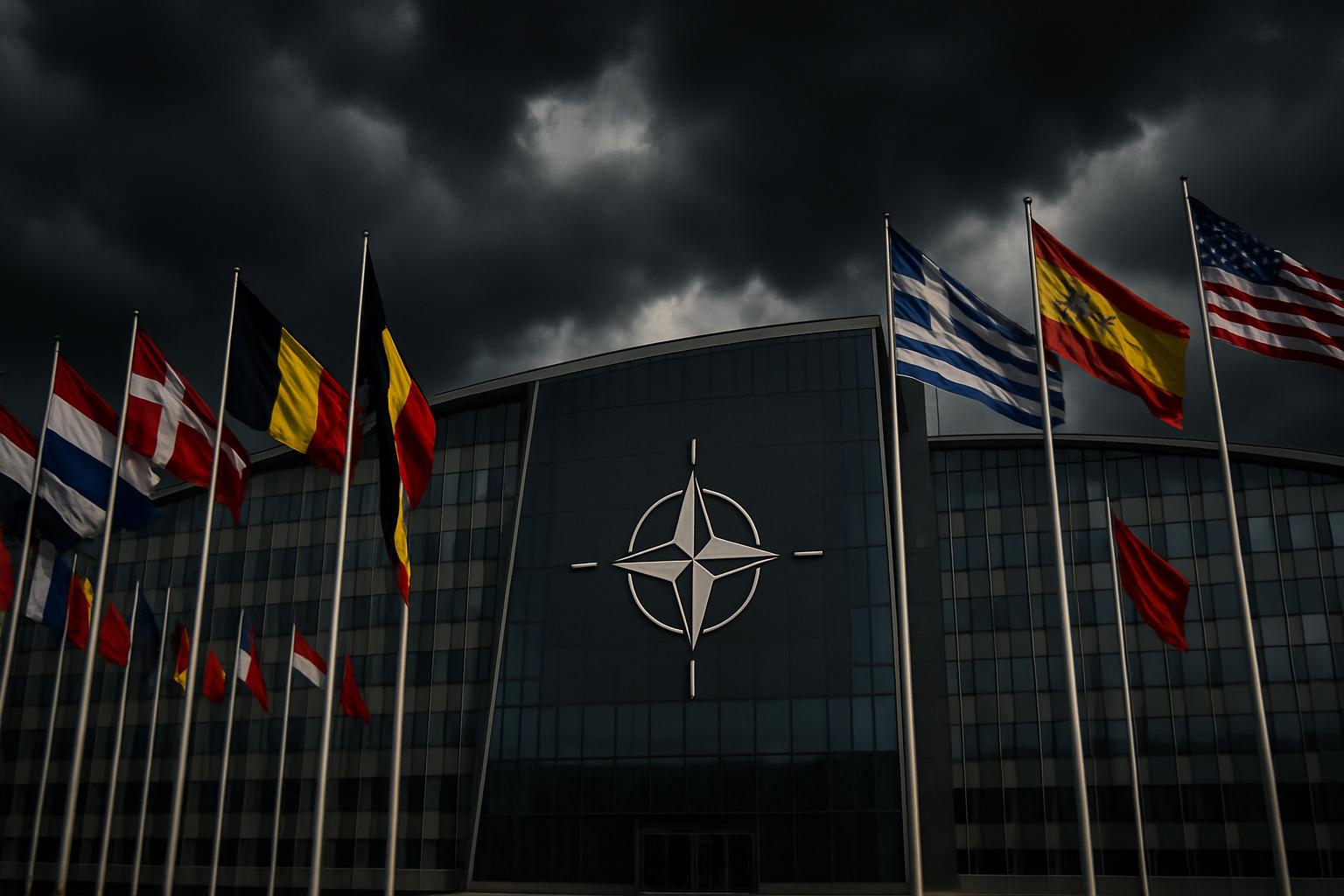
Europe is being pushed toward a confrontation it cannot afford. Moscow is demanding changes to NATO’s military presence, Western leaders are refusing to retreat, and the diplomatic space needed to prevent a catastrophic miscalculation appears to be shrinking.
Europe is once again staring into the abyss.
NATO insists its military posture is defensive. Moscow insists the alliance’s expansion and military presence threaten Russian security. Both sides are reinforcing their positions, issuing warnings and preparing for the possibility that the other side may eventually cross a line.
But there is a question that seems to be getting lost in all the military planning, diplomatic statements and political posturing:
What happens when neither side believes it can afford to back down?
That is the danger Europe is facing. Not necessarily an intentional decision to start a war, but the possibility that escalating pressure, miscalculation and political stubbornness could create a confrontation neither side originally intended.
And if that happens, the consequences could extend far beyond the European continent.
MOSCOW IS DEMANDING MORE THAN A UKRAINE SETTLEMENT
Russia is not simply negotiating over Ukrainian territory.
Moscow has returned to demands involving NATO’s military presence in Eastern Europe, including proposals to roll back deployments to positions held before 1997.
Such demands would affect numerous countries that joined NATO after that date, including Poland and the Baltic states.
For Moscow, this is about reshaping Europe’s security arrangements and limiting NATO’s military reach.
For NATO members, accepting those demands would raise fundamental questions about national sovereignty, collective defence and the right of independent countries to determine their own security arrangements.
These are not minor disagreements that can be brushed aside with another diplomatic statement.
They strike at the foundation of the European security order.
According to reporting published by The Washington Post on November 14, Russia’s latest negotiating demands include restrictions on NATO deployments, Western military assistance to Ukraine and Ukraine’s future relationship with the alliance.
The question is whether Moscow genuinely believes these demands can be negotiated or whether they are designed to divide Western governments and create pressure for concessions.
Either possibility presents a serious challenge.
NATO’S DETERRENCE STRATEGY HAS A DANGEROUS SIDE
NATO’s position is understandable.
Its members do not want to give Moscow the impression that military intimidation can force sovereign countries to surrender their security arrangements.
The alliance believes credible military strength is essential to preventing an attack.
That is the purpose of deterrence: convincing an adversary that the cost of aggression would be unacceptable.
But deterrence is not a complete foreign policy.
It is one component of a much larger strategy.
Military strength without effective communication can create dangerous misunderstandings. Statements intended to reassure one side can sound threatening to the other. Military exercises intended to demonstrate readiness can be interpreted as preparations for something more aggressive.
And when both sides begin interpreting every move through the lens of potential hostility, the margin for error becomes increasingly narrow.
NATO Secretary General Mark Rutte has previously rejected Moscow’s nuclear warnings and maintained that the alliance has no intention of attacking Russia.
That distinction matters.
But it does not eliminate the possibility of an incident escalating beyond what either side intended.
THE NUCLEAR QUESTION NOBODY CAN AFFORD TO IGNORE
Russia is a nuclear power.
So is the United States, and several NATO members operate within a broader nuclear deterrence framework.
That reality makes the current confrontation fundamentally different from an ordinary geopolitical dispute.
In September, Reuters reported that Moscow had warned NATO it could resort to its full military arsenal, including nuclear weapons, if the alliance attempted to isolate the Russian exclave of Kaliningrad.
NATO rejected the warning.
But nuclear threats should never become routine background noise in international politics.
Every escalation increases the importance of reliable communication, crisis management and clear military boundaries.
There is no guarantee that a conflict between Russia and NATO would remain conventional.
There is also no reason to assume that either side wants such an outcome.
That is precisely why preventing miscalculation must become a priority.
A war between nuclear powers would not produce a meaningful political victory for ordinary Europeans, Russians, Canadians or Americans.
It could produce consequences that last generations.
EUROPE IS TALKING ABOUT SECURITY — BUT WHO IS TALKING ABOUT DE-ESCALATION?
Here is where the situation becomes particularly troubling.
On November 16, Reuters reported that European Union foreign ministers considered broader security discussions with Moscow premature until Russia agrees to a ceasefire in Ukraine and makes meaningful concessions.
Their concerns are understandable.
European governments do not want Russia using negotiations over Europe’s security architecture to distract from the war in Ukraine or obtain concessions without addressing its military actions.
But there is an important distinction between negotiating a settlement and maintaining communication to prevent a wider war.
Those two objectives should not be confused.
Europe can refuse to accept Russia’s demands while still maintaining diplomatic channels.
It can support Ukraine while pursuing mechanisms to prevent accidental military confrontation.
It can strengthen NATO’s eastern defences while discussing military transparency, incident prevention and escalation management.
None of those actions requires abandoning Europe’s principles.
They require political maturity.
THE MISSING PIECE: AN OFF-RAMP
The most dangerous diplomatic situations are often those in which leaders become trapped by their own public positions.
Moscow cannot easily abandon demands it has repeatedly presented as essential to Russian security.
NATO governments cannot simply surrender the security guarantees of their members.
Ukraine cannot be expected to accept a settlement that leaves it vulnerable to another invasion.
These competing positions create an extraordinarily difficult negotiating environment.
But difficult does not mean impossible.
A serious diplomatic framework could explore reciprocal military transparency, restrictions on certain deployments near sensitive borders, improved military communication channels and agreements designed to prevent accidental encounters from becoming military confrontations.
Such arrangements would require verification, enforceable commitments and the participation of the countries whose security would be affected.
They would not resolve every underlying disagreement.
But they could reduce the immediate risk.
And that should matter to every government involved.
The objective should not be to reward aggression or allow one country to dictate another country’s future.
The objective should be to prevent a regional war from becoming something much larger.
ORDINARY EUROPEANS ARE THE ONES WHO WILL PAY
While political leaders debate military deployments, territorial arrangements and strategic influence, ordinary people are left watching the situation deteriorate.
Families worry about their children.
Businesses worry about economic instability.
Governments prepare for higher defence spending while citizens already struggle with the cost of living.
The possibility of a direct NATO-Russia confrontation would introduce an entirely different level of uncertainty into European life.
Energy markets, transportation, international trade and financial stability could all be affected.
And unlike the political figures making the decisions, ordinary citizens have very little influence over how an international crisis unfolds once military escalation begins.
That is why the public deserves more than speeches about strength and resolve.
It deserves to hear what governments are doing to prevent the worst possible outcome.
THE REAL DANGER IS LOSING CONTROL OF THE ESCALATION
Nobody should confuse diplomacy with weakness.
Nor should anyone confuse military preparedness with a guarantee of peace.
Both are necessary.
Russia’s invasion of Ukraine has fundamentally damaged European security, and NATO members have legitimate reasons to protect their territories and populations.
But the existence of legitimate security concerns on one side does not eliminate the need to understand the risks perceived by the other.
A functioning diplomatic strategy must recognize those realities without surrendering fundamental principles.
The Financial Times has argued in its November 16 coverage that Europe needs to combine military preparedness with renewed efforts to communicate with Moscow and reduce the risk of miscalculation.
That is an argument worth taking seriously.
The alternative is a dangerous cycle in which every military response creates another political reaction, every warning produces another warning, and every diplomatic opening is dismissed before it can be explored.
History has shown that international crises can become extremely dangerous when leaders underestimate the consequences of their own decisions.
Europe does not need another war.
It needs a credible security arrangement that protects sovereign nations, prevents aggression and leaves room for diplomacy.
Because deterrence may prevent an attack. But only diplomacy, communication and political judgment can help prevent a confrontation from spiralling out of control.
And that brings us back to the question nobody in Europe should be afraid to ask:
If NATO and Russia are both determined not to back down, who is actually working to make sure neither side crosses the point of no return?
SOURCES
- Reuters — Holding talks with Russia on Europe’s security now would be premature, EU ministers say — November 16, 2026
https://www.reuters.com/business/finance/holding-talks-with-russia-europes-security-now-would-be-premature-eu-ministers-2026-11-16/ - The Washington Post — Russia seeks NATO pullback; Zelensky says U.S. asked about ceding territory — November 14, 2026
https://www.washingtonpost.com/world/2026/11/14/russia-seeks-nato-pullback-zelensky-says-us-asked-about-ceding-territory/ - Reuters — Russia sends nuclear warning to NATO as tensions rise in the Baltic — September 30, 2026
https://www.reuters.com/business/aerospace-defense/russia-issues-nuclear-warning-nato-tensions-rise-baltic-2026-09-30/ - Financial Times — Europe needs to talk to Russia — November 16, 2026
https://www.ft.com/content/386813f4-2bf6-4fbe-9ab7-5f0c57f8e593 - NATO — Relations with Russia
https://www.nato.int/en/what-we-do/partnerships-and-cooperation/relations-with-russia