
CHRIS WICK NEWS | HEALTH, POWER & ACCOUNTABILITY | NOVEMBER 18, 2026
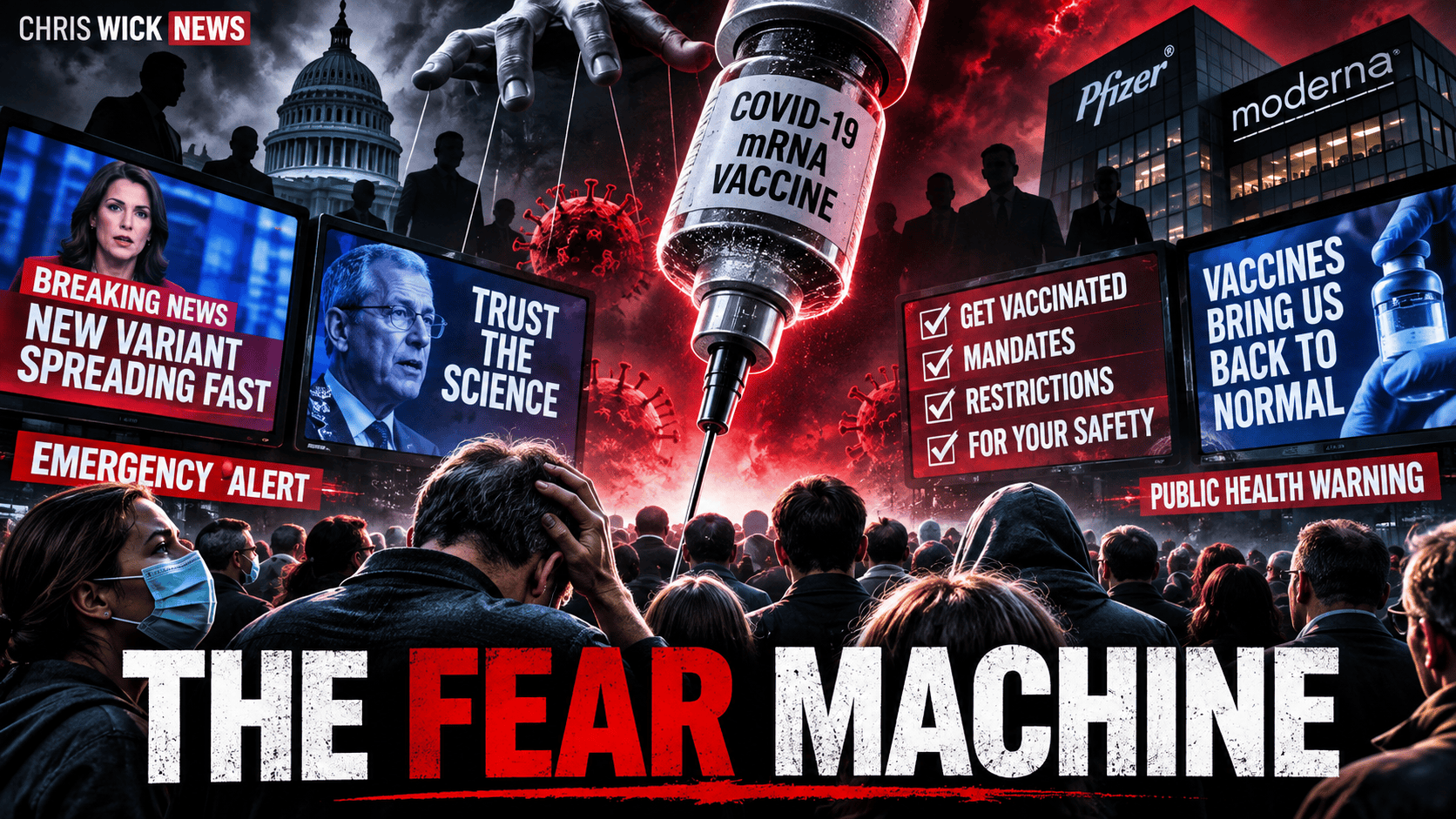
They told the public to trust the science. But when the science changed, did the messaging change with it—or did protecting public confidence become more important than asking difficult questions?
The Fear That Changed Everything
Fear is a powerful political weapon. It can empty streets, close businesses, silence dissent, and convince entire populations to surrender freedoms they once considered untouchable.
During the COVID-19 pandemic, fear also became the backdrop for one of the largest vaccination campaigns in human history.
Governments promised a path back to normal. Pharmaceutical companies delivered vaccines at unprecedented speed. News organizations amplified official health guidance. Social media platforms restricted certain claims about vaccine safety and effectiveness.
The public was repeatedly told to trust the science.
But science is not a slogan. It is a process of testing, questioning, challenging assumptions, and correcting mistakes.
And that raises an uncomfortable question: When did questioning public-health policy become something authorities treated as a threat rather than an essential part of scientific debate?
The Difference Between Emergency Authorization and Proven Certainty
The first COVID-19 mRNA vaccines were authorized after large clinical trials demonstrated strong short-term protection against symptomatic disease. They were not simply experimental injections released without evidence.
But important questions remained.
How long would protection last? How effectively would vaccination prevent transmission? What rare adverse effects might emerge after millions of doses? How would benefits and risks differ by age and medical history?
These were legitimate scientific uncertainties, not conspiracy theories.
Early public messaging sometimes conveyed more certainty than the evolving evidence justified, particularly about preventing infection and transmission.
As new variants emerged, breakthrough infections became increasingly common, and recommendations changed.
The vaccines continued to show important protection against severe disease, particularly among higher-risk populations. But the public also learned that vaccination was not a permanent barrier against infection.
That distinction mattered.
A vaccine can provide meaningful medical benefits without every government promise surrounding it being accurate.
When Public Health Became a Loyalty Test
The pandemic created an atmosphere in which medical decisions became political identities.
Workers faced vaccination requirements. Travellers encountered restrictions. Families argued. Public figures who challenged official policies were sometimes branded dangerous or irresponsible.
Some misinformation genuinely threatened public health. But not every criticism of mandates, pharmaceutical companies, or government communication was misinformation.
There is a fundamental difference between spreading a false medical claim and demanding transparent evidence.
When authorities blur that distinction, they risk destroying the trust they claim to defend.
A healthy democracy should be capable of acknowledging vaccine benefits while investigating coercive policies, conflicts of interest, communication failures, and adverse-event monitoring.
Instead, too much public debate became a contest between unquestioning loyalty and blanket rejection.
Neither approach serves the public.
The Pharmaceutical Money Nobody Should Ignore
COVID-19 vaccination generated enormous revenues for manufacturers, including Pfizer and Moderna.
Those revenues do not prove fraud. Nor do they invalidate clinical-trial findings.
But they make independent oversight essential.
When billions of public dollars flow into private pharmaceutical companies, citizens deserve clear answers about procurement contracts, liability protections, pricing, lobbying, and the evidence supporting recommendations.
They also deserve accurate information about risks.
Post-authorization surveillance identified rare cases of myocarditis and pericarditis associated with mRNA vaccination, particularly among adolescent and young adult males. Regulators subsequently updated safety warnings and guidance.
Recognizing those risks does not mean ignoring the risks of COVID-19 itself.
It means refusing to pretend that medical interventions are beyond scrutiny.
The Narrative Machine Had a Weakness: Reality Kept Changing
Public-health officials faced a rapidly evolving emergency. Some decisions were made under extraordinary uncertainty, and not every mistaken prediction was evidence of deliberate deception.
But uncertainty should have encouraged humility.
Instead, categorical statements, political pressure, simplified headlines, and social-media enforcement sometimes created the impression that official recommendations were settled truths.
When recommendations changed, some citizens saw scientific progress. Others saw broken promises.
Both reactions were predictable.
The deeper failure was not that science evolved. Science is supposed to evolve.
The failure was allowing public confidence to depend on a level of certainty the evidence could not always support.
The Questions That Still Deserve Answers
Years after the initial vaccine rollout, public accountability should not be controversial.
Governments should explain how mandates were justified, how proportionality was assessed, how adverse events were investigated, and how dissenting scientific opinions were handled.
Manufacturers should face rigorous independent scrutiny. Regulators should publish understandable evidence. Journalists should challenge official claims as aggressively as they challenge unsupported claims from critics.
And citizens should never be expected to confuse legitimate scientific uncertainty with a reason for blind obedience.
The COVID-19 vaccines were not untested, and the evidence does not support claiming they offered no protection. But neither were every policy, promise, and public-relations campaign surrounding them beyond criticism.
The real scandal would be learning nothing from the mistakes.
Because the next emergency will come.
And when it does, the public deserves something better than another demand for unquestioning trust.
It deserves evidence, transparency, informed consent, and the freedom to ask questions without being treated as the enemy.
Sources and further reading
- FDA — Comirnaty approval and clinical evidence
- CDC — COVID-19 vaccine safety information
- WHO — COVID-19 vaccines advice
- Health Canada — COVID-19 vaccines and treatments