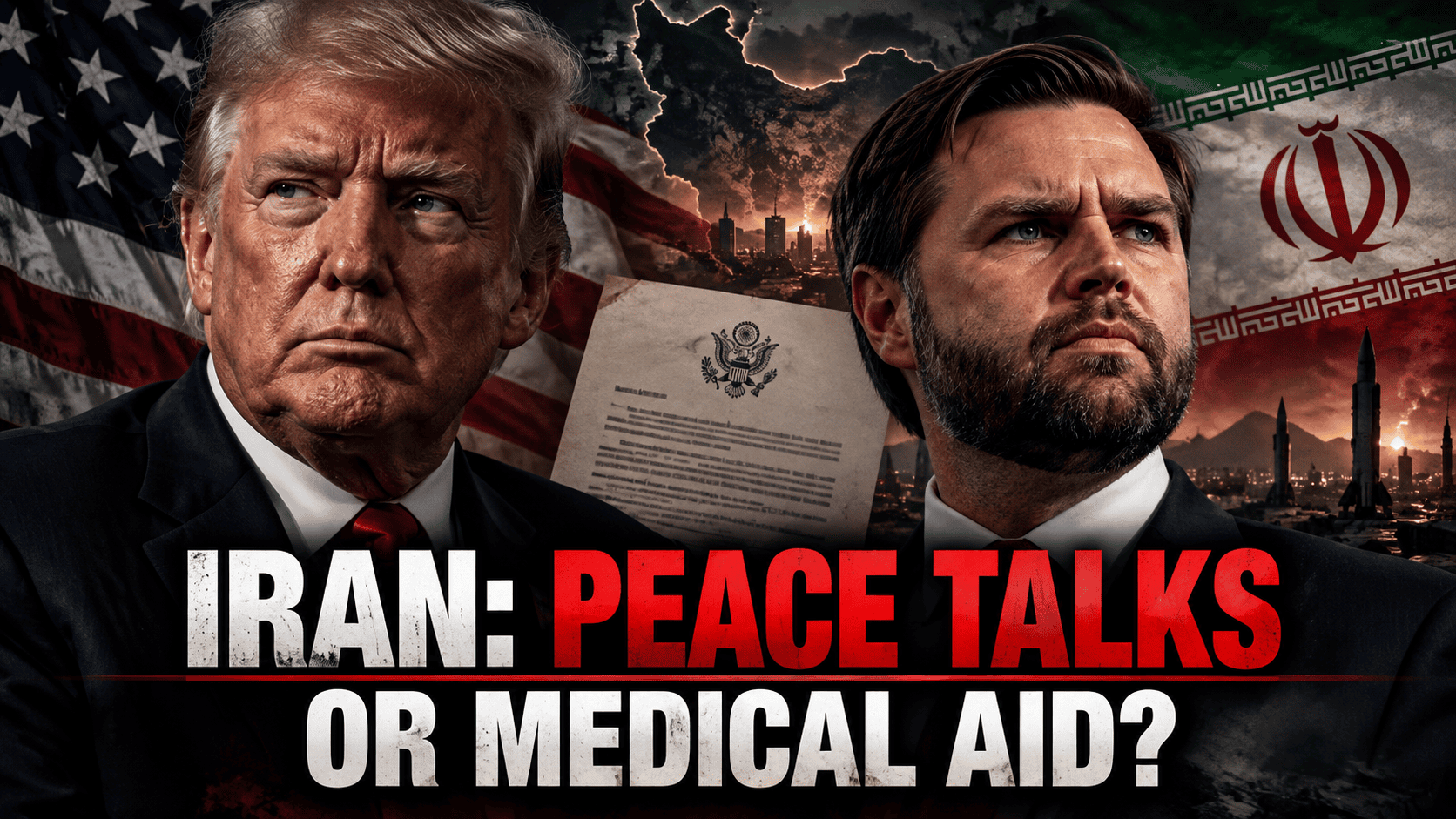
The White House says it was about humanitarian assistance. Other reports suggest it was an attempt to restart peace negotiations. And somewhere between those two explanations lies another unanswered question about Washington’s intentions toward Iran.
U.S. President Donald Trump has acknowledged that Vice President JD Vance contacted Iranian officials, but insists the outreach concerned medical supplies rather than an effort to revive stalled peace negotiations.
That explanation conflicts with accounts from American and Iranian officials reported by several news organizations, raising questions about whether the administration is publicly minimizing a diplomatic initiative while simultaneously maintaining military pressure on Tehran.
The distinction matters. A letter offering medicine is one thing. A letter proposing negotiations to end a war is something entirely different.
And with the United States considering renewed military operations against Iran, the timing could hardly be more consequential.
A Letter to Tehran — and Two Different Explanations
According to Reuters, Vance contacted Mohsen Rezaei, the head of Iran’s Supreme National Security Council, through a letter received by Tehran.
The Wall Street Journal and The New York Times reported that the communication was intended to reopen peace negotiations between Washington and Tehran.
Trump offered a different explanation.
Speaking to reporters Wednesday, the president denied directing Vance to restart negotiations. Instead, he characterized the communication as an effort to help Iran obtain medical supplies for civilians.
______________________________________________
🔴 Help keep this independent voice alive and uncensored.
Support independent journalism and help keep Chris Wick News going.
👉 Support Chris Wick on GoFundMe
Trump indicated that Vance had asked for his opinion about providing humanitarian assistance and that he had approved the idea.
However, reporting by Axios and The New York Times presents a considerably broader picture.
Axios reported that Vance’s communication addressed the possibility of restarting negotiations and emphasized that Iran’s nuclear program would have to be included in any discussions.
The New York Times, citing American and Iranian officials, reported that Vance proposed renewed direct negotiations and indicated that he would lead the American delegation.
These accounts have not been independently verified by Chris Wick News.
Nevertheless, the discrepancy raises an obvious question.
Why would an administration describe an apparent diplomatic initiative primarily as humanitarian assistance if the communication also addressed negotiations over the future of the conflict?
There could be several explanations, including efforts to preserve negotiating flexibility or avoid publicly committing to talks before Iran responds.
The available evidence does not establish which explanation is correct.
Washington’s Humanitarian Message Meets Its Economic Blockade
The medical-supplies explanation introduces another uncomfortable dimension.
The United States has imposed a naval blockade on Iran and intensified economic restrictions intended to reduce Tehran’s oil revenue and weaken its ability to sustain the conflict.
Iran has repeatedly argued that American sanctions and restrictions obstruct civilian access to essential goods, including medicine and medical equipment.
In August, Tehran accused Washington of deliberately depriving civilians of necessities through its economic pressure campaign.
Those allegations are Iran’s position, not independently established findings.
Nevertheless, the contradiction deserves examination.
Washington is pursuing policies designed to exert severe economic pressure on Iran while simultaneously presenting an offer to facilitate medical assistance.
Humanitarian assistance and economic sanctions are not necessarily incompatible. Sanctions systems can contain exemptions for medicine and other essential goods.
But exemptions on paper do not automatically guarantee functioning supply chains, banking access, transportation or timely delivery.
That distinction is especially important during wartime.
The relevant question is not simply whether Washington is willing to provide medical supplies. It is whether the broader restrictions allow civilians to obtain the essential goods they need.
Without details about the proposed assistance, its delivery mechanisms or the restrictions that might be relaxed, Trump’s explanation leaves significant questions unanswered.
Is JD Vance Becoming Washington’s Diplomatic Back Channel?
Vance’s involvement is particularly significant because of his previous role in negotiations with Iran.
The vice president participated in diplomatic efforts earlier this year, including talks in Pakistan that failed to produce a lasting resolution.
He has also publicly expressed skepticism about prolonged American military interventions.
That history makes him a potentially useful intermediary for an administration attempting to combine military pressure with renewed diplomacy.
According to reporting by The New York Times, the letter was delivered through Qatari intermediaries and proposed direct negotiations.
Axios separately reported that the communication addressed Iran’s nuclear program, one of the central obstacles to any agreement.
If those accounts are accurate, the outreach represents more than an isolated humanitarian gesture.
It suggests that Washington may be exploring another diplomatic opening while avoiding a public commitment to negotiations.
That would not necessarily be unusual.
Governments frequently use private communications to test whether an adversary is prepared to negotiate before announcing formal discussions.
What makes this situation different is the contradiction between the reported contents of the letter and the president’s public description.
Until the letter is released or its contents are independently confirmed, that contradiction remains unresolved.
The War Is Becoming an Expensive Political Problem
The diplomatic uncertainty comes against the backdrop of a conflict that has already imposed substantial military and economic costs.
The United States and Israel launched military operations against Iran in late February.
Eight months later, Washington has yet to secure a durable agreement ending the conflict.
According to The Washington Post, an assessment prepared by U.S. Central Command estimated that American military operations had cost more than $47 billion through mid-October.
That reported figure includes approximately $29 billion in expended munitions and another $6 billion associated with destroyed military platforms.
The assessment does not account for every potential cost of the conflict.
Meanwhile, disruptions involving the Strait of Hormuz and regional energy supplies have contributed to higher energy prices and economic uncertainty.
Those consequences extend far beyond the Middle East.
Consumers and businesses around the world are exposed to rising transportation, fuel and production costs when major energy supply routes become unstable.
The political consequences are particularly important for Trump.
With the November midterm elections approaching, the administration faces pressure over the economic effects of the war.
Renewed negotiations could provide a diplomatic opportunity.
Another escalation could introduce additional military costs, economic disruption and political risks.
Neither outcome is guaranteed.
But the incentives for exploring diplomacy are increasingly apparent.
Qatar’s Peace Efforts Face a Familiar Obstacle
Vance’s outreach comes as Qatar continues efforts to mediate between Washington and Tehran.
Reuters reported that Qatari mediators presented Iran with a proposed agreement intended to end the war.
A senior Iranian official subsequently described the ideas as unacceptable.
Other reporting indicates that negotiations remain complicated by disagreements over the sequencing of concessions.
Iran wants relief from the American naval blockade and other economic restrictions.
Washington wants progress on nuclear restrictions and other security demands.
Both sides appear reluctant to surrender their principal bargaining leverage before receiving meaningful concessions.
This creates a familiar diplomatic deadlock.
Iran does not want to make major commitments while economic pressure remains in place.
The United States does not want to remove that pressure without assurances that Iran will meet its demands.
The result is a situation in which both governments have reasons to negotiate but substantial obstacles to reaching an agreement.
A letter from Vance might help reopen communication.
It cannot, by itself, resolve those underlying disagreements.
Medical Supplies, Peace Talks or Political Cover?
There is an important difference between identifying contradictions in official statements and claiming to know the motives behind them.
The available reporting establishes that Vance contacted Iranian officials and that Trump publicly characterized the communication as humanitarian.
Multiple news organizations have reported a broader diplomatic purpose, citing officials familiar with the outreach.
What remains uncertain is precisely what the letter contained, why Trump emphasized medical assistance and whether the communication will produce formal negotiations.
One possibility is that humanitarian assistance provided a relatively uncontroversial reason to establish contact.
Another is that the administration is attempting to preserve flexibility while evaluating Iran’s willingness to negotiate.
It is also possible that humanitarian and diplomatic objectives were both present.
Those possibilities should not be confused with verified conclusions.
Still, the episode illustrates a larger problem in modern diplomacy.
Governments often present carefully controlled explanations of their actions while the public receives only fragments of the underlying negotiations.
That makes independent scrutiny essential.
When an administration is simultaneously maintaining economic pressure, considering military escalation and communicating privately with an adversary, the public deserves a clear understanding of what its leaders are attempting to accomplish.
The Bigger Question: Is Washington Looking for an Exit?
The central issue is no longer simply whether JD Vance sent a letter.
It is whether the Trump administration is preparing for a diplomatic settlement, another round of military confrontation or some combination of both.
The costs of the conflict are mounting.
Regional governments are pressing for negotiations.
Iran continues to resist American demands while facing substantial economic pressure.
And Washington must consider the consequences of a prolonged conflict that has already disrupted energy markets and consumed billions of dollars.
Vance’s communication could represent a meaningful diplomatic opening.
It could also become another unsuccessful attempt to bridge differences that have repeatedly defeated negotiations.
For now, neither outcome can be established.
What is clear is that the administration’s humanitarian explanation does not fully address the broader diplomatic activity described in multiple reports.
Final Thought: The Public Deserves More Than Carefully Managed Explanations
There is something deeply troubling about a war in which the public can receive one explanation for a diplomatic communication while officials familiar with that same communication describe something substantially different.
That does not prove deception.
But it does justify skepticism.
If Washington is attempting to negotiate an end to the conflict, Americans deserve to know what objectives their government is pursuing.
If the outreach is genuinely limited to humanitarian assistance, the administration should be able to explain how that assistance will reach civilians and what restrictions might be affected.
And if both objectives are involved, acknowledging that reality would provide a clearer picture than leaving the public to reconcile conflicting accounts.
Wars are expensive. Diplomacy is complicated. But neither should require the public to accept incomplete explanations without asking questions.
The real test will not be what Washington calls the letter.
It will be whether the communication helps deliver humanitarian assistance, opens meaningful negotiations or leaves the region facing another escalation.
Sources
Reuters — Vance outreach to Iran related to medical supplies, says Trump
https://www.reuters.com/world/middle-east/vance-outreach-iran-related-medical-supplies-says-trump-2026-10-29/
Axios — Vance tells top Iranian official negotiations must address nuclear program
https://www.axios.com/2026/10/28/vance-iran-nuclear-talks-letter
The New York Times — Vance proposes restarting peace talks in outreach to Iranian official (republished by The Philadelphia Inquirer)
https://www.inquirer.com/news/nation-world/jd-vance-peace-talks-iran-20261029.html
The Washington Post — Vance makes Tehran outreach as Middle East braces for resumption of Iran war
https://www.washingtonpost.com/politics/2026/10/28/iran-war-costs-rise-47-billion-us-military-estimates/
Editorial note: This article combines verified public statements, attributed reporting and independent commentary. The complete contents of Vance’s communication have not been independently authenticated by Chris Wick News. Interpretations of diplomatic motives are presented as analysis rather than established fact.
Chris Wick News — Independent Journalism. Uncomfortable Questions. No Sacred Cows