
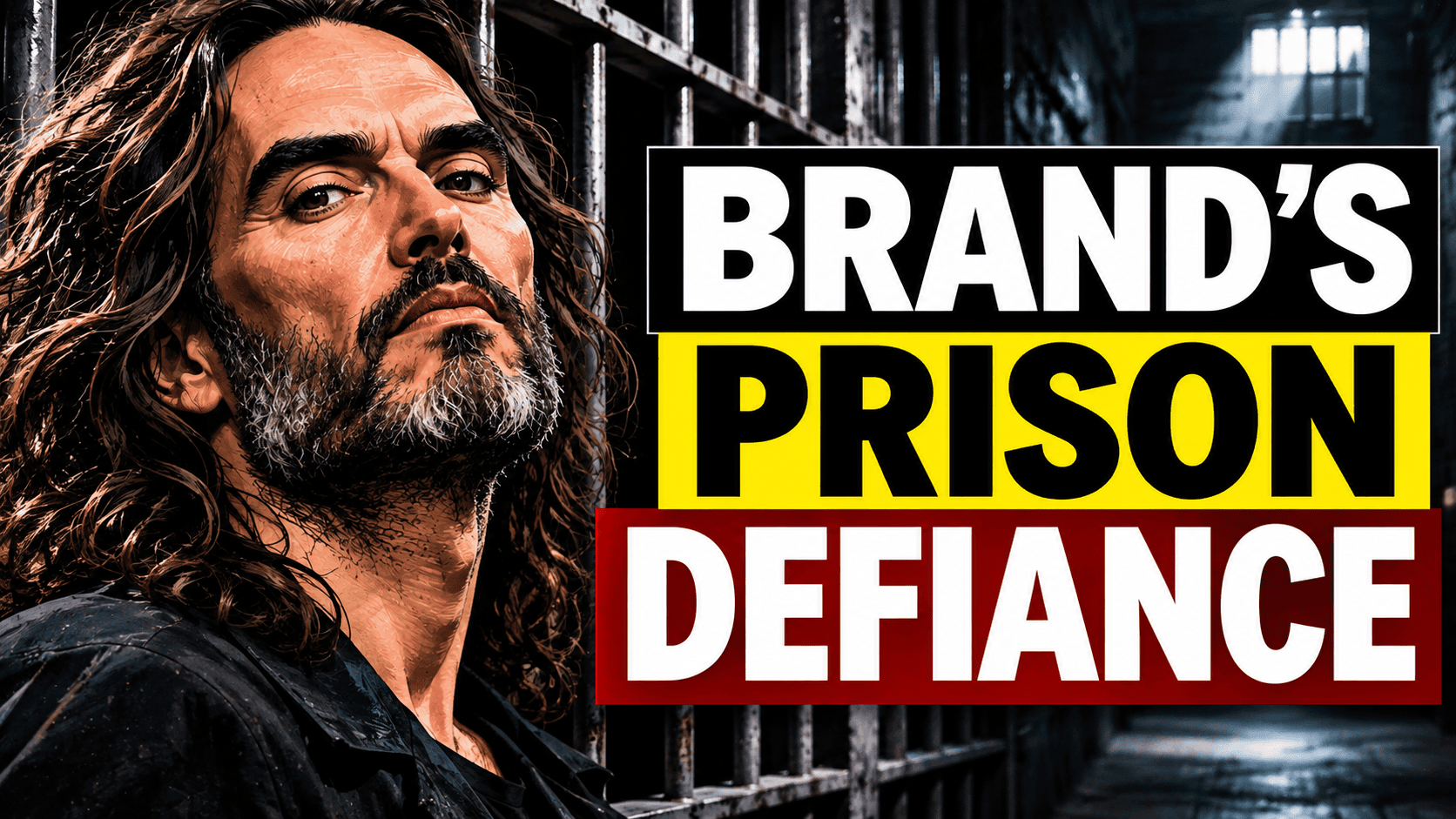
A prison cell was supposed to silence the celebrity circus surrounding Russell Brand. Instead, the disgraced British comedian has found another way to reach the outside world — and British authorities are not amused.
Just days after receiving a 10-and-a-half-year prison sentence for rape and sexual assault, Brand has triggered a fresh investigation after his wife delivered a defiant message to millions of YouTube subscribers.
His message was unmistakable: he still insists he is innocent.
But there is a problem.
Prisoners in Britain cannot simply use family members as broadcasting intermediaries to evade restrictions designed to protect victims.
Now authorities are investigating whether Brand crossed that line, potentially exposing him to additional disciplinary punishment. Reuters+1
From Hollywood Celebrity to Prison Inmate
Russell Brand, 51, once occupied a privileged position in entertainment.
He was a comedian, television personality, Hollywood actor and later a political commentator who built an enormous following by challenging establishment narratives.
His transformation into a Christian influencer introduced him to another audience, one that followed his religious broadcasts and public declarations of faith.
But on November 5, 2026, a jury at London’s Southwark Crown Court convicted Brand of one count of rape and three counts of sexual assault.
Four days later, Mr Justice Joel Bennathan sentenced him to 10 years and six months in prison.
The court’s official sentencing remarks confirmed the punishment and acknowledged the courage of the women who testified against him. Courts and Tribunals Judiciary
Brand has denied committing non-consensual sexual acts.
His denials, however, do not overturn the jury’s verdict.
The YouTube Message That Sparked Outrage
On November 15, Brand’s wife, Laura Gallacher, appeared during the couple’s Sunday Service broadcast on YouTube.
She read a message attributed to her husband, who was reportedly being held at HMP Littlehey in Cambridgeshire, a prison housing many convicted sex offenders.
Brand maintained his innocence and suggested something was seriously wrong with the circumstances of his imprisonment.
He also spoke about his Christian faith, forgiveness and the people he had encountered inside prison.
The message reached a channel with approximately 6.6 million subscribers.
For an ordinary prisoner, communication with the outside world is regulated.
For a celebrity with millions of followers, even a few sentences can become international headlines.
And that is precisely why the British government is taking the matter seriously. The Guardian+1
British Authorities Launch Investigation
The UK’s Ministry of Justice is investigating whether Brand’s message violated prison regulations.
Justice Secretary Alex Norris publicly condemned the broadcast and said he expected action if investigators established that rules had been broken.
The regulations are intended, among other things, to prevent prisoners from making public statements that cause serious distress to victims.
They also restrict communications intended for media publication.
Crucially, authorities have indicated that prisoners cannot automatically escape those restrictions by having relatives publish their statements.
If investigators determine that Brand knowingly arranged an unauthorized communication, he could face consequences including restricted telephone access, reduced privileges or other disciplinary measures.
Some reporting has also identified a possible sentence extension, although that is not an established outcome.
As of November 18, no finding that Brand violated prison rules has been confirmed. The Independent+1
The Victims Are Being Drowned Out by the Celebrity Machine
There is another side to this story, and it deserves far more attention than the celebrity spectacle.
The women whose testimony helped secure Brand’s conviction have already endured the criminal justice process.
Now they are watching the man convicted of attacking them maintain his innocence before an enormous online audience.
Mia Latter, who separately alleges Brand raped her when she was 16 and who was not a complainant in the recent trial, has publicly criticized the broadcast.
She described the message as insulting to the women involved in the trial and questioned YouTube’s responsibility in distributing it.
Her allegations are separate from the offences for which Brand was convicted.
The controversy raises a serious question about the responsibilities of digital platforms when prominent convicted offenders continue communicating publicly through intermediaries. The Guardian+1
Is Celebrity Status Becoming a Prison Loophole?
This is where the story becomes larger than Russell Brand.
Modern celebrity influence does not necessarily disappear when someone enters prison.
An audience remains. Social media accounts remain. Supporters remain. The machinery that once generated fame, attention and revenue can continue operating.
That does not automatically make every public message unlawful.
Prisoners retain legal rights, including the ability to challenge their convictions.
But there is a meaningful difference between pursuing an appeal through the courts and using a massive media platform in circumstances that might violate prison regulations.
The unanswered questions are straightforward.
Did Brand know his message would be broadcast? Was permission required or obtained? Was the communication prepared before or after his conviction? Did it breach rules intended to protect victims?
Those facts matter more than the size of his audience.
And investigators must establish them before imposing punishment.
Dark Final Thoughts: The Prison Walls Went Up, but the Celebrity Machine Kept Running
Russell Brand spent years building a career around challenging authority, questioning institutions and presenting himself as an outsider confronting powerful systems.
Now he is inside one of those systems.
The difference is that prison rules are not supposed to bend according to someone’s subscriber count.
Brand has the right to maintain his innocence and pursue lawful appeals.
The victims have the right to protection under the law.
And the public has the right to expect that prison regulations apply equally, whether someone has six followers or six million.
The real scandal would not be that Russell Brand continues speaking. It would be discovering that celebrity influence allows prisoners to bypass rules that everyone else must obey.
For now, that remains a question, not a proven violation.
But one thing is undeniable.
The courtroom delivered its verdict. The prison doors closed.
And somehow, Russell Brand still managed to make himself the headline.
Verified sources
- CBC News — Russell Brand under investigation for claiming innocence from prison
- Reuters — UK authorities investigate Russell Brand’s prison message
- The Guardian — Ministry of Justice investigation
- UK Judiciary — Official sentencing remarks, November 9, 2026