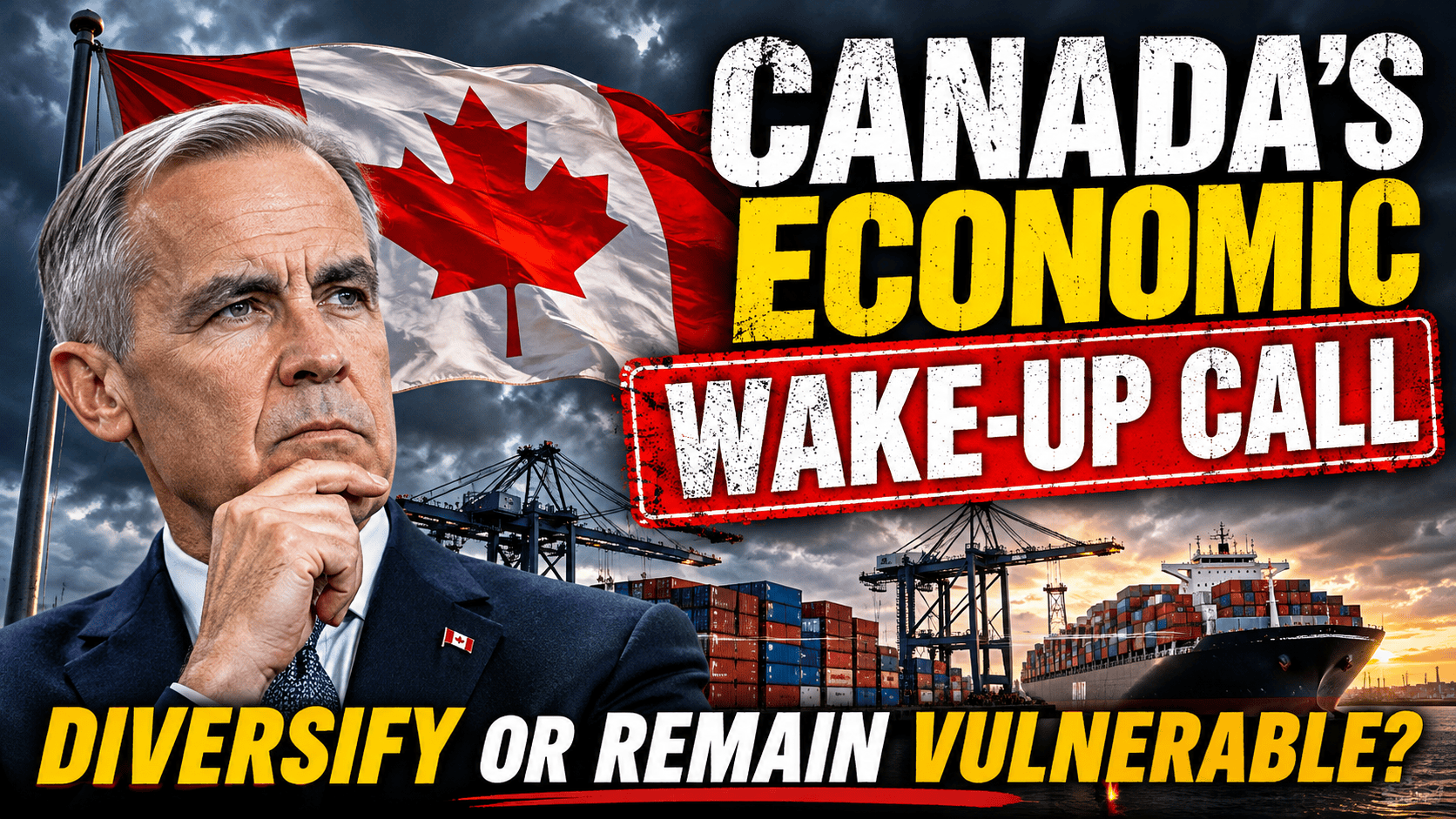
CANADA’S TRADE WAKE-UP CALL: WHY
The uncomfortable question is no longer whether Canada needs to diversify its economy. It’s why successive governments allowed the country to become so economically dependent on one trading partner in the first place.
Canada is once again talking about a trade deal with U.S. President Donald Trump. At the same time, Prime Minister Mark Carney is travelling internationally, pursuing new trade relationships and promising to reduce Canada’s dependence on the American market.
Both objectives may be necessary. But they expose a much bigger problem.
For decades, Canada treated its economic relationship with the United States as though it were practically guaranteed. That relationship generated enormous prosperity, created jobs and helped build industries on both sides of the border.
But there was a serious weakness in that arrangement: Canada became extraordinarily dependent on access to a market over which it has no control.
And now, that vulnerability is impossible to ignore.
For years, Canadian governments of different political stripes encouraged deeper economic integration with the United States. Businesses built supply chains around American customers. Manufacturers relied on cross-border production. Canada’s energy, automotive, steel, lumber and agricultural industries became deeply connected to the American economy.
It was profitable. It was convenient. And for a long time, it appeared relatively safe.
But dependence is not the same thing as security.
When Washington began using tariffs and economic pressure against its closest trading partners, Canada discovered just how much leverage another country could have over its economy.
According to reporting by The Washington Post, roughly three-quarters of Canada’s exports have traditionally gone to the United States.
That is an extraordinary concentration of economic risk for a country with access to global markets, enormous natural resources and a highly educated workforce.
Why wasn’t reducing that vulnerability treated as a national priority years ago?
Trump’s trade war exposed a weakness Ottawa should have addressed long ago
There is no question that the American market remains enormously important to Canada. Geography, established transportation networks, shared industries and decades of commercial relationships cannot simply be replaced.
But the problem was never that Canada traded with the United States.
The problem was allowing that relationship to become so dominant that political decisions made in Washington could send shockwaves through Canadian industries, workers and communities.
Tariffs are one weapon. Threats to existing agreements are another. Uncertainty surrounding the future of continental trade creates its own economic damage.
Businesses cannot confidently invest, hire or expand when the rules governing their largest export market can suddenly change.
Canada should never have needed a trade war to recognize that vulnerability.
Carney is finally looking beyond Washington
To his credit, Mark Carney appears to understand that Canada needs alternatives.
On November 14, Carney announced that negotiations on a free-trade agreement with the Association of Southeast Asian Nations had been substantially concluded. Separate negotiations with the Philippines had also been completed.
The ASEAN agreement involves a market of nearly 700 million people. Ottawa estimates it could add almost $2 billion to Canada’s economy and generate approximately 14,000 jobs.
The proposed Philippines agreement could also help triple Canadian exports to that country by 2035.
Carney has established an ambitious objective: double Canadian exports to countries outside the United States by 2035.
Those are meaningful developments, not simply another round of diplomatic photographs.
But there is a difference between announcing trade agreements and actually building an economy capable of benefiting from them.
The agreements still need to be signed and implemented. Canadian businesses need the capacity to reach those markets, and the infrastructure must exist to move products efficiently.
That is where the real work begins.
Canada cannot diversify its way out of trouble overnight
There is another uncomfortable reality Ottawa needs to acknowledge.
Canada cannot simply turn its back on the United States and expect other countries to absorb the economic activity that currently crosses the southern border.
The American market is enormous, geographically close and deeply integrated with Canadian manufacturing.
Replacing even a portion of that relationship will require years of investment, infrastructure development, new commercial relationships and sustained government commitment.
Canada needs better ports, more efficient rail connections, expanded energy transportation and stronger domestic manufacturing capacity.
It also needs to make it easier for Canadian companies to build, produce and export.
Trade agreements are useful, but agreements alone do not create prosperity.
If Ottawa wants Canadian businesses to compete internationally, it must give them the infrastructure, regulatory environment and investment conditions to succeed.
Otherwise, diversification risks becoming another political slogan that sounds impressive during international visits but delivers little for ordinary Canadians.
The United States relationship still matters
Reducing dependence does not mean abandoning the United States.
That would be economically foolish.
Canada and the United States share an enormous commercial relationship, and millions of Canadians depend on industries connected to American customers.
A sensible government should pursue a workable agreement with Washington while simultaneously creating alternatives.
Carney has recently reported progress in discussions with Trump, but he also made clear on November 14 that an agreement has not yet been reached.
He has said Canada will not accept a deal that undermines its automotive industry.
That position matters.
Canada should negotiate from a position of strength, not desperation.
A deal that temporarily reduces tariffs but leaves Canadian businesses exposed to another round of political pressure may solve today’s problem without addressing tomorrow’s.
The objective should be stability, predictability and respect for Canadian economic sovereignty.
The bigger question: Where was this strategy before the crisis?
This is where Canadians should be asking some difficult questions.
Why did successive governments allow Canada’s export economy to become so heavily concentrated in one market?
Why weren’t alternative trade relationships developed more aggressively when economic conditions were favourable?
Why did it take an American president threatening Canadian industries and imposing tariffs to make economic diversification an urgent national priority?
These are not exclusively questions for Carney’s government.
They belong to every administration that treated the American trading relationship as something Canada could rely on indefinitely.
The warning signs were there. The risks of excessive dependence were always present.
Now Canadians are being asked to accept the economic disruption while Ottawa works to correct a problem that should have been addressed long before this confrontation.
Canada needs a national strategy, not another photo opportunity
Mark Carney deserves credit if his government can turn its international trade ambitions into measurable results.
But Canadians should judge the government by outcomes, not announcements.
Are Canadian companies actually reaching new markets?
Are exports outside the United States increasing?
Are new manufacturing jobs being created?
Are major infrastructure projects moving forward?
Are Canadian industries becoming more resilient to political pressure from abroad?
Those are the questions that matter.
Canada has the natural resources, agricultural capacity, energy supplies, industrial expertise and geographic advantages to become a much stronger independent trading power.
But potential means very little without execution.
The goal should not be to replace American dependence with dependence on another country. It should be to build an economy with enough trading partners, domestic capacity and strategic flexibility that no single government can hold Canada’s economic future hostage.
The bottom line
Canada needs the United States. But Canada should never have to depend on Washington’s goodwill to protect its own economic future.
A serious diversification strategy is long overdue. Carney now has an opportunity to deliver one.
The question is whether this government will follow through when the headlines disappear and the difficult work begins.
And perhaps the most uncomfortable question of all is this:
If it took a trade war with Donald Trump to finally wake Ottawa up, how much economic opportunity did Canada lose by waiting this long?
Sources
- The Washington Post — Canada, pressured by Trump, wants new trade partners. Here’s why it’s hard.
https://www.washingtonpost.com/world/2026/08/26/canada-pressured-by-trump-wants-new-trade-partners-heres-why-its-hard/ - Prime Minister of Canada — Prime Minister Carney delivers remarks on Canada-U.S. trade negotiations
https://www.pm.gc.ca/en/news/speeches/2026/08/22/prime-minister-carney-delivers-remarks-canada-us-trade-negotiations - Reuters — Mark Carney’s trade push collides with reality of U.S. dependence
https://www.investing.com/news/economy-news/mark-carneys-trade-push-collides-with-reality-of-us-dependence-4732000