November 9, 2026 | Chris Wick News | Technology & Geopolitics
The world’s artificial intelligence boom has a problem nobody in Silicon Valley wants to talk about: what happens when the man at the centre of the industry becomes the subject of a national security controversy?
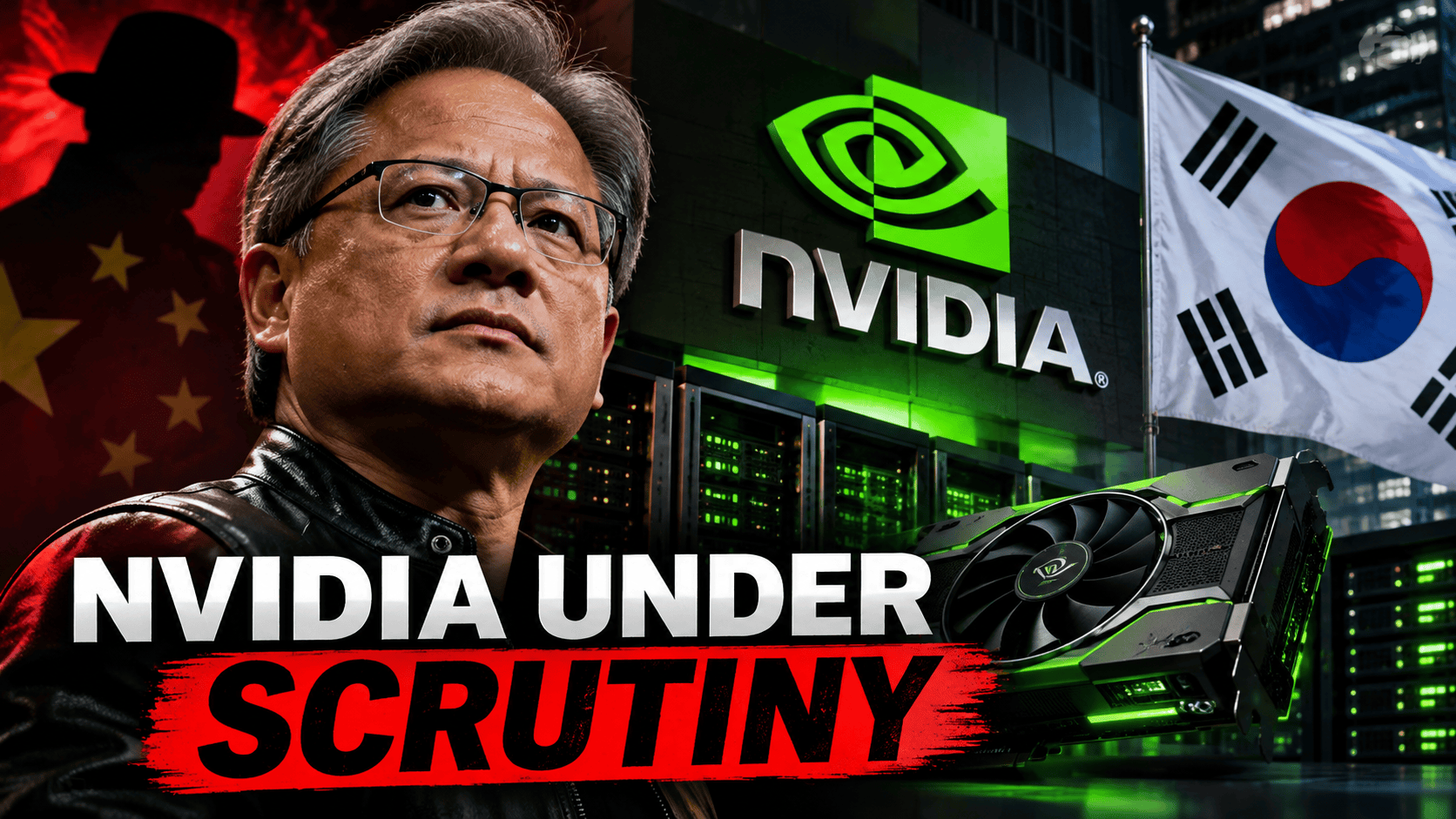
That’s the uncomfortable question hanging over Nvidia as CEO Jensen Huang faces scrutiny following allegations involving a suspected Chinese intelligence operation.
And while Nvidia’s board investigates, South Korea is making one thing painfully clear: whatever happens to Huang, the country’s AI ambitions cannot afford to become collateral damage.
South Korea Wants Its Chips, Not Silicon Valley’s Drama
South Korea’s Vice Minister of Science and ICT, Ryu Jemyung, told a parliamentary budget committee Monday that the country expects contracted Nvidia graphics processing units (GPUs) to arrive without disruption.
According to Reuters, 10,000 GPUs financed through a supplementary government budget in 2025 have already been delivered and are operating.
Additional processors ordered for 2026 are under contract and expected to enter service before the end of the year.
South Korean officials are monitoring developments and discussing delivery schedules and pricing with Nvidia Korea.
That’s reassuring on paper.
______________________________________________
🔴 Help keep this independent voice alive and uncensored.
Support independent journalism and help keep Chris Wick News going.
👉 Support Chris Wick on GoFundMe
But reassurance isn’t the same thing as certainty, especially when the company supplying some of the world’s most sought-after AI hardware is confronting questions about its chief executive.
The Intelligence Allegations Rocking Nvidia
Nvidia’s board announced an independent investigation Sunday following reports that Huang may have been targeted by a Chinese intelligence effort involving his relationship with businesswoman Alice Huang.
These remain allegations, not established findings of espionage or wrongdoing by Jensen Huang.
The company’s board stated that it had no reason to believe American national security or Nvidia’s confidential information had been compromised.
Huang has said he will cooperate with the investigation.
Nevertheless, the controversy has raised questions about corporate leadership, sensitive technology and the enormous influence concentrated around one individual.
Nvidia isn’t some obscure technology company. Its processors are central to AI development, data centres and increasingly important national technology strategies.
When uncertainty surrounds its leadership, the implications can extend far beyond shareholders.
The Fallout Has Already Reached Seoul
The controversy has disrupted Nvidia’s planned activities in South Korea.
Madison Huang, Jensen Huang’s daughter and a senior Nvidia director, cancelled scheduled appearances involving South Korean AI startup Rebellions and Kakao Mobility.
Rebellions attributed the cancellations to internal circumstances at Nvidia.
Kakao Mobility’s planned business agreement with Nvidia was still expected to proceed, with another company executive attending.
Meanwhile, Nvidia AI Day Seoul, a two-day technology event expected to attract approximately 2,000 participants, was reportedly continuing.
Business as usual, apparently. At least publicly.
The Bigger Problem Nobody Can Ignore
Here’s where this story gets particularly interesting.
Governments are spending enormous sums building AI infrastructure while depending heavily on technology supplied by a relatively small number of powerful corporations.
South Korea’s assurances demonstrate how determined governments are to keep those investments moving, even when a supplier faces serious controversy.
But the deeper vulnerability isn’t necessarily whether one shipment arrives on schedule.
It’s how much strategic infrastructure has become dependent on the stability, decisions and leadership of individual technology giants.
An investigation does not establish guilt. Nor does it automatically threaten contracted deliveries.
Still, it exposes an uncomfortable reality: the world’s AI ambitions are increasingly intertwined with corporate leadership risks and geopolitical tensions.
And perhaps the most important question isn’t whether Nvidia can survive this controversy.
It’s why so much of the world’s technological future depends on so few companies in the first place.
Source
Reuters — South Korea says Nvidia issues won’t affect contracted GPU supplies