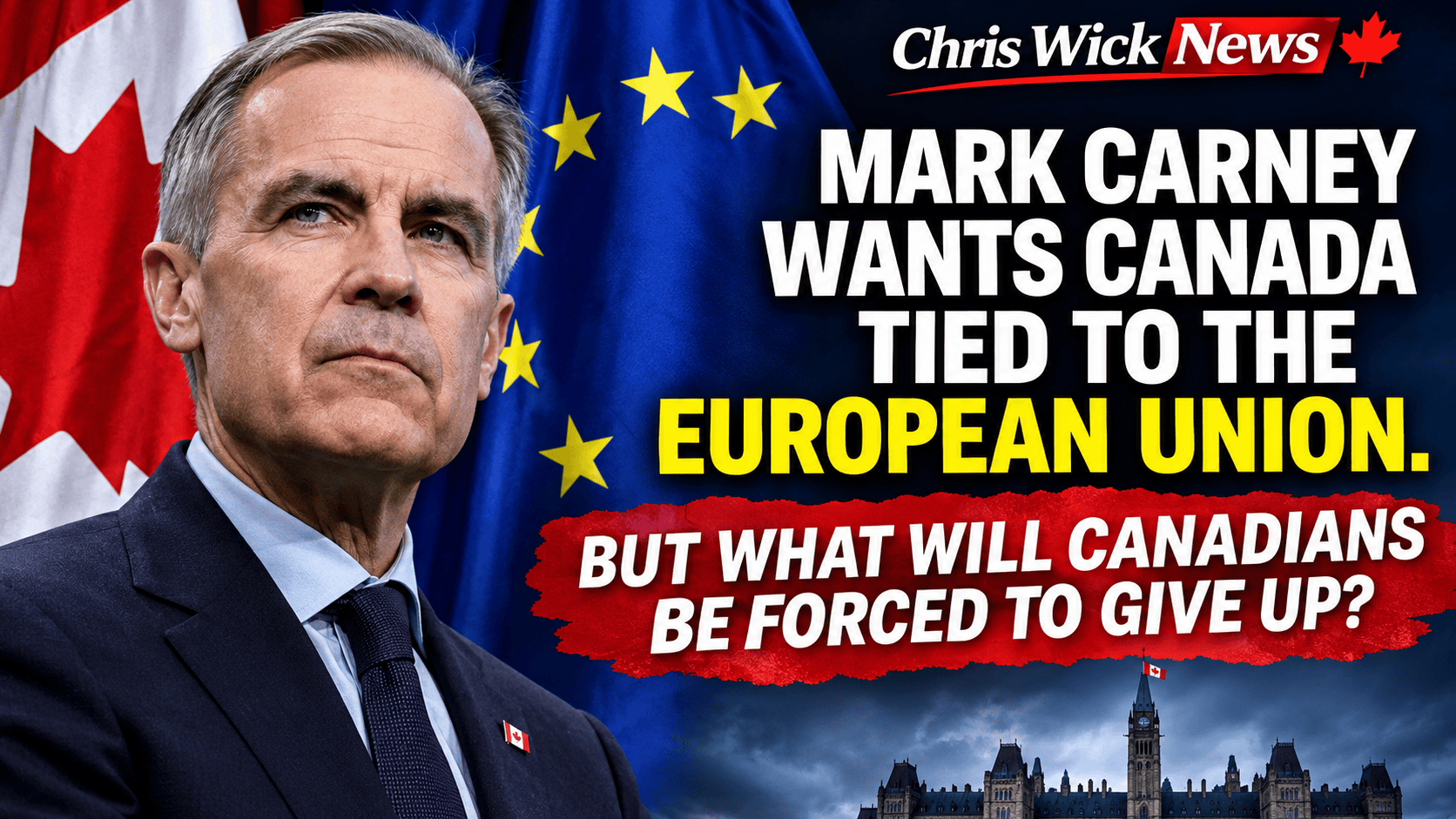
Canada is moving toward an unprecedented relationship with the European Union. Mark Carney promises greater prosperity, independence, and economic security. But the details remain unfinished, the potential obligations are unclear, and Canadians have every reason to demand answers before Ottawa signs another historic agreement.
Canada Is Being Offered a New Future. The Fine Print Hasn’t Been Written.
Prime Minister Mark Carney wants Canada to become the European Union’s first associate member.
Not a full member. Not simply another trading partner. Something entirely new.
And that should immediately raise an uncomfortable question.
How can Canadians evaluate an international arrangement when the governments negotiating it have not yet defined what membership actually means?
Following the Canada-European Union summit in Montreal on October 29–30, Carney confirmed that Ottawa and Brussels intend to establish the scope of a deeper partnership by June 2027.
The proposed relationship would extend beyond traditional trade agreements, potentially encompassing defence, energy, artificial intelligence, critical minerals, research, and regulatory cooperation.
Carney describes the initiative as an opportunity to strengthen Canadian sovereignty and reduce economic vulnerability.
There is a legitimate argument behind that ambition.
______________________________________________
🔴 Help keep this independent voice alive and uncensored.
Support independent journalism and help keep Chris Wick News going.
👉 Support Chris Wick on GoFundMe
But there is also a dangerous temptation in modern politics: announcing the benefits of an agreement long before anyone can properly examine its costs.
And Canadians have seen enough political promises to understand the difference.
Why Canada Is Looking Across the Atlantic
For decades, Canada’s economic prosperity has depended heavily on the United States.
Geography, integrated manufacturing, energy exports, agricultural trade, and established supply chains have made the American market indispensable.
According to reporting by the Associated Press, the United States accounted for approximately 71.7% of Canadian merchandise exports in 2025.
That concentration creates an obvious vulnerability.
When Washington imposes tariffs, threatens trade restrictions, or changes industrial policy, Canadian businesses can suffer almost immediately.
Factories face uncertainty. Investment decisions are delayed. Workers worry about their jobs.
Carney’s response is to diversify.
Europe offers a massive consumer market, sophisticated manufacturing industries, advanced research institutions, and opportunities for Canadian energy and natural resources.
The European Union is already Canada’s second-largest trading partner for goods and services, with bilateral trade valued at approximately $178 billion in 2025.
Expanding that relationship makes economic sense.
But reducing dependence on Washington should not automatically mean accepting new dependence on Brussels.
Economic diversification should give Canada more options, not simply replace one powerful partner with another.
That distinction matters.
The European Union’s Associate Membership Problem
Here is something Canadians should understand before getting carried away by political announcements.
The European Union does not currently have an established legal category of associate membership comparable to what Carney is proposing.
The proposed arrangement has no existing definition in EU treaties.
Its rights, obligations, financial implications, and institutional structure remain subject to negotiation.
That is not speculation.
It is a central feature of the proposal itself.
European Commission President Ursula von der Leyen introduced the concept in September, presenting Canada as a potential first participant in a new form of European partnership.
But the idea has encountered resistance among European governments.
Germany has opposed the associate-membership terminology, and the final Montreal summit declaration avoided using it.
Instead, European leaders endorsed the broader objective of an increasingly close association.
This creates an unusual situation.
Canada’s prime minister is publicly promoting a form of international membership that European governments have not collectively agreed to recognize.
That does not make the proposal illegitimate.
It does mean Canadians are being asked to embrace a political vision before its legal and practical foundations are settled.
And that deserves scrutiny.
What Will This Actually Cost Canadian Taxpayers?
This is where the discussion becomes considerably more important than diplomatic speeches.
International partnerships can generate economic benefits.
They can also involve substantial public spending.
Research initiatives require funding. Defence cooperation can involve procurement commitments. Joint infrastructure projects require investment. Participation in international programs may involve negotiated financial contributions.
The European Commission has identified possible areas of deeper cooperation, including scientific research, student exchanges, digital trade, critical minerals, and defence industries.
Some could produce measurable benefits for Canadian businesses and workers.
Others could involve expenses or obligations that have not yet been publicly quantified.
As of October 31, there is no finalized associate-membership agreement establishing a comprehensive price tag for Canada.
That uncertainty should not be confused with evidence that Canada has already agreed to pay billions in new membership fees.
No such conclusion can responsibly be drawn from the available agreement documents.
But the absence of a final cost is precisely why Canadians should demand a detailed financial assessment.
How much additional federal spending would be required?
Would Canada contribute to European programs through negotiated participation fees?
Would Canadian taxpayers finance infrastructure or research projects primarily benefiting European institutions?
Would new defence arrangements involve long-term procurement commitments?
And perhaps most importantly, how would Ottawa demonstrate that these investments deliver better results than alternative uses of Canadian public money?
These are not anti-European questions.
They are basic questions of fiscal accountability.
Sovereignty Is More Than a Political Slogan
Carney has repeatedly framed closer European cooperation as a way to protect Canada’s sovereignty.
His argument is that countries become more independent when they have more economic partners and fewer strategic vulnerabilities.
There is merit to that reasoning.
A country with diversified markets can be less vulnerable to pressure from any single trading partner.
But sovereignty involves more than choosing whom to trade with.
It also concerns who establishes the rules governing Canadian businesses, industries, public spending, and institutions.
A deeper Canada-EU arrangement could eventually involve closer regulatory coordination.
That might simplify trade and reduce unnecessary barriers.
It could also create difficult choices when European standards conflict with Canadian economic priorities.
Consider Canada’s energy sector.
European climate regulations and industrial policies do not always align neatly with Canada’s resource-based economy.
Would deeper integration require Canadian companies to adopt additional European standards?
Would Ottawa retain full flexibility over energy development, environmental regulation, and industrial policy?
Would Canadian manufacturers face new compliance requirements to access European programs?
None of these outcomes should be presented as established obligations.
The final agreement has not been negotiated.
But these are precisely the areas where governments should identify potential trade-offs before making commitments.
A partnership that expands Canadian opportunity can strengthen sovereignty. A partnership that unnecessarily restricts Canadian choices can weaken it.
The difference lies in the details.
The Existing Trade Agreement Raises Another Question
Canada and the European Union already have a major trade arrangement.
The Comprehensive Economic and Trade Agreement, commonly known as CETA, has been provisionally applied since 2017.
It has reduced numerous trade barriers and created additional opportunities for businesses operating across the Atlantic.
Yet the agreement has still not completed ratification in every EU member state.
That unfinished process matters.
If a major trade agreement has faced prolonged political and legal obstacles, Canadians should reasonably ask how quickly an entirely new form of European association could be established.
The European Union consists of 27 member countries with different economic priorities, political interests, and domestic pressures.
Canada cannot assume that enthusiasm in Brussels automatically translates into agreement across every European capital.
The resistance to associate-membership terminology already demonstrates that reality.
Before promising Canadians a historic new partnership, Ottawa should explain how it intends to navigate those political obstacles.
Otherwise, the country risks spending years debating an ambitious international framework that proves far more difficult to implement than politicians initially suggested.
What About Canada’s Relationship With the United States?
There is another uncomfortable reality.
Canada cannot simply replace the American economy with Europe.
The United States and Canada share one of the world’s most deeply integrated commercial relationships.
Automotive production, electricity, energy infrastructure, agricultural supply chains, transportation networks, and countless other industries depend on cross-border cooperation.
Europe offers valuable opportunities.
But geographic distance, transportation costs, regulatory differences, and existing commercial relationships limit how quickly European markets can substitute for American demand.
That is especially true for industries built around continental supply chains.
A Canadian automotive supplier cannot necessarily replace a customer in Michigan with a buyer in Germany without significant changes to production, logistics, and investment.
Diversification is a long-term economic strategy.
It is not an emergency escape hatch.
Carney should pursue stronger European relationships while recognizing that Canada’s prosperity still depends heavily on maintaining workable relations with Washington.
Turning economic diversification into another geopolitical confrontation could create additional uncertainty for Canadian businesses.
The objective should be expanding Canada’s options, not narrowing them through unnecessary political conflict.
Canadians Deserve a Parliamentary Debate Before Any Agreement
There is one important safeguard.
Carney has indicated that the proposed enhanced partnership will be presented to Canada’s Parliament for debate and a final vote.
That commitment matters.
But parliamentary approval should be the final stage of a transparent process, not the first meaningful opportunity for public scrutiny.
Before any agreement is finalized, Canadians should be able to examine:
- Financial commitments: The projected costs, contributions, and long-term spending obligations.
- Regulatory obligations: Any requirements to align Canadian policies or standards with European rules.
- Trade benefits: Credible estimates of additional exports, investment, employment, and economic growth.
- Defence cooperation: The scope of military-industrial commitments and their implications for Canadian procurement.
- Sovereignty protections: Clear provisions preserving Canada’s authority over domestic legislation and policy.
- Withdrawal provisions: The legal and financial consequences if Canada eventually decides to leave the arrangement.
These questions should be answered through published negotiating objectives, independent economic assessments, and meaningful parliamentary scrutiny.
A government confident in the benefits of its proposal should welcome that examination.
It should not treat legitimate questions as opposition to international cooperation.
The Bigger Issue Is Accountability
There is nothing inherently wrong with Canada building stronger relationships with Europe.
In fact, reducing excessive dependence on a single export market is a sensible long-term objective.
Canada needs additional customers, diversified investment, resilient supply chains, and stronger international partnerships.
But the political appeal of a grand international alliance should never substitute for an honest assessment of its consequences.
Carney’s European initiative could ultimately deliver meaningful opportunities for Canadian workers, researchers, manufacturers, and businesses.
It could also create complicated regulatory arrangements, financial commitments, and political disputes.
Both possibilities deserve serious consideration.
The problem is not that Canada is exploring something new.
The problem would be asking Canadians to celebrate the destination before anyone has explained the journey, the price, or the obligations waiting at the other end.
And that is where political ambition must meet public accountability.
Final Thought: Canada’s Future Should Not Be Negotiated Behind Closed Doors
Mark Carney wants Canada to become the European Union’s first associate member.
He presents the proposal as a historic opportunity to strengthen Canada’s independence in an increasingly unstable world.
Perhaps it will be.
But Canadians should not be expected to accept sweeping political promises without knowing precisely what their government intends to negotiate.
A stronger relationship with Europe could benefit Canada.
A poorly designed agreement could leave future governments dealing with commitments they never would have accepted under different circumstances.
The distinction will not be determined by speeches, summit photographs, or diplomatic declarations.
It will be determined by the actual agreement.
Canada should pursue every partnership that strengthens its economy and protects its independence.
But before Ottawa signs anything, Canadians deserve to know exactly what they are getting, what they are giving up, and who will ultimately pay the bill.
Because sovereignty means very little if the people supposedly exercising it are the last to discover what their government has agreed to.
Sources
1. Prime Minister of Canada — October 30, 2026
Prime Minister Carney delivers remarks to conclude the Canada-European Union Summit
https://www.pm.gc.ca/en/news/speeches/2026/10/30/prime-minister-carney-delivers-remarks-conclude-canada-european-union
2. Reuters — October 30, 2026
Carney says EU and Canada will define ‘deepest possible partnership’ by mid-2027
https://www.reuters.com/world/eu-canada-define-ever-closer-association-by-2027-summit-2026-10-30/
3. European Commission — EU-Canada Relations
Official overview of the proposed partnership and existing bilateral cooperation
https://commission.europa.eu/topics/foreign-affairs-and-security-policy/eu-canada-relations_en
4. Associated Press — September 2026
EU chief floats ‘associate membership’ for Canada. But that doesn’t exist yet
https://apnews.com/article/5e9f9486a4c92120d9371cfefc472a97
5. Euronews — October 30, 2026
Canada aims to become EU’s first ‘associate member’ by June 2027, Carney says
https://www.euronews.com/2026/10/30/canada-aims-to-become-eus-first-associate-member-by-june-2027-carney-says