Something is changing in the American conversation about childhood vaccines.
Even as the United States confronts its largest measles outbreak in decades, a new national poll suggests confidence in one of the country’s most established childhood vaccines is moving in the opposite direction. The shift is not enormous, but compared with where public opinion stood just six years ago, it is difficult to ignore.
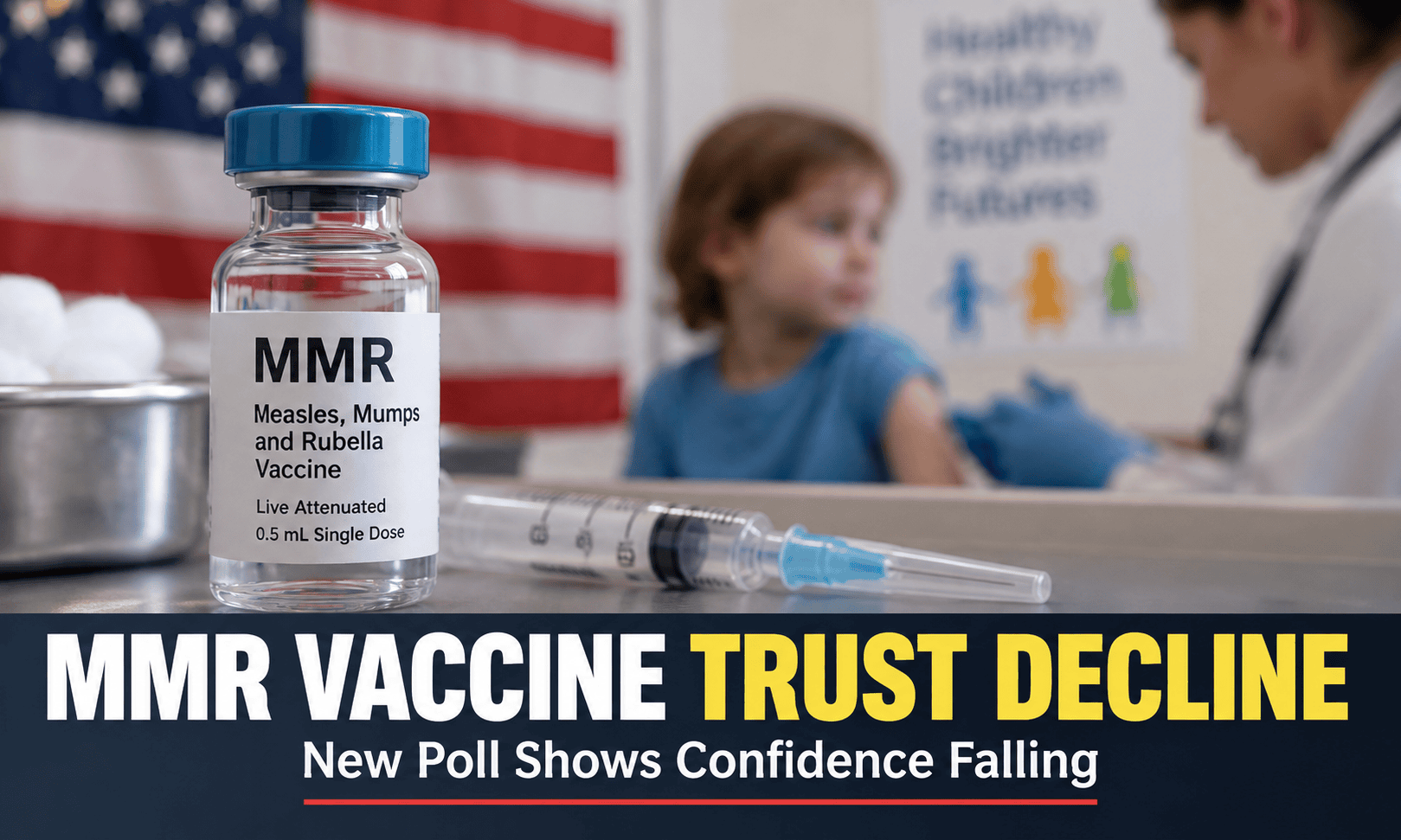
A new Reuters/Ipsos poll found that 76% of Americans believe the measles-mumps-rubella vaccine, commonly known as MMR, is safe for children. In a May 2020 Reuters/Ipsos poll, that figure stood at 84%.
That eight-point decline raises a larger question extending far beyond one vaccine: Why is public confidence falling at a moment when measles cases are receiving intense national attention?
The findings were highlighted in reporting by Children’s Health Defense, which examined the polling numbers alongside declining vaccination rates, the current measles outbreak and the rapidly changing political debate surrounding U.S. vaccine policy.
The latest four-day poll surveyed 1,143 U.S. adults and had a margin of error of 3 percentage points.
MMR Confidence Has Fallen Since 2020
The headline number tells only part of the story.
According to the figures cited in the report, MMR vaccination among American kindergarten students has also declined.
Vaccination coverage was reported at 92.4% for the 2025-26 school year, compared with 92.5% in 2024-25. During the 2019-20 school year, the rate was 95.2%.
______________________________________________
🔴 Help keep this independent voice alive and uncensored -> Buy us a Coffee <-
The recent year-to-year movement is small — just one-tenth of a percentage point — but the longer-term decline is considerably more noticeable.
At the same time, measles has returned forcefully to the national conversation.
The report said the CDC had recorded 3,294 U.S. measles cases in 2026 as of September 10, amid outbreaks that have placed renewed attention on vaccination policy.
Yet greater attention to measles has not translated into greater confidence in the MMR vaccine, at least according to the Reuters/Ipsos polling comparison.
That tension may become one of the most consequential public-health stories to watch.
The Vaccine Debate Is Becoming a Trust Debate
Numbers alone cannot explain why confidence has fallen.
Children’s Health Defense officials interviewed for the report argued that growing public attention to alleged vaccine injuries and questions about vaccine safety have contributed to skepticism.
Brian Hooker, the organization’s chief scientific officer, attributed some of the decline to increased attention surrounding vaccines and autism as well as anecdotal reports from families who believe their children were harmed following vaccination.
Those arguments remain highly contentious within the broader vaccine debate, and anecdotal reports by themselves do not establish causation.
The article also cited reports submitted to the federal Vaccine Adverse Event Reporting System, or VAERS. Such reports can serve as signals for further investigation, but a report following vaccination does not by itself establish that a vaccine caused the event.
That distinction is crucial.
What the polling does demonstrate, however, is something measurable: fewer Americans now tell pollsters they consider the MMR vaccine safe for children than did in 2020.
Whatever is driving that change, public-health institutions now face a communication problem as well as a disease-control challenge.
Measles Risk Is Becoming Part of a Larger Argument
The dispute also extends to how Americans are told about the risks associated with measles itself.
Karl Jablonowski, a senior research scientist with Children’s Health Defense, challenged commonly cited measles mortality figures in comments included in the report. He argued that historical mortality estimates are frequently communicated without enough consideration of advances in modern medical treatment.
That represents the interpretation of Jablonowski and Children’s Health Defense, rather than a conclusion established independently here.
But the argument illustrates why the current debate has become so difficult.
Americans are no longer simply hearing competing opinions about whether vaccines work. They are encountering competing interpretations of risk, safety data, historical disease outcomes and the institutions responsible for communicating that information.
When trust in those institutions weakens, even straightforward public-health messaging becomes harder to deliver.
Washington Is Changing the Vaccine Conversation
The debate is unfolding against a major shift in federal vaccine policy.
According to the report, President Donald Trump signed an executive order calling for changes to the U.S. childhood vaccination schedule, including reducing the number of diseases routinely targeted by childhood vaccines from 18 to 11.
The order also called for moving away from the combined MMR vaccine in favor of separate measles, mumps and rubella vaccines once those products become available in the United States.
The stated rationale cited in the report is greater parental choice over the timing and frequency of vaccination.
But changing the policy may be easier than changing the pharmaceutical supply.
The United States has primarily relied on the combined MMR vaccine since 1971, and separate measles vaccines are no longer routinely available in the U.S. market.
Merck previously produced a single-disease measles vaccine but discontinued it in 2008, according to the information cited in the report.
Bringing separate vaccines back could therefore take years.
Jablonowski said a manufacturer could face a lengthy regulatory process to return a monovalent measles vaccine to the American market. Hooker argued that single-disease vaccines should eventually be offered as an alternative for families wishing to space out vaccinations.
For parents expecting an immediate choice between a combined MMR vaccine and three separate injections, that choice may not arrive quickly.
Politics Is Now Entangled With Public Health
The polling revealed another striking divide.
Only 19% of respondents said they approved of the Trump administration’s handling of measles outbreaks in Pennsylvania, Utah and South Carolina, while 52% disapproved.
When respondents were asked about political parties and infectious-disease outbreaks, 45% expressed confidence in the Democratic Party’s ability to respond, compared with 25% who chose the Republican Party.
Those figures underscore how thoroughly public health has become intertwined with American politics.
Vaccination was once largely treated as a technical question handled by doctors, researchers and public-health agencies.
Today, it is increasingly discussed alongside parental rights, institutional credibility, government authority, medical freedom and political identity.
That transformation may matter as much as the individual polling numbers.
The Bigger Story Is Confidence
It would be easy to look at the latest poll and focus exclusively on the fact that 76% of Americans still consider the MMR vaccine safe.
That remains a substantial majority.
But public opinion is about direction as well as absolute numbers.
The comparable figure was 84% in 2020.
Kindergarten MMR vaccination coverage has also moved downward from its 2019-20 level.
Meanwhile, measles cases have surged back into the headlines and Washington is reconsidering fundamental elements of childhood vaccination policy.
Those developments are colliding at the same moment.
That makes the central issue larger than measles, mumps or rubella.
It is about trust.
Trust in vaccines.
Trust in pharmaceutical manufacturers.
Trust in government health agencies.
Trust in doctors and researchers.
Trust in political leaders.
And increasingly, trust in the information Americans receive about all of them.
The new polling does not tell us precisely why that trust has changed. It does, however, provide evidence that attitudes toward the MMR vaccine have shifted since 2020.
The question now is whether that decline stabilizes — or becomes part of a much broader transformation in how Americans view childhood vaccination.
About the Author