
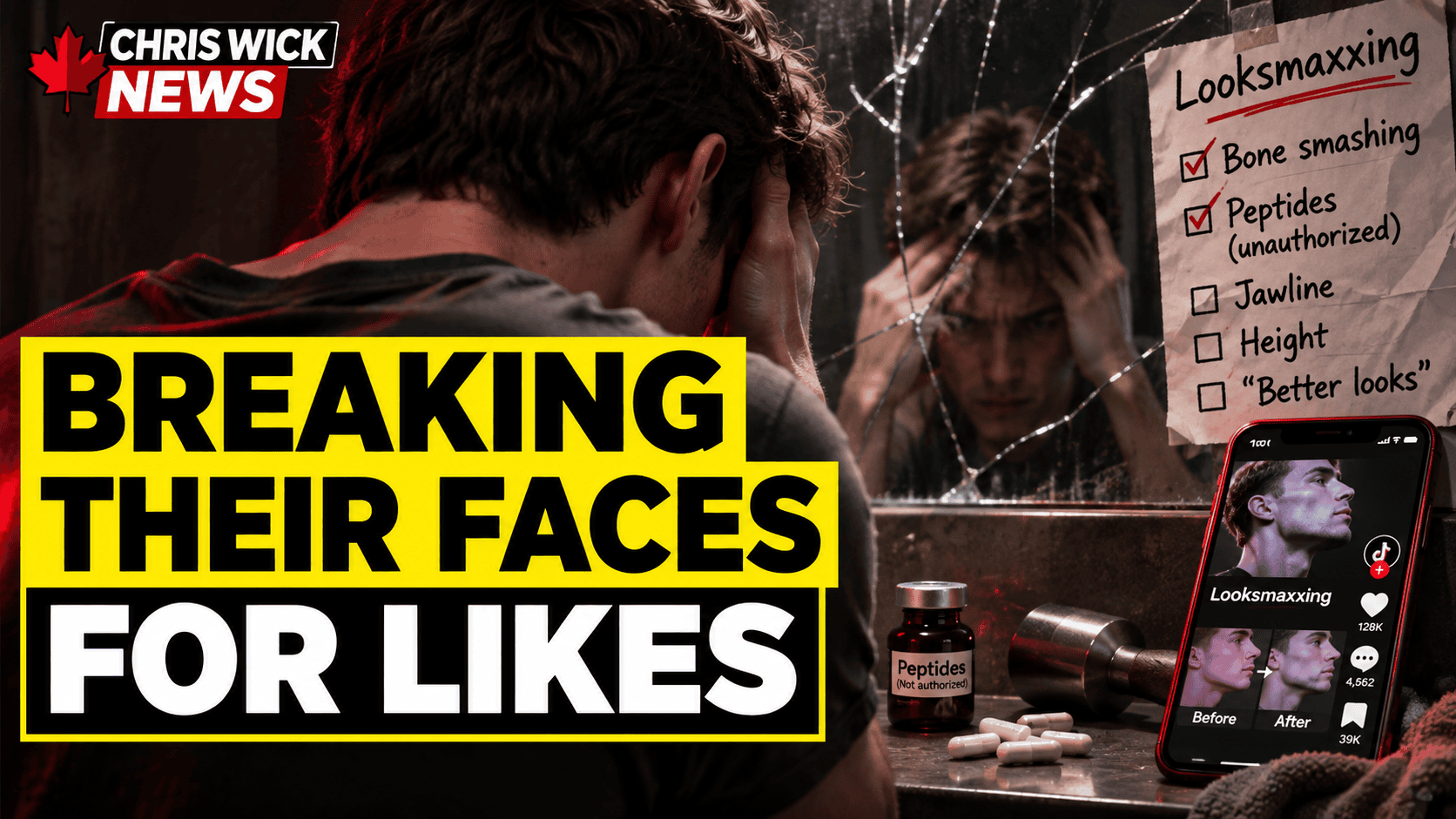
The disturbing rise of “looksmaxxing” is exposing young men to dangerous body modification, experimental substances and an online culture that turns insecurity into a business.
November 19, 2026 | Chris Wick News
There is something deeply rotten about an internet culture that can convince a teenage boy his face is so inadequate that he should consider smashing his own bones to improve it.
Not getting a haircut. Not going to the gym. Not eating healthier.
Actually striking his own face in the desperate pursuit of a supposedly better jawline.
Welcome to the disturbing world of looksmaxxing, where appearance becomes an obsession, social media influencers become self-appointed experts, and young men are increasingly exposed to dangerous advice disguised as self-improvement.
Now Canada’s Chief Public Health Officer, Dr. Joss Reimer, is raising concerns.
During a November 14 appearance on CBC Radio’s The House, Reimer discussed the dangers of extreme looksmaxxing practices, including so-called bone smashing and unauthorized peptides. Her warning reflects a broader concern among medical professionals about the lengths some boys and young men are being encouraged to go to change their appearance. Apple Podcasts+1
When Self-Improvement Becomes Self-Destruction
There is nothing wrong with wanting to look better.
Exercise, proper nutrition, grooming and personal hygiene have been part of ordinary self-improvement for generations.
But looksmaxxing can take that perfectly normal desire and push it into something considerably darker.
At its extremes, online communities promote rigid beauty standards, experimental substances, extreme dieting and dangerous attempts to reshape facial features.
One particularly disturbing practice, called bone smashing, involves deliberately striking facial bones in the belief that injury and healing will produce a more attractive appearance.
Medical professionals warn that such behaviour can cause serious injury rather than the promised cosmetic improvement.
Johns Hopkins Medicine has also identified risks involving anabolic steroids, experimental peptides, disordered eating and obsessive appearance monitoring. Johns Hopkins Medicine+1
And here’s the question nobody should ignore:
How did we reach a point where young men are being encouraged to injure themselves to meet beauty standards invented and amplified online?
The Insecurity Industry Has Found Another Customer
For years, unrealistic beauty standards have been marketed heavily to women.
Now boys and young men are being targeted by a growing online culture that measures human worth through jawlines, facial symmetry, muscle definition and physical attractiveness.
The American Academy of Dermatology warns that looksmaxxing communities can combine ordinary grooming advice with pseudoscientific claims and unregulated interventions.
It also identifies potential psychological consequences, including body dissatisfaction, anxiety and obsessive appearance-related behaviour. American Academy of Dermatology
This is where the entire situation becomes particularly ugly.
An insecure young man searches for advice about his appearance.
He encounters influencers offering supposedly revolutionary methods to improve it.
Some promote products, procedures or substances that promise dramatic results.
And instead of developing confidence, he may find himself increasingly convinced that his perfectly ordinary face is a problem requiring constant correction.
The financial incentives deserve scrutiny. When influencers can profit from selling solutions to perceived physical flaws, insecurity becomes commercially valuable.
That does not mean every fitness creator or grooming adviser is exploiting young people. But the conflict of interest is impossible to ignore when someone profits from convincing an audience that it needs fixing.
Canadian Researchers Are Warning About the Consequences
This isn’t simply another passing internet fad that authorities have misunderstood.
On November 9, the University of Toronto highlighted new research commentary warning that looksmaxxing can expose adolescent boys and young men to serious physical and psychological risks.
Researchers emphasized that ordinary grooming and fitness should not be confused with dangerous or compulsive practices.
They also identified concerns involving extreme dieting, steroid and peptide use, body-image disturbances and self-harm.
Importantly, the researchers acknowledged that significant questions remain about how widespread harmful participation is and what interventions work best. Factor-Inwentash Faculty of Social Work
That distinction matters.
Not every young man watching a fitness video is in danger. Not everyone interested in improving his appearance is experiencing a mental health crisis.
But when online advice encourages deliberate injury or unregulated drug use, the issue has crossed far beyond personal grooming.
Who Is Holding the Online Influence Machine Accountable?
Canada’s public health warning raises an uncomfortable question about the responsibilities of social media platforms.
Platforms distribute enormous quantities of appearance-related content, including material that may promote unsafe practices.
But the responsibility cannot rest entirely with parents, teachers and medical professionals trying to undo harmful messages after young people have already absorbed them.
There should be serious questions about how dangerous content is recommended, whether promotional claims are adequately scrutinized, and what happens when influencers market questionable substances to impressionable audiences.
Those questions do not require blanket censorship of legitimate fitness or health advice.
They require transparency, evidence and accountability.
And they require acknowledging something that too often gets overlooked: boys and young men can struggle with body-image pressures just as seriously as anyone else.
Dark Final Thoughts
We have built an online culture where people can be judged, ranked, mocked and financially exploited over physical characteristics they may have little control over.
And now some young men are being exposed to advice so extreme that intentionally damaging their own faces is presented as a path toward improvement.
That’s not confidence.
That’s not empowerment.
That’s a warning sign of what happens when insecurity, online influence and questionable medical advice collide.
Canada’s Chief Public Health Officer is right to raise the alarm about dangerous practices. But warnings alone will not solve the underlying problem.
We need to examine the online systems and commercial incentives that help spread this material.
Because when a teenage boy starts believing that breaking his own face might make him more acceptable to the world, something has gone seriously wrong.
And the people profiting from that desperation deserve far more scrutiny than they’re getting.
Verified Sources
- CBC Radio — Chief Public Health Officer’s warnings on looksmaxxing
- University of Toronto — November 9, 2026 research commentary
- Johns Hopkins Medicine — Looksmaxxing risks
- American Academy of Dermatology — Looksmaxxing complications