November 4, 2026 | Chris Wick News
Canada is one of the wealthiest nations on Earth. A country blessed with enormous natural resources, agricultural land, economic opportunity, and the ability to produce tremendous wealth.
So why are so many Canadians struggling to afford something as basic as food?
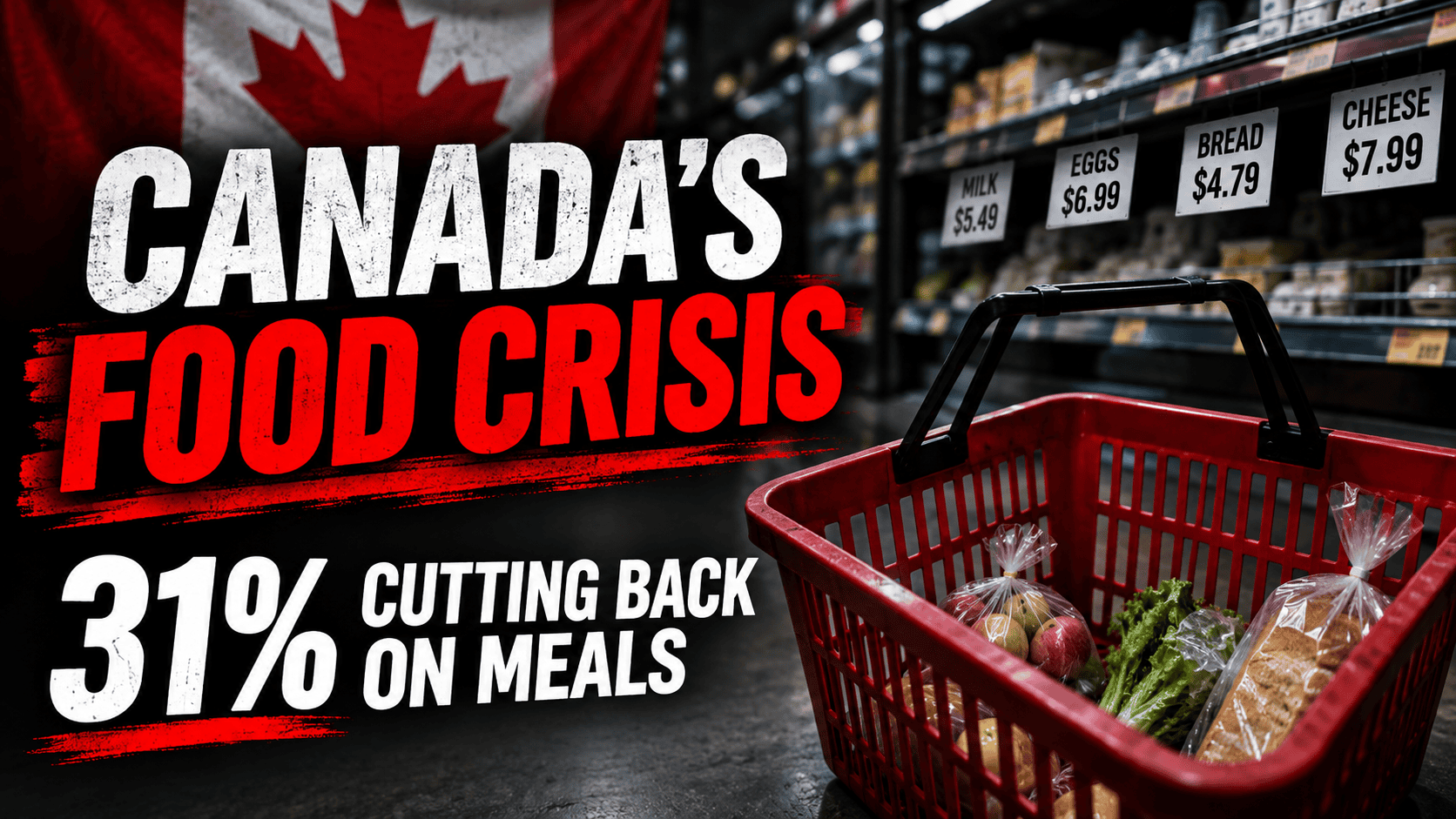
A disturbing new report released November 3 by The Salvation Army reveals that 31% of Canadians surveyed have skipped meals or reduced their portion sizes because they couldn’t afford groceries.
That’s nearly one in three.
And the situation appears to be getting worse.
The organization’s 2026 Canadian Poverty and Socioeconomic Analysis found that the figure increased from 27% in 2025. Meanwhile, 15% of respondents reported accessing community food assistance, compared with 11% the previous year.
These are the highest levels recorded during the study’s four-year history.
A Wealthy Country With Empty Plates
Think about what those numbers represent.
______________________________________________
🔴 Help keep this independent voice alive and uncensored.
Support independent journalism and help keep Chris Wick News going.
👉 Support Chris Wick on GoFundMe
People standing in grocery aisles calculating what they can afford. Parents stretching meals to make groceries last longer. Canadians making decisions between paying bills and putting food on the table.
This isn’t about giving up restaurant dinners or expensive vacations.
We’re talking about FOOD.
And younger Canadians are reporting even greater difficulties.
According to the survey, 41% of respondents aged 18 to 34 said they had skipped meals or reduced portions because groceries were too expensive.
Nearly one-quarter of that age group reported accessing community food supports.
For a generation trying to establish financial independence, those numbers raise serious questions about Canada’s economic future.
Ottawa Talks Billions. Canadians Count Pennies.
Governments routinely announce multibillion-dollar programs, infrastructure investments, and economic initiatives.
Some of those investments may deliver genuine long-term benefits.
But economic announcements and household financial security are two very different things.
A country can report economic growth while substantial numbers of its residents struggle with basic necessities.
Statistics Canada’s separate figures show that approximately 9.8 million Canadians lived in food-insecure households in 2024.
That doesn’t mean every one of those people skipped meals. Food insecurity includes different levels of difficulty accessing adequate food.
But it reinforces the broader affordability problem.
Housing costs, groceries, transportation, and household debt are competing for the same limited income.
The Salvation Army survey also found that half of respondents had drawn on savings to cover basic needs, while 40% reported using debt or credit.
That’s hardly a picture of widespread financial comfort.
When Does Affordability Become a National Emergency?
There are no simple explanations for Canada’s affordability challenges.
Housing shortages, food prices, income pressures, supply-chain costs, and international trade tensions all deserve examination.
And the survey itself has limitations: it was conducted online among 1,525 Canadians, excluded the territories, and used non-probability sampling.
Nevertheless, its findings raise questions that deserve serious attention from federal and provincial policymakers.
What measurable improvements are affordability programs delivering?
Are household incomes keeping pace with essential living costs?
And how should governments measure economic success when so many people report difficulty buying groceries?
Because here’s the uncomfortable truth: national prosperity means considerably less to someone who cannot afford dinner.
Canada has the resources, institutions, and economic capacity to confront food insecurity.
Whether existing policies are delivering sufficient results is a legitimate question for public debate.
And perhaps the most important question is also the simplest:
What good is being a wealthy country if millions of its citizens struggle to afford food?
Sources
- The Salvation Army — 2026 Canadian Poverty and Socioeconomic Analysis, November 3, 2026
- Statistics Canada — Food Availability and Affordability in Canada
- Global News / The Canadian Press — Nearly a Third of Canadians Skipping Meals Due to Food Insecurity