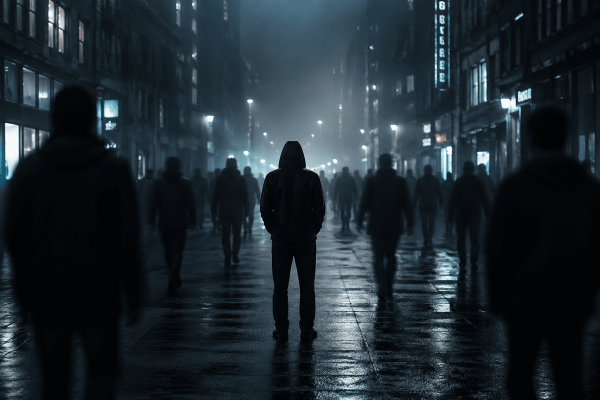
You don’t see control where it’s loud. You see it where people suddenly go quiet.
Where conversations shift, voices lower, and certain names never quite get said.
That silence isn’t accidental. It’s learned.
What Actually Happened
Across Western societies, a subtle but measurable shift has taken place in how people speak — or don’t speak — about power.
Surveys and academic studies have repeatedly shown that individuals are increasingly self-censoring, not because of laws, but because of perceived consequences. This includes fear of social backlash, professional damage, or public labeling.
A 2023 report from the Cato Institute highlighted that a growing number of Americans feel they cannot express their real opinions openly. While this trend is often discussed in political terms, it extends far beyond politics — into culture, media, and institutional trust.
At the same time, governments and tech platforms have expanded moderation policies, often justified as necessary for safety or misinformation control.
For example, reporting from Reuters outlines how content moderation systems have evolved rapidly, shaping what is visible and what quietly disappears from public view:
https://www.reuters.com/technology/how-social-media-content-moderation-is-evolving-2023-10-05/
The result isn’t always censorship in the traditional sense. It’s something harder to measure — a narrowing of what people feel safe to say.
______________________________________________
🔴 Help keep this independent voice alive and uncensored -> Buy us a Coffee <-
Why This Moment Matters
Power has always relied on control of information. But historically, that control was visible — laws, bans, enforcement.
Now, it’s more diffuse.
Instead of being told what not to say, people learn it indirectly. Through reactions. Through consequences faced by others. Through patterns that become obvious over time.
The shift matters because it changes how control operates. It becomes internal.
When individuals begin filtering themselves automatically, the system no longer needs to intervene directly. The boundaries enforce themselves.
The Pattern Behind the Event
There’s a consistent pattern in how silence forms:
First, certain topics become emotionally charged.
Then, questioning those topics becomes socially risky.
Eventually, avoidance becomes the default.
A BBC analysis on freedom of expression notes how cultural pressure — not just legal restriction — plays a growing role in shaping discourse:
https://www.bbc.com/news/world-63155985
This creates a feedback loop.
The less something is questioned, the more untouchable it becomes.
The more untouchable it becomes, the more power it accumulates.
And over time, that power stops needing visibility at all.
Where the Tensions Are Building
The tension isn’t just between governments and citizens. It’s between perception and reality.
People sense limits, even when they aren’t clearly defined.
Institutions, meanwhile, maintain that open dialogue still exists — pointing to the absence of outright bans as proof.
But the gap between what is technically allowed and what feels safe to say continues to widen.
According to analysis from The Guardian, debates over free speech are increasingly centered on informal pressures rather than formal restrictions:
https://www.theguardian.com/media/2024/jan/15/free-speech-debate-social-pressure-censorship
This is where friction builds — in the gray area between freedom and consequence.
What This Could Signal Next
If current patterns continue, the next phase isn’t louder control — it’s quieter normalization.
Fewer direct confrontations.
More unspoken rules.
Power becomes less about enforcement and more about expectation.
And the strongest signal of where that power sits won’t be in laws or headlines — but in hesitation.
In the pause before someone speaks.
In the topics that never quite get finished.
Because when fear begins to guide language, authority no longer needs to announce itself.
It’s already understood.
About the Author