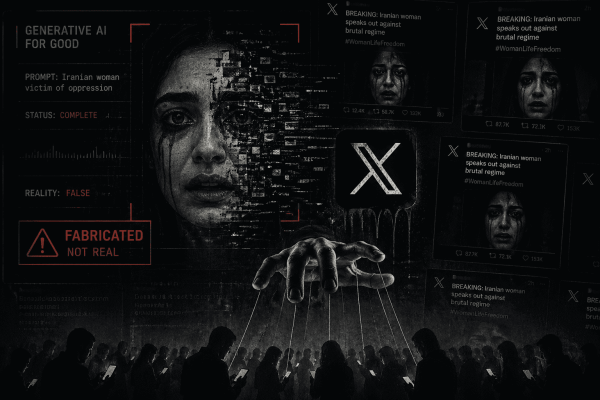
The first signs didn’t look unusual.
Another video. Another emotional testimony. Another face speaking directly into the camera.
It felt real.
That’s what made it effective.
But something has started to shift beneath the surface — and it’s becoming harder to ignore.
Reports and online discussions have begun raising quiet concerns about the coordinated use of AI-generated personas in geopolitical narratives — digital identities engineered to feel real, and deployed at just the right moment to shape perception.
This isn’t happening in isolation.
Research shows that even when people are explicitly warned a video is fake, many still rely on what they see and feel rather than the warning itself.
https://www.nature.com/articles/s44271-025-00381-9
______________________________________________
🔴 Help keep this independent voice alive and uncensored -> Buy us a Coffee <-
That changes the equation.
Because it means the power of these videos doesn’t come from being believed completely.
It comes from being felt.
The structure behind this is becoming more visible.
These videos aren’t designed to dominate headlines. They move quietly — blending into timelines, appearing between real posts, real reactions, real events.
Platforms don’t separate them.
They amplify them.
And the more emotionally charged the content is, the further it travels.
Government analysis has already warned that deepfakes are uniquely effective because of their realism — not necessarily to convince, but to destabilize, confuse, and reinforce existing beliefs.
This connects to earlier patterns in algorithmic amplification and narrative shaping — where engagement becomes the priority, not verification.
The system doesn’t filter for truth.
It filters for reaction.
And now, the timing is changing.
Moments of geopolitical tension, public distrust, and fragmented information environments create ideal conditions for synthetic narratives to take hold.
Not everywhere.
Just enough.
A similar structure appears in recent reporting on deepfake use in political campaigns, where AI-generated videos are already being deployed to influence perception — sometimes with labels so subtle they’re barely noticed.
That report shows how fabricated content is no longer experimental — it’s operational.
And increasingly normalized.
There’s another layer to this.
The technology itself is no longer difficult to access.
Studies show deepfake content has reached a level where a significant portion of people cannot reliably distinguish it from reality.
This lowers the barrier.
Not just for governments or institutions.
But for anyone.
And as that barrier drops, the volume rises.
The signal gets harder to isolate.
This is where the shift becomes more subtle — and more unsettling.
Because the question is no longer:
Is this real?
It becomes:
How many people need to believe it before it matters?
This will likely evolve into broader analysis of how synthetic narratives begin to influence not just public opinion, but institutional responses — shaping reactions before verification ever happens.
Because once something is seen…
and felt…
and shared…
it doesn’t need to be true to have impact.
This connects to earlier patterns in algorithm-driven narrative amplification, where emotional engagement often outweighs factual verification.
A similar structure has appeared in previous coverage of synthetic media and the gradual erosion of trust across digital ecosystems.
Over time, this will likely evolve into a broader investigation of AI-driven perception control and its role in shaping geopolitical narratives.
About the Author