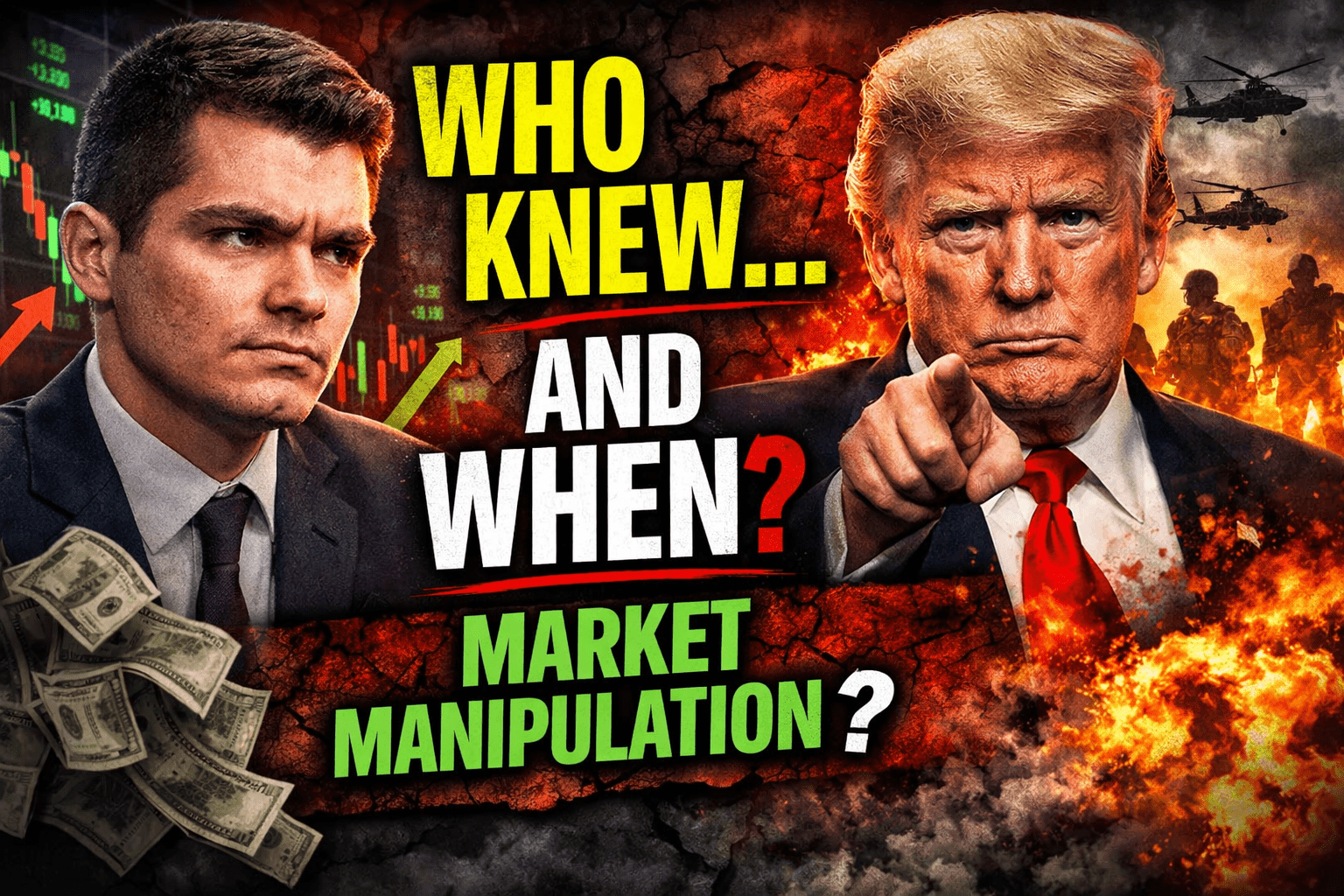
It happened fast.
Too fast for most people to process.
One moment, the drums were beating. The next… silence.
And somewhere in that gap, a question slipped through.
Who knew?
When Nick Fuentes raised it, it didn’t sound like outrage. It sounded more like something being noticed for the first time — or maybe something that had been sitting there all along, waiting for the right moment to be said out loud.
The timing is what unsettles people.
A sudden shift by Donald Trump to call off what many believed was an imminent move — one that had already begun shaping markets, narratives, and expectations. Decisions at that level don’t happen in isolation. They ripple outward. Quietly at first.
But not everyone moves at the same speed.
Some react.
Others anticipate.
______________________________________________
🔴 Help keep this independent voice alive and uncensored.
Support independent journalism and help keep Chris Wick News going.
👉 Support Chris Wick on GoFundMe
That’s where the discomfort begins to take shape.
Because if a decision like that was known ahead of time — even in fragments, even as a possibility — it raises a different kind of question. Not about politics, but about positioning. About who stands to gain when the direction suddenly changes.
This becomes clearer when looking at how markets tend to behave in moments like these. Not the headlines — the subtle movements beneath them. Small shifts that don’t look like much at first glance, but start to form patterns when viewed over time.
And patterns don’t emerge by accident.
A similar pattern appeared in past geopolitical pivots, where announcements seemed to arrive after the real movement had already taken place. Quiet positioning. Strategic exits. Timed entries. None of it obvious in the moment. All of it clearer in hindsight.
What happened next raised more questions than answers.
Because the narrative stayed focused on the surface — the decision itself, the messaging, the reaction. But beneath that, something else lingered. A sense that the sequence didn’t quite line up the way it should.
This connects to a broader shift in how information moves now. It’s no longer just about what is said publicly. It’s about what circulates privately, in smaller circles, before the rest of the world catches up.
Not leaks. Not necessarily.
Signals.
And signals are only useful if someone knows how to read them.
There’s a difference between reacting to news… and moving ahead of it.
That difference doesn’t always show up right away. But over time, it leaves traces. In numbers. In timing. In decisions that seem just slightly ahead of the curve.
None of this proves anything on its own.
But it doesn’t disappear either.
And that may be the part people are starting to notice — not a single event, but a pattern that feels familiar without being fully understood.
Because if timing like this isn’t coincidence… then it points to something else entirely.
Something quieter.
Something harder to see while it’s happening.
And maybe that’s why the question lingers longer than it should.
Who knew… and when?
What just happened in market reaction trends may change how this is understood
A deeper look at this pattern reveals something unexpected
This may connect to a broader shift that’s quietly underway.
Article Sources:
https://www.reuters.com/markets/
https://www.bloomberg.com/politics
https://www.cnbc.com/politics/
About the Author