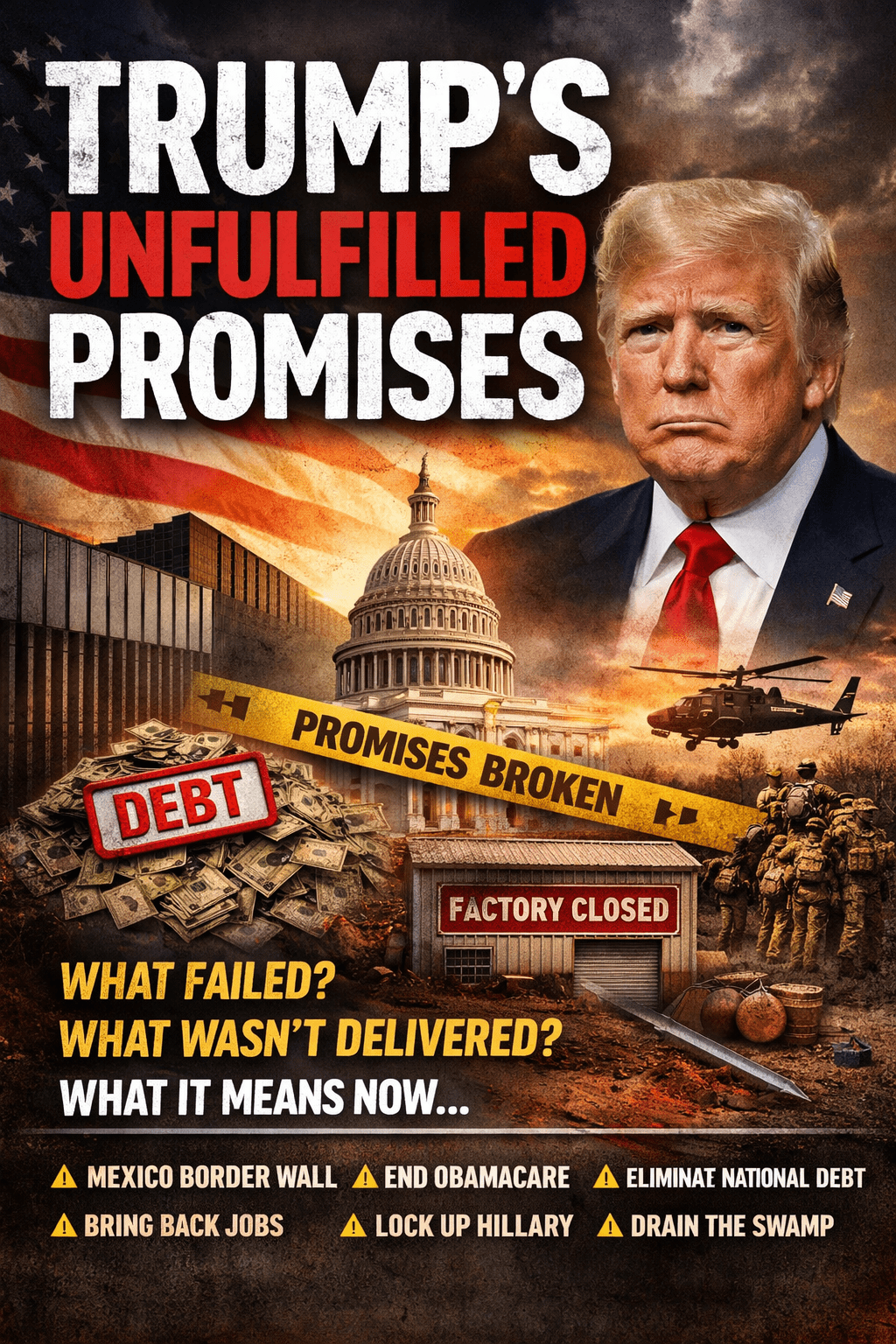
There was a moment when the message was simple, sharp, and powerful. Big promises. Clear direction. A sense that something fundamental was about to change in America.
Donald Trump didn’t campaign on small ideas. He went all in—sweeping reforms, bold claims, and timelines that sounded immediate. For millions, it wasn’t just politics. It felt like a reset.
But time has a way of testing every promise.
What remains today is a record—one that supporters and critics both continue to debate. Not just what was attempted, but what never fully materialized.
Let’s walk through it.
The Border Wall and Who Pays
The promise was direct: a strong southern border wall, fully funded by Mexico.
Construction did happen. Sections were built or reinforced. But the central claim—that Mexico would pay—never came to pass. The cost fell to U.S. taxpayers, reshaping the original narrative.
Healthcare Overhaul That Never Landed
______________________________________________
🔴 Help keep this independent voice alive and uncensored -> Buy us a Coffee <-
Repealing and replacing the Affordable Care Act was a cornerstone issue.
Despite multiple attempts, the law remained largely intact. No full replacement plan successfully passed Congress, leaving the system largely unchanged from what it was before.
The Debt That Grew Instead
There was a pledge to eliminate—or at least dramatically reduce—the national debt.
Instead, the opposite occurred. Spending increased, and the debt climbed significantly during his time in office, influenced by tax cuts, policy choices, and later, the global pandemic response.
Infrastructure Week That Never Became Reality
A massive rebuilding of America’s infrastructure was repeatedly promised.
Roads, bridges, airports—modernization at scale.
Yet no sweeping infrastructure bill was passed during the presidency, turning “Infrastructure Week” into more of a phrase than a policy outcome.
Manufacturing Revival: Partial Gains, Unmet Scale
The return of American manufacturing jobs was central to the economic message.
There were gains before COVID-19 disrupted global markets. Still, the large-scale reshoring of industry never reached the level many expected. Automation and global supply chains continued to dominate.
The Clinton Prosecution That Didn’t Happen
Calls to prosecute Hillary Clinton became a rallying cry.
But once in office, no legal action or imprisonment followed. The issue quietly faded from official priorities.
Draining the Swamp… Or Managing It?
Washington was supposed to be cleaned out—lobbyists gone, insiders removed.
Yet critics argue many traditional power players remained, and in some cases, were brought into the administration itself. The system proved harder to uproot than the slogan suggested.
Birthright Citizenship Remained Untouched
Ending birthright citizenship was proposed as a major immigration shift.
Despite strong rhetoric, no executive action or legal change ultimately occurred.
Ending Endless Wars… Partially
There was a clear commitment to bring troops home and end long-running conflicts.
Some withdrawals did happen. But U.S. forces remained active in key regions, showing the complexity of disengaging from global military commitments.
Trade Deals Rewritten, Results Debated
NAFTA was replaced with the USMCA.
While it marked a formal change, debate continues over its real-world impact. Some industries benefited, others faced new pressures, and the broader promise of job return remains contested.
Balanced Budget That Never Balanced
A commitment was made to balance the federal budget.
Instead, deficits expanded year over year, reflecting both policy decisions and external pressures.
High Growth Expectations Fell Short
Ambitious projections of sustained 4%–6% economic growth were part of the vision.
While there were periods of strong performance, those levels were not consistently achieved.
The Opioid Crisis Continued
The opioid epidemic was acknowledged as a national emergency.
Efforts were made, but the crisis persisted, continuing to impact communities across the country without a rapid resolution.
Term Limits Left Unchanged
A push for congressional term limits was promised.
No constitutional amendment or legislative success brought this idea into reality.
Trade Wars: A Mixed Outcome
Tariffs, especially against China, were used as a tool to protect American jobs.
The results were mixed. Some domestic industries saw relief, while others—particularly agriculture and manufacturing—faced new challenges and retaliatory measures.
The Bigger Picture
What stands out isn’t just what was or wasn’t achieved—it’s the gap between scale and outcome.
Campaign promises often meet the resistance of political systems, global realities, and economic complexity. In this case, many of the boldest commitments faced those limits head-on.
For some, that’s proof the system resists change.
For others, it’s a reminder that promises and execution are two very different things.
Either way, the record is there—unchanged, and still shaping the conversation.
Sources
- GAO Debt Report
https://bit.ly/us-debt-overview - CBO Budget Data
https://bit.ly/us-budget-data - BBC News Promise Tracker
https://bit.ly/trump-promises-bbc - Reuters Fact Check
https://bit.ly/trump-factcheck-reuters - PolitiFact Trumpometer
https://bit.ly/trumpometer - The New York Times Promise Tracker
https://bit.ly/nyt-trump-promises - Council on Foreign Relations Conflict Tracker
https://bit.ly/global-conflicts - Brookings Institution Infrastructure Analysis
https://bit.ly/us-infrastructure-report
About the Author