It didn’t arrive with headlines.
No official declaration. No press conference. Just a slow alignment—names that rarely appear together in the same sentence now moving in a similar direction.
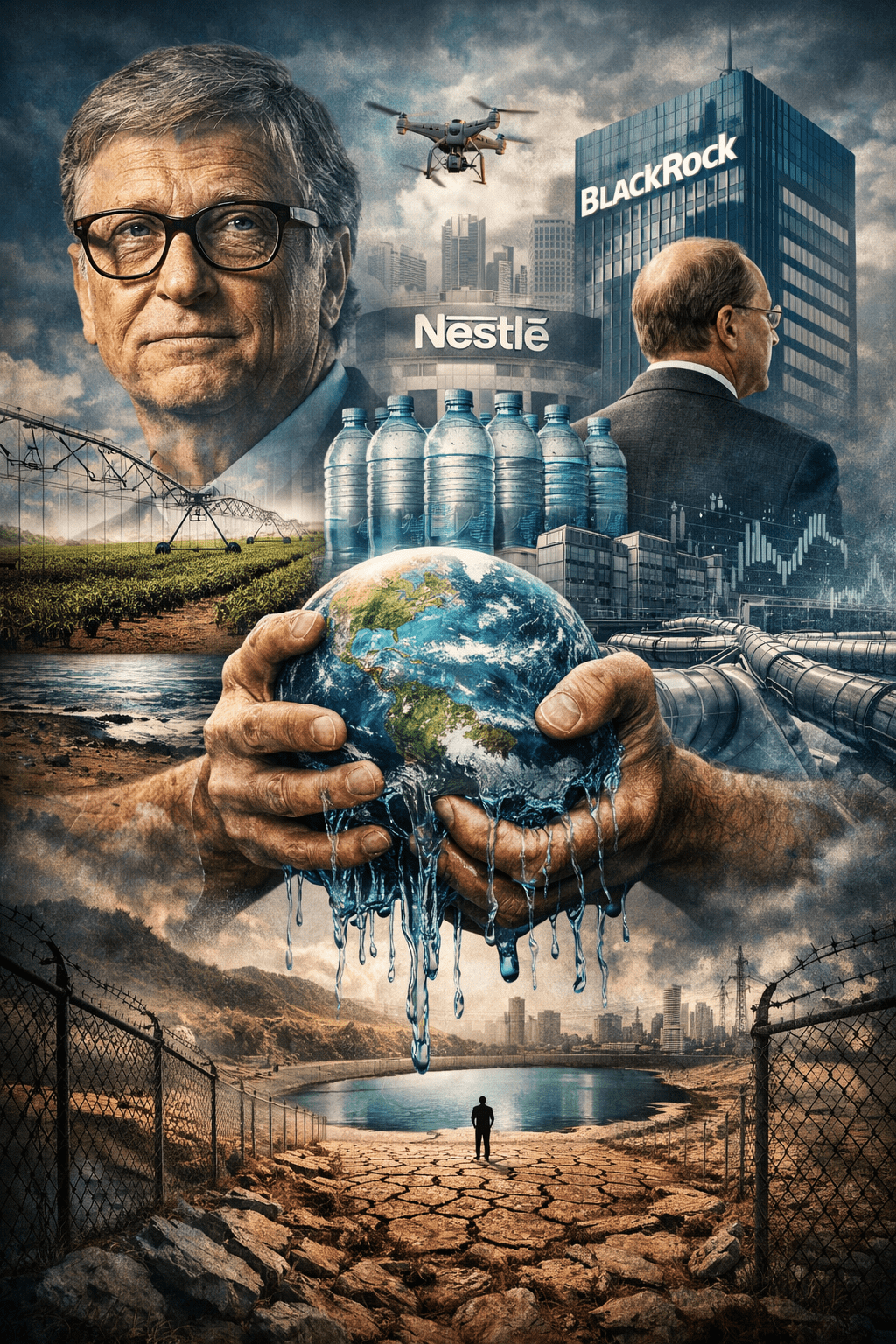
Bill Gates. Nestlé. BlackRock.
On the surface, their interests are different. Technology. Food. Finance. Separate lanes, separate mandates. But lately, those lines have begun to blur in subtle ways—especially when it comes to something far more basic than any of those industries.
Water.
Not the kind that fills a glass or runs from a tap without thought. The kind that sits beneath land, moves through infrastructure, and quietly determines who has access—and who doesn’t.
It’s not a new idea that water is valuable. But the tone has shifted. Not in public messaging, which still leans toward sustainability and stewardship, but in positioning.
Ownership. Control. Long-term access.
These are the words that appear more often once you start looking closely.
______________________________________________
🔴 Help keep this independent voice alive and uncensored.
Support independent journalism and help keep Chris Wick News going.
👉 Support Chris Wick on GoFundMe
And that’s where things begin to feel different.
Because water, unlike oil or data, doesn’t have a substitute.
—
There’s an early question that lingers beneath the surface of all this:
When essential resources become investment assets, who are they really for?
That question doesn’t get answered directly. It tends to dissolve into policy language, into ESG frameworks, into carefully structured partnerships. But it keeps showing up.
Especially when large-scale agricultural land purchases intersect with water rights.
Especially when infrastructure funds begin targeting utilities.
Especially when bottled water companies expand their footprint in regions already experiencing stress.
This becomes clearer when looking at how water scarcity is being discussed—not just as an environmental issue, but as a market signal.
Something to anticipate.
Something to position around.
—
For years, these movements were treated as isolated.
A farmland acquisition here. A water fund there. A corporate expansion framed as meeting global demand.
But taken together, a pattern begins to form.
Quiet. Methodical. Patient.
Not rushed. Not chaotic.
Deliberate.
And what stands out isn’t just the activity itself—it’s the timing.
Because water concerns are no longer theoretical. In many places, they’re already visible. Reservoir levels dropping. Restrictions tightening. Costs rising in ways that don’t always make immediate sense.
What happened next raised even more questions.
Why now?
Why this level of coordination, even if unspoken?
—
Midway through this shift, another angle starts to come into focus.
Technology.
Water monitoring systems. Data tracking. Predictive models that map usage, availability, and risk years in advance.
On their own, these tools make sense. Efficiency. Planning. Conservation.
But combined with large-scale investment strategies, they introduce a different possibility.
Insight becomes leverage.
And leverage, in the context of a finite resource, changes how decisions are made.
A similar pattern appeared in energy markets years ago—long before the public fully understood what was happening. The infrastructure was laid quietly, then gradually revealed through pricing, policy, and access.
Water may be following a similar path, though the signs are still early.
—
There’s also the matter of narrative.
Publicly, the focus remains on sustainability, climate adaptation, responsible use. These are valid concerns. Necessary, even.
But they also create a framework where consolidation can occur without drawing attention.
Because who would argue against protecting water?
The question, again, isn’t about intent alone.
It’s about structure.
Who holds the rights. Who manages distribution. Who decides allocation when scarcity becomes more than a projection.
—
And that brings us back to where this started.
A quiet convergence.
Not announced, but observable.
Not explained, but traceable.
It doesn’t require assuming coordination to notice alignment. Large entities often move toward the same conclusions when incentives point in one direction.
Water is becoming one of those directions.
The kind that reshapes industries slowly, then all at once.
—
What’s still unclear is how far this goes.
Whether this remains a series of strategic investments… or evolves into something more centralized.
Whether access stays broadly distributed… or gradually narrows under layers of management and pricing.
And whether the public recognizes the shift while it’s still unfolding—or only after it’s already set.
Because by the time these patterns become obvious, they’re usually no longer flexible.
They’re established.
—
What just happened in global farmland acquisitions may change how this is understood.
A deeper look at water rights and infrastructure funding reveals something unexpected.
This may connect to a broader shift that’s already underway.
Sources & References
Global investment firms quietly positioning around water:
https://www.reuters.com/markets/blackrock-water-investments
The rising market value of water scarcity:
https://www.bloomberg.com/news/articles/global-water-scarcity-investment-trends
Water now ranked among top global risks:
https://www.weforum.org/agenda/water-scarcity-global-risk
Corporate water stewardship and expansion strategies:
https://www.nestle.com/media/water-stewardship-report
Farmland, agriculture, and long-term water access:
https://www.gatesfoundation.org/ideas/agricultural-development-water
Water as the next major asset class:
https://www.cnbc.com/water-becoming-investable-asset
Global water scarcity data and projections:
https://www.unwater.org/water-facts/scarcity
Infrastructure, policy, and water control frameworks:
https://www.worldbank.org/en/topic/water
About the Author




Yes. This is all deliberate. I totally agree and it is imperative that you share it as you do.
But – that leaves the question to be What do we do about it?
Same question on many fronts we currently face. All rooted in the same corrupt deceptive seats of power in our society and fully enabled by our own institutions that we the people supposedly own.
What do we do about it?
The answer is taking the reigns of the government that we own. Flowing the power from the people up through our Town Halls, through our state/provincial capitals and into the seats of our federal govt. The people rule — and it is time to make that our reality.
Please explore the videos on our web page. We are taking action in our own community and have it open to sharing with all communities from coast-to-coast. OurTownHall.org. Watch the videos. We need you to move forward with us. Let’s light the path. Power to the People!